5G is the highly anticipated technology that is expected to change the way we live by connecting everything around us. 5G falls into three main categories. 1) enhanced mobile broadband (eMBB), 2) ultra-reliable and low latency communications (uRLLC) for critical machine communications, and; 3) massive machine-to-machine (M2M) communications. Each application requires a slightly different set of parameters. To facilitate the “enhanced broadband everywhere” concept that comes with 5G, gigabit levels of capacity will be required, which has some wondering if microwave has the wherewithal to backhaul 5G cell sites.
Currently, microwave backhauls anywhere from 50-60% of all mobile sites worldwide; and as 5G deploys, the number of mobile sites will multiply along with capacity, complexity, and stringent latency requirements. Whether or not microwave can successfully meet each of these requirements is a hot debate. While it is true, that fiber will be used if it is available, it is also true that fiber won’t be able to reach every site, and other technologies will need to be considered. This is where microwave will be essential. Microwave manufacturers are insuring their radios will meet 5G requirements by addressing the following key areas:
Capacity
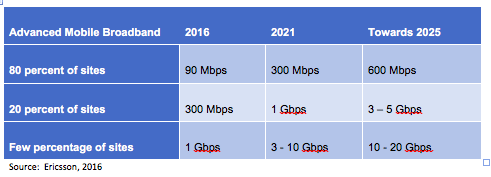
While the industry agrees that more capacity will be required for a 5G mobile network, what is more speculative is exactly how much capacity will be required. While multi-gigabit capacities are expected, they are expected at only a few very high-end sites. The majority of sites will require less than 10 Gbps of capacity and microwave is already able to achieve 10 Gbps with E-band and aggregation techniques. According to Ericsson’s research, speculative speeds required for 5G are below.
Microwave manufacturers have proven that by combining two microwave links together, backhaul capacity of up to 10 Gbps can be achieved. Not only does capacity increase substantially when multiple channels in traditional microwave bands (6 -42 GHz) are aggregated, but when a traditional microwave band and a millimeter wave 80 GHz band are combined, capacity can reach 10 Gbps, covering a span of up to 7 kilometers. Research is ongoing to move beyond the 80 GHz band to the W band (75 -110 GHz) or D band (130-170 GHz) which will push capacity beyond 10 Gbps.
Leading microwave vendors have announced dual band (MMW/MW) radios that are ready to ship in 2017 or are on their near-term roadmaps. This is significant, because the first phase of 5G is expected to start rolling out in select areas in the 2018-2019 timeframe with Korea being the most aggressive. Korea is planning to deploy 5G in time for the 2018 Winter Olympic Games and since backhaul is the crux of the network, it will start about six to nine months before the rest of the network, which puts 5G backhaul deployments starting in late 2017.
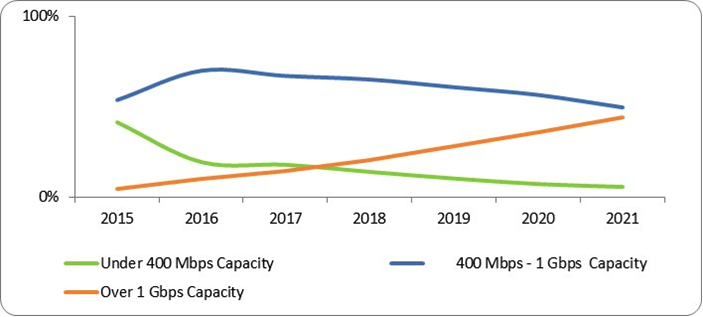
Looking at the chart below, the trend towards higher capacities is apparent. Currently, 400 Mbps -1 Gbps radios are the bulk of shipments, with 1+ Gbps radios cannibalizing these at an accelerating rate over the next five years.
Microwave radio projections
Source: Sky Light Research Global Equipment Forecast Report 2017-2021
Latency
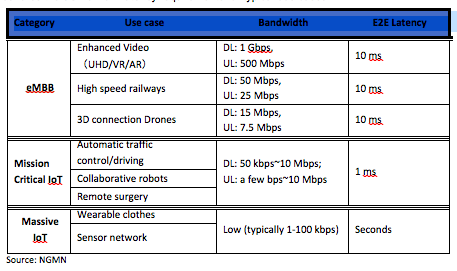
Another key requirement for 5G mobile backhaul networks is low latency, especially in URLLC applications like automated driving, collaborative robots, and remote surgery. 4G legacy networks are not able to support these critical applications, thus opening up an additional revenue stream for operators willing to make the 5G network investment. The chart below illustrates the 5G network latency requirements for typical use cases:
Source: Next Generation Mobile Networks
To meet the 10 milliseconds end-to-end requirement, transmission latency cannot exceed 5 milliseconds. These low latency levels are attainable through a variety of methods already being used by microwave vendors today. By enabling L3 routing capability to edge, the forwarding path becomes shorter and thus lowers latency, achieving around 1-2 milliseconds. Some microwave radios employ low latency ASIC/algorithms to shorten single hop equipment latency to as low as 50 microseconds. Additionally, smaller cells shorten the transport path and thus lower latency, as do wider channels – both of these techniques are ideal for millimeter wave bands above 70 GHz or for the dual band MW/MMW solution.
Densification
Cell densification not only lowers latency but also increases capacity. Thus, densification is extremely practical and achieved by overlaying macro cells with small cells. Future small cell topologies will bring the cell to the street level using unlicensed 60 GHz (V band) or sub 6 GHz backhaul. In this scenario, 70-80 GHz (E-band), traditional microwave radios, and/or fiber will also be used.
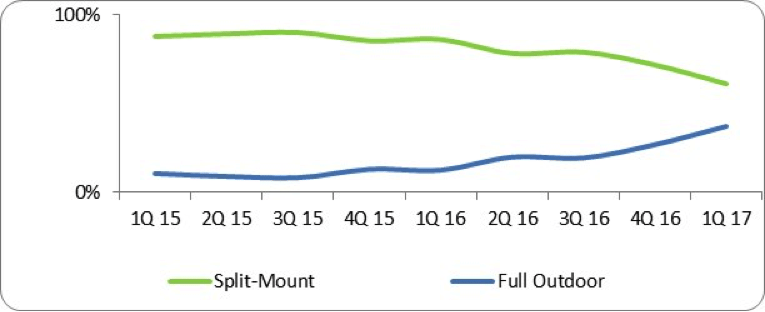
To facilitate this network topology, microwave radios are being designed as an all outdoor, small compact form factor that easily blends with the urban landscape. Although outdoor small cells have not been widely deployed, operators are already taking advantage of this new, smaller form factor as evidenced by shipment data from Sky Light Research.
Microwave radio shipments
Source: Sky Light Research 1Q 2017 Market Share Report
Street level cells will be built using very short, high capacity hops by utilizing unlicensed 60 GHz spectrum. In some regions where 70-80 GHz is inexpensive, this spectrum can be used as well in hotspot sites. In an effort to reduce clutter on the street, radios will be hung on street lights, traffic poles, and bus stop signs. To eliminate any problems with sway or non-line-of-sight that may be inherent with alternative masts, a wide beam antenna will be used and radios will be placed strategically to bounce signals off each other to work their way around buildings and other obstructions. Additionally, a mesh network topology may be used, which will create multiple paths a signal can take if a hop is blocked by a passing bus or a blooming tree. The street level signal will be aggregated and carried to the top of a building using a 70-80 GHz hop. Once again, in lieu of towers, operators will take advantage of already existing infrastructure – hanging radios on the sides of buildings and carefully disguising them so they are aesthetically pleasing to the community. Once the aggregated signals hit the rooftop, the signal will be carried to another cell site via microwave link and absorbed into the greater macro network. Alternatively, the radio on the top of the building may be connected via fiber to the building, and will be absorbed into the network at that point. Either way, a multitude of technologies will be required, deployed, and managed in a complex architecture, further highlighting the need for SDN enabled microwave.
SDN and microwave radios
As more options are added to the network, the network becomes more complex, requiring a high degree of flexibility in a dynamic network built by multiple manufacturers. Software defined networks (SDN) help make the complex 5G network easier to manage by implementing a variety of software management protocols that automatically manage the network’s traffic based on dynamic physical attributes of the network. Although SDN for microwave is a relatively new concept, forward thinking carriers moving toward 5G are doing so with SDN. Vodafone has stated that “5G has key components that really can’t happen without SDN and NFV and those include low latency applications, self-healing networks and an ability to manage mobile applications at the very edge of the network using a technology called network slicing, used to create multiple dedicated end-to-end virtual networks.” Although Vodafone is speaking about the greater network, SDN saves the carrier money, and SDN in the transport is no different.
SDN on a microwave link can automatically re-route traffic in peak times with congested links in order to keep data traffic flowing. It also can make the network more efficient and keep operational costs in check by managing link usage and adjusting traffic to one or more links. Huawei has shown that by moving traffic off of a spare link and adjusting modulation and transmit power during off-peak times, operators can realize a 15-20% savings in power consumption costs.
Conclusion
5G is a new frontier that will connect people and things on a massive scale. In order to achieve this, a completely new mobile data network will need to be built that caters to the multitude of applications 5G offers. This new network will require a multi-gigabit high capacity, extremely low latency, and flexible SDN managed mobile backhaul component – and this is exactly what the recent innovations in microwave have achieved. Microwave manufacturers, together with carriers, are building solutions that not only meet these challenges, but scale into the foreseeable future.
Leading microwave manufacturers have 5G strategies in place, each meeting various needs of the highly anticipated 5G network today and for the foreseeable future. Two of the most recent 5G specific platform strategies announced are Huawei’s “Multi-wave, ready for 5G” strategy and Nokia’s Wavence platform.
About Sky Light Research
Sky Light Research is a third party market research firm, specializing in wireless backhaul equipment and the applications that drive them. This includes, microwave point-to-point radios, millimeterwave point to point radios; and unlicensed broadband point-to-point radios. Sky Light was founded in 2001 by Emmy Johnson. [email protected] or +1-480-563-2251.