

RCR Wireless
  • News
  • Channels
    • 5G
    • 6G
    • BSS OSS
    • Carriers
    • IoT
    • Network Infrastructure
    • Open RAN
    • Private 5G
    • Telco AI
    • Telco Cloud
    • Test & Measurement
  • Resources
    • Reports
    • Webinars
    • White papers
    • AI Fundamentals
    • Analyst Angle
    • Editorial Calendar
    • Fundamentals
      • 5G NR Release 17
      • AI
        • Telco AI in 2025
    • Podcasts
      • Let’s Get Digital with Carrie Charles
      • Wireless Connectivity to Enable Industry 4.0 for the Middleprise
      • Well Technically…
      • Will 5G Change the World
      • Accelerating Industry 4.0 Digitalization
  • AI Infrastructure
  • Programs
  • Events
  • RCRtv
  • Advertise
  • Subscribe
Tuesday, August 18, 2026
RCR Wireless
  • News
  • Channels
    • 5G
    • 6G
    • BSS OSS
    • Carriers
    • IoT
    • Network Infrastructure
    • Open RAN
    • Private 5G
    • Telco AI
    • Telco Cloud
    • Test & Measurement
  • Resources
    • Reports
    • Webinars
    • White papers
    • AI Fundamentals
    • Analyst Angle
    • Editorial Calendar
    • Fundamentals
      • 5G NR Release 17
      • AI
        • Telco AI in 2025
    • Podcasts
      • Let’s Get Digital with Carrie Charles
      • Wireless Connectivity to Enable Industry 4.0 for the Middleprise
      • Well Technically…
      • Will 5G Change the World
      • Accelerating Industry 4.0 Digitalization
  • AI Infrastructure
  • Programs
  • Events
  • RCRtv
  • Advertise
  • Subscribe
Add RCR Wireless as a preferred source on Google
  • Qualcomm 6G Insights
  • Huawei Content Hub
  • Qualcomm – 6G Vision
  • OSS/BSS Channel
  • RCRTech Roundtable: AI Infrastructure
RCR Wireless
RCR Wireless
  • Advanced Mimo
  • Mobile mmWave
  • 5G Positioning
  • Green Networks
  • Metaverse
  • Automotive
  • Industrial and Wide-area IoT
Copyright 2021 - All Right Reserved
Home - Eight crucial technologies to drive the digital revolution in smart manufacturing
Data AnalyticsFundamentalsInternet of Things (IoT)PlatformsSmart Factory

Eight crucial technologies to drive the digital revolution in smart manufacturing

by James Blackman July 3, 2018
written by James Blackman July 3, 2018 Share
LinkedinEmail
Share 0LinkedinEmail
three big losses
112

The move to a ‘lights-out’ factory has already begun, but the developing transition requires an overhaul of industrial facilities, equipment, systems and people if it is to go the distance. Transformation of the manufacturing industry, or ‘vertical’ in service-provider parlance, must also make way for full integration of many ‘horizontal’ technologies.

ABI Research has considered these horizontal technologies, and come up with eight, out of “dozens”, which cannot be ignored by manufacturers, nor by any enterprise vertical actually. These include connectivity, additive manufacturing, drones, mobile collaborative robotics, industrial internet-of-things (IoT) platforms and AI.

Some have taken root already, notably industrial IIoT platforms and edge intelligence; industrial operatives will start to “piece together” other technologies during the next decade to make factories less dependent on fixed assembly lines and immobile assets, says ABI.

Each step in this transformation will make plants and their workers more productive, says ABI. “Manufacturers want technologies they can implement now without disrupting their operations,” says Pierce Owen, principal analyst at ABI Research.

“They will change the way their employees perform jobs with technology if it will make them more productive, but they have no desire to rip out their entire infrastructure to try something new. This means technologies that can leverage existing equipment and infrastructure, such as edge intelligence, have the most immediate opportunity.”

Vendors that open up their solutions and integrate with legacy equipment and parallel technologies will carve out a share of this growing opportunity. “Implementation will go step-by-step over multiple decades, but ultimately, how we produce goods will change drastically from what we see today,” says Owen.

Here are the eight, as selected by ABI.

1 | ADDITIVE MANUFACTURING

Additive manufacturing (AM) describes technologies that build three-dimensional objects one superfine layer at a time. “After decades of producing little more than prototypes, the AM winter has ended and new growth has sprung up,” says ABI. It was certainly a fixture on the show floor at Hannover Messe in April. ABI also points to recent bets by the likes of GE and Siemens, with the former acquiring Arcam and Concept in 2016, and the latter debuting its own AM platform in April. Others to watch among AM specialists include EOS, Stratasys, HP and 3D Systems, says ABI.

2 | ARTIFICIAL INTELLIGENCE

This covers both the fields of artificial intelligence (AI) and machine learning (ML). There are differences. AI creates computer programmes capable of thinking about complex situations, much as humans make decisions. ML is the process of marrying algorithms and statistics to hone the AI process continually. The differences are explained here. It is notable, European governments in particular are pinning major parts of their developing economic strategies on the integration of AI and ML into their industrial operations, and also the stimulation of their local tech scene.

3 | AUGMENTED REALITY

Robots are making their way onto factory floors, but many activities still require human capabilities, notably tasks that require high dexterity and flexibility, and an ability to improvise. This is where augmented reality (AR) comes in; it is well suited for training, collaboration and decision-making. It can help with staff training, providing provide a way to annotate real-time images of manufacturing processes with work instructions. AR guides can also ensure critical information is delivered on time, when one-off product configurations are required, and processes change.

4 | BLOCKCHAIN

The benefits of blockchain – principally immutability, traceability, and disintermediation – are just as compelling in manufacturing supply chain, as they are in other sectors. It provides a rapid and efficient way to record and store data. The challenge remains its implementation. Manufacturing goods are wildly varied, their data tends to be unstructured; imposing order in a distributed ledger is no mean feat.

5 | DIGITAL TWINS

As sexy as it gets, when it comes to new factory tech; digital twins are actually glorified CAD programmes, which provide near-real-time digital imagery of physical objects and processes, and can be used to inform operations. They can provide a complete digital footprint, from first concept to final delivery, accelerating time-to-market, performance, and quality. Innovative vendors in digital twins and simulation software include PTC, SAP, Siemens, and ANSYS, reckons ABI.

6 | EDGE INTELLIGENCE

The rise of edge computing spells the end of cloud computing, at least in its current form. That was. But there is work to be done to understand its implications and specifications. Defining where the edge of the network should be is a good start. The Industrial Internet Consortium, which has a number of work streams dedicated to the cause, makes clear the edge is a logical layer, rather than a specific physical divide. Its precise location is defined by the use case, along a “continuum of fundamental capabilities”, it says.

7 | IIOT PLATFORMS

Industrial IoT (IIoT) platforms must support many of these other technologies to better integrate them with the enterprise and each other, says ABI. “Those that can connect and support equipment from multiple manufacturers, such as PTC Thingworx and Telit deviceWISE, will last,” it says. In a parallel report, analyst house Gartner puts the leading IIoT platforms through their paces, and comes up with the best. PTC, Hitachi and SAP top the chart, it reckons, ahead of IBM, Software AG and Accenture. But the analyst house warn also that major challenges remain for IoT providers in the industrial space, including with market fragmentation and inconsistency.

8 | ROBOTICS

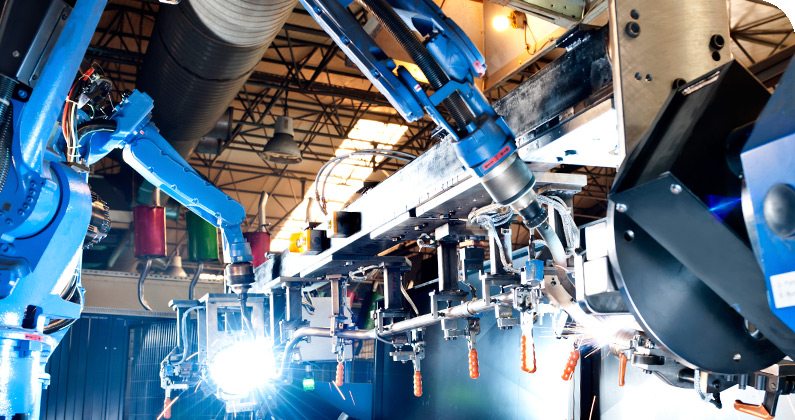
The above technologies have already started to converge, and robotics provide a physical representation of this convergence. “Robotics use AI and computer vision and connect to IIoT platforms where they have digital twins,” notes ABI. This connectivity and AI will increase in importance as more cobots join the assembly line and work alongside humans. The robotics vendors that can integrate the most deeply with other transformative technologies have the biggest opportunity. ABI singles out ABB, KUKA, FANUC, Universal Robots, Rethink Robotics and Yaskawa as companies that can.

You Might Also Like
  • Physical AI is exposing a data sovereignty gap (Reader Forum)
  • Japan’s private 5G market is finally moving beyond demo experiments (Analyst Angle)
  • Monday (telco diary) | Sovereign AI for Industry 4.0
  • When the push becomes the pull – private 5G and physical AI
  • Fast-growing private 5G offers blueprint for AI-era telecoms
  • Monday (telco diary) | Consolidation, orchestration, automation

Table of Contents

  • 1 | ADDITIVE MANUFACTURING
  • 2 | ARTIFICIAL INTELLIGENCE
  • 3 | AUGMENTED REALITY
  • 4 | BLOCKCHAIN
  • 5 | DIGITAL TWINS
  • 6 | EDGE INTELLIGENCE
  • 7 | IIOT PLATFORMS
  • 8 | ROBOTICS
Share 0 LinkedinEmail
James Blackman
James Blackman

James Blackman has been writing about the technology and telecoms sectors for over a decade. He has edited and contributed to a number of European news outlets and trade titles. He has also worked at telecoms company Huawei, leading media activity for its devices business in Western Europe. He is based in London.

previous post
For enterprises, Wi-Fi is here to stay, analyst says
next post
Car maker Hyundai takes stake in Israeli V2X chipset maker Autotalks

White Papers

  • Norton eBook: The 2026 Telco Playbook

  • Enea White Paper: Why Intelligent AAA is the Swiss Army Knife of Telecom

  • CSG White Paper: Telco AI Enabler: Mediation’s Defining Role

  • Enea White Paper: Scalable Database Design for 5G and Beyond

  • Supermicro and NVIDIA Whitepaper: Powering sovereign AI at scale

Editorial Reports

  • Report: NTN in motion — evolving standards, expanding services

  • Market Pulse Report: Telco AI in 2026 – Trends, Challenges and Opportunities

  • Nvidia Report: The State of AI in Telecommunications: 2026 Trends

Webinars

  • Webinar: Building 6G — aligning technology, policy and purpose

  • SIMCom Webinar: Scaling your next deployment – from plastic to provisioning

  • Webinar: Rethinking the RAN as AI, cloud and openness converge

  • Webinar: Scale-Up, Scale-Out, Scale-Across – Building AI-Era Network Fabrics

  • Webinar: NTN in motion – evolving standards, expanding services

Since 1982, RCR Wireless News has been providing wireless and mobile industry news, insights, and analysis to mobile and wireless industry professionals, decision makers, policy makers, analysts and investors.

Facebook Twitter Youtube Linkedin Envelope Rss

Useful Links

  • Subscribe
  • About RCR Wireless News
  • Contact Us
  • Advertise
  • Editorial Calendar
  • Archive
  • RSS
  • Wireless News Archive
  • Subscribe
  • About RCR Wireless News
  • Contact Us
  • Advertise
  • Editorial Calendar
  • Archive
  • RSS
  • Wireless News Archive

Edtior's Picks

The bulk-managed Wi-Fi threat didn’t die – it fragmented (Analyst Angle)
Indosat, Nvidia launch AI center as telco expands AI infra
Lockheed’s NetSense turns Verizon’s 5G network into a drone-tracking system

Latest Articles

The bulk-managed Wi-Fi threat didn’t die – it fragmented (Analyst Angle)
Indosat, Nvidia launch AI center as telco expands AI infra
Lockheed’s NetSense turns Verizon’s 5G network into a drone-tracking system
Criss-cross comms – Lumen bets on east-west AI, while the edge keeps north-south in play

© 2026 RCR Wireless News All Right Reserved. Developed by Eight Hats.

Cookie Policy | Privacy Policy

RCR Wireless
  • News
  • Channels
    • 5G
    • 6G
    • BSS OSS
    • Carriers
    • IoT
    • Network Infrastructure
    • Open RAN
    • Private 5G
    • Telco AI
    • Telco Cloud
    • Test & Measurement
  • Resources
    • Reports
    • Webinars
    • White papers
    • AI Fundamentals
    • Analyst Angle
    • Editorial Calendar
    • Fundamentals
      • 5G NR Release 17
      • AI
        • Telco AI in 2025
    • Podcasts
      • Let’s Get Digital with Carrie Charles
      • Wireless Connectivity to Enable Industry 4.0 for the Middleprise
      • Well Technically…
      • Will 5G Change the World
      • Accelerating Industry 4.0 Digitalization
  • AI Infrastructure
  • Programs
  • Events
  • RCRtv
  • Advertise
  • Subscribe
RCR Wireless
  • News
  • Channels
    • 5G
    • 6G
    • BSS OSS
    • Carriers
    • IoT
    • Network Infrastructure
    • Open RAN
    • Private 5G
    • Telco AI
    • Telco Cloud
    • Test & Measurement
  • Resources
    • Reports
    • Webinars
    • White papers
    • AI Fundamentals
    • Analyst Angle
    • Editorial Calendar
    • Fundamentals
      • 5G NR Release 17
      • AI
        • Telco AI in 2025
    • Podcasts
      • Let’s Get Digital with Carrie Charles
      • Wireless Connectivity to Enable Industry 4.0 for the Middleprise
      • Well Technically…
      • Will 5G Change the World
      • Accelerating Industry 4.0 Digitalization
  • AI Infrastructure
  • Programs
  • Events
  • RCRtv
  • Advertise
  • Subscribe
@2020 - All Right Reserved. Designed and Developed by PenciDesign
