


RCR Wireless
  • News
  • Channels
    • 5G
    • 6G
    • BSS OSS
    • Carriers
    • IoT
    • Network Infrastructure
    • Open RAN
    • Private 5G
    • Telco AI
    • Telco Cloud
    • Test & Measurement
  • Resources
    • Reports
    • Webinars
    • White papers
    • AI Fundamentals
    • Analyst Angle
    • Editorial Calendar
    • Fundamentals
      • 5G NR Release 17
      • AI
        • Telco AI in 2025
    • Podcasts
      • Let’s Get Digital with Carrie Charles
      • Wireless Connectivity to Enable Industry 4.0 for the Middleprise
      • Well Technically…
      • Will 5G Change the World
      • Accelerating Industry 4.0 Digitalization
  • AI Infrastructure
  • Programs
  • Events
  • RCRtv
  • Advertise
  • Subscribe
Tuesday, August 25, 2026
RCR Wireless
  • News
  • Channels
    • 5G
    • 6G
    • BSS OSS
    • Carriers
    • IoT
    • Network Infrastructure
    • Open RAN
    • Private 5G
    • Telco AI
    • Telco Cloud
    • Test & Measurement
  • Resources
    • Reports
    • Webinars
    • White papers
    • AI Fundamentals
    • Analyst Angle
    • Editorial Calendar
    • Fundamentals
      • 5G NR Release 17
      • AI
        • Telco AI in 2025
    • Podcasts
      • Let’s Get Digital with Carrie Charles
      • Wireless Connectivity to Enable Industry 4.0 for the Middleprise
      • Well Technically…
      • Will 5G Change the World
      • Accelerating Industry 4.0 Digitalization
  • AI Infrastructure
  • Programs
  • Events
  • RCRtv
  • Advertise
  • Subscribe
Add RCR Wireless as a preferred source on Google
  • Qualcomm 6G Insights
  • Huawei Content Hub
  • Qualcomm – 6G Vision
  • OSS/BSS Channel
  • RCRTech Roundtable: AI Infrastructure
RCR Wireless
RCR Wireless
  • Advanced Mimo
  • Mobile mmWave
  • 5G Positioning
  • Green Networks
  • Metaverse
  • Automotive
  • Industrial and Wide-area IoT
Copyright 2021 - All Right Reserved
Home - The top 10 digital governments – Denmark comes top, the US trails leading nations
FundamentalsInternet of Things (IoT)PolicySmart Cities

The top 10 digital governments – Denmark comes top, the US trails leading nations

by James Blackman August 14, 2018
written by James Blackman August 14, 2018 Share
LinkedinEmail
Share 0LinkedinEmail
Christiansborg Palace - the seat of the Danish parliament, the leading digital government
355

The United Nations (UN) has ranked its top 10 countries for digital governance, and placed Denmark top for provision of online services. Australia, South Korea, the United Kingdom and Sweden round out the top five.

The UN’s Department for Economic and Social Affairs (UNDESA) collated data on 193 countries’ online services, digital infrastructure and citizens’ wellbeing to determine their score on the E-Government Development Index (EGDI). The index measures governments’ ability to deliver public services digitally, rating the e-government performance of countries relative to one another as opposed to being an absolute measurement.

Denmark jumped from ninth to first place in the biennial survey, thanks to its five-year digital strategy. The country, with just 5.7 million inhabitants, ranks well ahead of larger economies like the US, which finished just outside the top 10 in the 2018 review.

The survey notes the per capita income of a country, indicating economic capacity, has a strong influence on national e-government development. In 2018, Europe (0.7727) leads with the highest regional EGDI score, followed by the Americas (0.5898), Asia (0.5779), Oceania (0.4611) and Africa (0.3423). There has been no change in regional positions in the review since 2003.

The UN splits countries into ‘very high’, ‘medium’, and ‘low’ EGDI groups. Two thirds (67 per cent) of countries in the top bracket are from Europe, followed by Asia (20 per cent), the Americas (eight per cent) and Oceania (five per cent). No European country is in the middle or low EGDI-level groups.

The EGDI result is a weighted average of three normalised scores on the three most important dimensions of e-government: the scope and quality of online services (Online Service Index, OSI), the development status of telecommunication infrastructure (Telecommunication Infrastructure Index, TII), and the inherent human capital (Human Capital Index, HCI). The below table shows the top 20 nations; the top 10 are considered in brief below this.
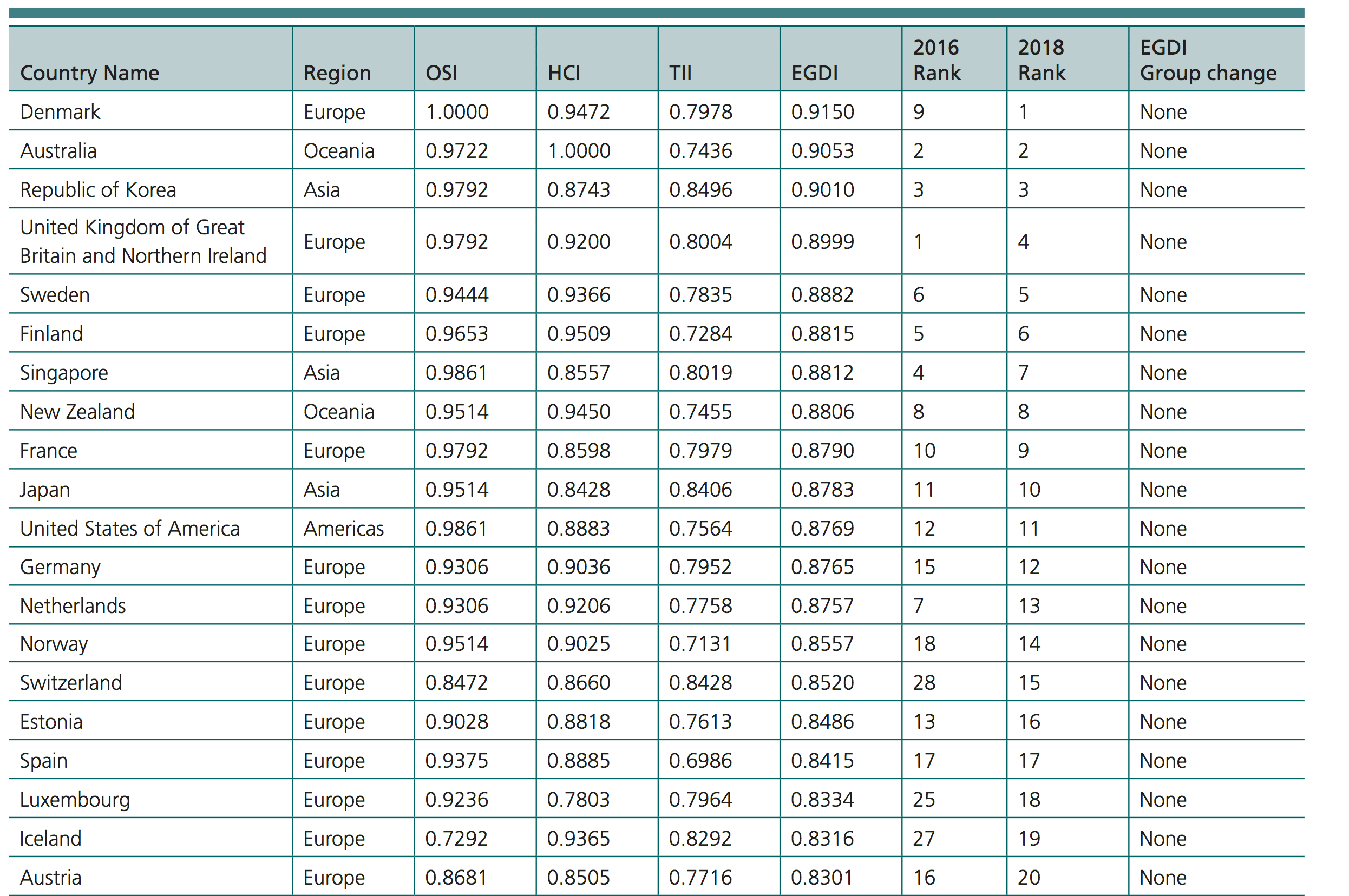
Screen Shot 2018 08 14 at 11.05.52

1 | DENMARK

Denmark has been implementing its digital strategy since the last survey, in 2016. The five-year programme sets a course for Danish public-sector digitisation, as well as public-private sector collaboration.

“This strategy is aimed at building the basis for a strong and secure digital Denmark. Denmark has also made digital government-citizen interactions mandatory without excluding those unable to use digital services,” says UNDESA.

2 | AUSTRALIA

Australia retains its second place from the last US e-government survey in 2016. UNDESA says the country leads the chart in human capital development and is in the top 10 in online services.

Its government is proactive, regularly updating its 2016 digital transformation roadmap with “snapshots of expected deliverables”.

3 | SOUTH KOREA

The Republic of Korea remains in the third spot, as in 2016. The country performed well in online service and technology infrastructure, but its human capital development was relatively low compared to other top ranked countries, said UNDESA.

“The country facilitates convenient, efficient, and transparent government in enhancing citizens’ satisfaction and government productivity and is constantly improving to provide better government services to its citizens in the face of rapid technology changes.”

4 | THE UNITED KINGDOM

The United Kingdom slipped from first in 2016, as a consequence of a relative decrease in the ranking of its human capital and online service indices. The British Government is providing more integrated online services through its one-stop platform GOV.UK.

UNDESA said: “Its government transformation strategy, published in 2017, is setting the course for further e-government development through business transformation, growing the right people, culture and skills, building better tools, processes and governance for civil servants.”

5 | SWEDEN

Sweden stepped up one position from 2016. In 2017, the government outlined its new digital policy, detailing ow it will contribute to competitiveness, full employment, and economic, social and environmentally sustainable development.

“The strategy aims for Sweden to become the world leader in harnessing the opportunities of digital transformation. Sweden has high rates of mobile broadband take-up and its market is characterised by a rapidly growing consumer demand for fast broadband,” it said.

6 | FINLAND

Finland’s ‘national knowledge society strategy’ has focuses on the provision of multi-channel, interactive e-services together with interoperability of information systems in the public administration.

“Digitalisation is a cross-cutting theme in the Government strategy,” said UNDESA. “Principles for client-oriented public services are being drawn up and the public sector is being encouraged to commit to automation and the digitalisation of their practices.”

7 | SINGAPORE

Singapore fells three places to the seventh, compared with the EGDI 2016 survey. It ranks second in online service delivery index together with US, behind Denmark, but dropped a few positions due to its human capital index.

The government has had an e-government plan since the 1980s. Its ‘smart nation’ programme was unveiled in 2014, with digital governance as a central plank. “Singapore has been embracing e-government as a whole-of-government approach in its national development strategy,” said UNDESA.

8 | NEW ZEALAND

New Zealand scores well in both online services and human capital. Alongside its ICT strategy, the government has established a ‘digital economy work programme’.

“The government is supporting the growth of the digital sector, the uptake of ICT across its economy, and citizens’ secure use of digital technologies to support their development, access jobs, run businesses, and
trade goods,” said UNDESA.

9 | FRANCE

Francewas up one place on 2016, with the government’s objective to take all services online by 2022. France launched its ‘public action 2022’ programme last year, among to simplify and digitise administrative processes.

The government has also launched a development programme to build a common foundation of applications, digital bricks, repositories and shared frameworks to accelerate digital transformation.

10 | JAPAN

Japan moved up from eleventh in 2016. It scored highly in technology infrastructure and online service. Japan has stated a ‘digital government strategy’ and a plan for utilising public and private sector data.

“One of the three pillars of its digital strategy is a platform for public-private partnerships to promote sustained, inclusive and sustainable economic growth, full and productive employment and decent work for all,” said UNDESA.

You Might Also Like
  • Physical AI is exposing a data sovereignty gap (Reader Forum)
  • Japan’s private 5G market is finally moving beyond demo experiments (Analyst Angle)
  • Monday (telco diary) | Sovereign AI for Industry 4.0
  • When the push becomes the pull – private 5G and physical AI
  • Subsea shift – ITU and FCC redraw rules for global cable resilience
  • Fast-growing private 5G offers blueprint for AI-era telecoms

Table of Contents

  • 1 | DENMARK
  • 2 | AUSTRALIA
  • 3 | SOUTH KOREA
  • 4 | THE UNITED KINGDOM
  • 5 | SWEDEN
  • 6 | FINLAND
  • 7 | SINGAPORE
  • 8 | NEW ZEALAND
  • 9 | FRANCE
  • 10 | JAPAN
Share 0 LinkedinEmail
James Blackman
James Blackman

James Blackman has been writing about the technology and telecoms sectors for over a decade. He has edited and contributed to a number of European news outlets and trade titles. He has also worked at telecoms company Huawei, leading media activity for its devices business in Western Europe. He is based in London.

previous post
New Jersey names GovLab director Noveck as chief information officer
next post
Libelium patches security flaws in IoT gateway to ward off Mirai-style attacks

White Papers

  • Norton eBook: The 2026 Telco Playbook

  • Enea White Paper: Why Intelligent AAA is the Swiss Army Knife of Telecom

  • CSG White Paper: Telco AI Enabler: Mediation’s Defining Role

  • Enea White Paper: Scalable Database Design for 5G and Beyond

  • Supermicro and NVIDIA Whitepaper: Powering sovereign AI at scale

Editorial Reports

  • Report: Building AI-Era Network Fabrics

  • Quantum Safe Networks Market Pulse Report

  • Report: NTN in motion — evolving standards, expanding services

Webinars

  • Mimosa Webinar – Build the Right Network

  • Webinar: Building 6G — aligning technology, policy and purpose

  • SIMCom Webinar: Scaling your next deployment – from plastic to provisioning

  • Webinar: Rethinking the RAN as AI, cloud and openness converge

  • Webinar: Scale-Up, Scale-Out, Scale-Across – Building AI-Era Network Fabrics

Since 1982, RCR Wireless News has been providing wireless and mobile industry news, insights, and analysis to mobile and wireless industry professionals, decision makers, policy makers, analysts and investors.

Facebook Twitter Youtube Linkedin Envelope Rss

Useful Links

  • Subscribe
  • About RCR Wireless News
  • Contact Us
  • Advertise
  • Editorial Calendar
  • Archive
  • RSS
  • Wireless News Archive
  • Subscribe
  • About RCR Wireless News
  • Contact Us
  • Advertise
  • Editorial Calendar
  • Archive
  • RSS
  • Wireless News Archive

Edtior's Picks

Lightyear launches Dispatch, an agentic AI platform for enterprise telecom
The smart apartment era is ending. The smart building contract is next (Analyst...
Mimosa Webinar – Build the Right Network

Latest Articles

Lightyear launches Dispatch, an agentic AI platform for enterprise telecom
The smart apartment era is ending. The smart building contract is next (Analyst Angle)
Mimosa Webinar – Build the Right Network
ZTE’s computing business drives H1 growth as carrier spending weakens

© 2026 RCR Wireless News All Right Reserved. Developed by Eight Hats.

Cookie Policy | Privacy Policy

RCR Wireless
  • News
  • Channels
    • 5G
    • 6G
    • BSS OSS
    • Carriers
    • IoT
    • Network Infrastructure
    • Open RAN
    • Private 5G
    • Telco AI
    • Telco Cloud
    • Test & Measurement
  • Resources
    • Reports
    • Webinars
    • White papers
    • AI Fundamentals
    • Analyst Angle
    • Editorial Calendar
    • Fundamentals
      • 5G NR Release 17
      • AI
        • Telco AI in 2025
    • Podcasts
      • Let’s Get Digital with Carrie Charles
      • Wireless Connectivity to Enable Industry 4.0 for the Middleprise
      • Well Technically…
      • Will 5G Change the World
      • Accelerating Industry 4.0 Digitalization
  • AI Infrastructure
  • Programs
  • Events
  • RCRtv
  • Advertise
  • Subscribe
RCR Wireless
  • News
  • Channels
    • 5G
    • 6G
    • BSS OSS
    • Carriers
    • IoT
    • Network Infrastructure
    • Open RAN
    • Private 5G
    • Telco AI
    • Telco Cloud
    • Test & Measurement
  • Resources
    • Reports
    • Webinars
    • White papers
    • AI Fundamentals
    • Analyst Angle
    • Editorial Calendar
    • Fundamentals
      • 5G NR Release 17
      • AI
        • Telco AI in 2025
    • Podcasts
      • Let’s Get Digital with Carrie Charles
      • Wireless Connectivity to Enable Industry 4.0 for the Middleprise
      • Well Technically…
      • Will 5G Change the World
      • Accelerating Industry 4.0 Digitalization
  • AI Infrastructure
  • Programs
  • Events
  • RCRtv
  • Advertise
  • Subscribe
@2020 - All Right Reserved. Designed and Developed by PenciDesign
