
RCR Wireless
  • News
  • Channels
    • 5G
    • 6G
    • BSS OSS
    • Carriers
    • IoT
    • Network Infrastructure
    • Open RAN
    • Private 5G
    • Telco AI
    • Telco Cloud
    • Test & Measurement
  • Resources
    • Reports
    • Webinars
    • White papers
    • AI Fundamentals
    • Analyst Angle
    • Editorial Calendar
    • Fundamentals
      • 5G NR Release 17
      • AI
        • Telco AI in 2025
    • Podcasts
      • Let’s Get Digital with Carrie Charles
      • Wireless Connectivity to Enable Industry 4.0 for the Middleprise
      • Well Technically…
      • Will 5G Change the World
      • Accelerating Industry 4.0 Digitalization
  • AI Infrastructure
  • Programs
  • Events
  • RCRtv
  • Advertise
  • Subscribe
Sunday, August 16, 2026
RCR Wireless
  • News
  • Channels
    • 5G
    • 6G
    • BSS OSS
    • Carriers
    • IoT
    • Network Infrastructure
    • Open RAN
    • Private 5G
    • Telco AI
    • Telco Cloud
    • Test & Measurement
  • Resources
    • Reports
    • Webinars
    • White papers
    • AI Fundamentals
    • Analyst Angle
    • Editorial Calendar
    • Fundamentals
      • 5G NR Release 17
      • AI
        • Telco AI in 2025
    • Podcasts
      • Let’s Get Digital with Carrie Charles
      • Wireless Connectivity to Enable Industry 4.0 for the Middleprise
      • Well Technically…
      • Will 5G Change the World
      • Accelerating Industry 4.0 Digitalization
  • AI Infrastructure
  • Programs
  • Events
  • RCRtv
  • Advertise
  • Subscribe
Add RCR Wireless as a preferred source on Google
  • Qualcomm 6G Insights
  • Huawei Content Hub
  • Qualcomm – 6G Vision
  • OSS/BSS Channel
  • RCRTech Roundtable: AI Infrastructure
RCR Wireless
RCR Wireless
  • Advanced Mimo
  • Mobile mmWave
  • 5G Positioning
  • Green Networks
  • Metaverse
  • Automotive
  • Industrial and Wide-area IoT
Copyright 2021 - All Right Reserved
Home - Seven PSCR tech challenges that could shape public safety
public safety

Seven PSCR tech challenges that could shape public safety

by Kelly Hill July 29, 2020
written by Kelly Hill July 29, 2020 Share
LinkedinEmail
Share 0LinkedinEmail
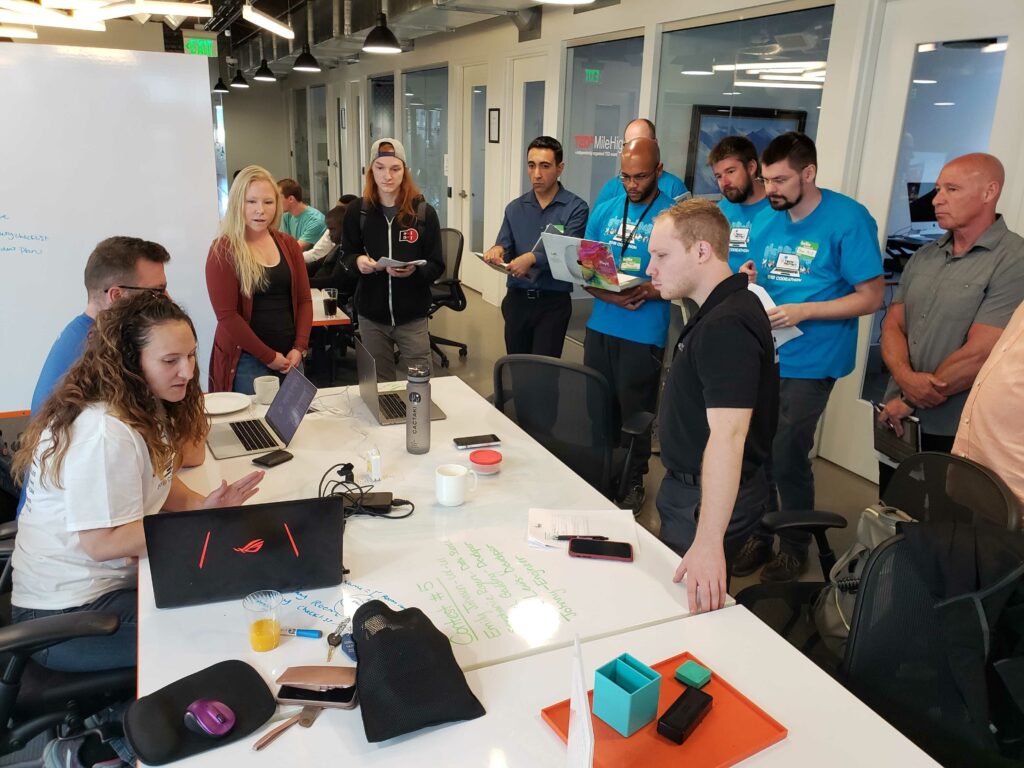
From the Tech to Protect challenge's event last year in Denver, CO. Image: PSCR
196

The Defense Advanced Research Projects Agency (DARPA) helped lay the foundation for autonomous ground vehicles with a 300-mile challenge race. DARPA also pushed AI-powered, software-defined radios to their limits in the three-year Spectrum Collaboration Challenge that culminated at last year’s Mobile World Congress Los Angeles, and now the underlying technology is being further explored in 5G test beds.

The National Institute of Standards and Technology’s Public Safety Communications Research Division is hoping to spark similar innovation for public safety technology with a series of challenges funded out of $300 million in research funding that it has to spend by 2022. Public challenges, according to Division Chief Dereck Orr, put PSCR in touch with experts, organizations and innovators that it might not otherwise come across.

PSCR recently concluded its “Tech to Protect” challenge, which included public safety hackathons in 10 cities across the U.S. and awarded $800,000 worth of prizes in May. The challenge was unique in that it wasn’t a single-day hackathon series, but was designed to bring application development along over time. The winners from May received $30,000 each in “seed” money, and in November, they can come back to PSCR for up to $70,000 each in additional funds, depending on how much progress they’ve made on a “growth strategy” get their solutions closer to market — and in the hands of first responders. This particular challenge was also aimed at supporting public safety solutions that could be brought to reality quickly; PSCR usually focuses on research that will ultimately support tech developments are further out, on the scale of 5-10 years away.

The Tech to Protect challenge is just one of PSCR’s current challenges and planned 2020-2021 challenges. There are six others, which include:

-The ongoing 2020 CHARIoT Challenge, which centers around integrating information from IoT devices, smart buildings and smart cities into augmented reality interfaces to help inform first responders and improve situational awareness; as well as emulating smart city data sources for disaster response scenarios. The four-phase challenge will award up to $1.1 million in prizes; the first round is already complete. 

-The 2020 UAS Endurance Challenge, focused on advancing drone design for public safety search and rescue use. In those circumstances, long operating time (90 minutes+) and the ability to carry a heavy load are useful features, but can pose design challenges. This is a four-stage competition, and first-stage winners have already been announced. Walk-on entries are still being accepted through mid-December.

-2020 Automated Streams Analysis for Public Safety (ASAPS) Prize Challenge. This challenge will involve competitors developing algorithms to handle live streams of unstructured public safety data and pick out emergency events, derived from an “extensive and unique staged dataset designed to stimulate a day in the life of a busy city,” according to PSCR.

-The upcoming Enhancing Computer Vision for Public Safety Challenge, which will center on creating image datasets that include common camera image problems, like glare or a dirty lens. A roadblock to the deployment of computer vision and video analytics is the myriad problems cameras experience when deployed in real world environments,” PSCR explains. Computer vision systems need images on which to be trained so that they can be trained to spot and account for such problems, so that public safety computer vision use is more accurate. The two-phase challenge will have prizes of up to $240,000.

-Planned for the winter/spring of 2021 is a Mobile Fingerprint Capture for First Responders Challenge, in which PSCR said it wants competitors to explore “ways to utilize already-deployed mobile technologies to provide a portable, on-the-scene fingerprint capture solution that would save public safety personnel resources and potentially save lives.”

-PSCR is also planning a follow-up to a 2018 challenge related to differential privacy algorithms. In a public safety context, being able to identify people’s locations and track them over time is valuable for emergency and disaster response, evacuation, personnel placement and more — but tracking people’s locations over time also represents a privacy risk. The upcoming 2020 NIST PSCR Differential Privacy Temporal Map Data Challenge seeks to “develop algorithms that preserve data utility while guaranteeing individual privacy is protected.” That challenge is expected to begin this fall.

PSCR noted that more information about the related issues to privacy and data-sharing will be among those highlighted at its virtual annual stakeholder event, being held this week.

Information about more U.S. federal challenges is available here.

You Might Also Like
  • AT&T, AST SpaceMobile get FCC approval for FirstNet Direct-to-Cell trials
  • Behind the signal are the people who show up
  • FirstNet exceeds 7 million subscribers
  • Kagan: Thank you to AT&T, T-Mobile, Verizon, Starlink, Tesla on LA wildfires
  • T-Mo enables Starlink service for those impacted by LA fires
  • FCC grants FirstNet use of 4.9 GHz, dealing a blow to Verizon
Share 0 LinkedinEmail
Kelly Hill

Kelly Hill reports on network test and measurement, AI infrastructure and regulatory issues, including spectrum, for RCR Wireless News. She began covering the wireless industry in 2005, focusing on carriers and MVNOs, then took a few years’ hiatus and returned to RCR Wireless News to write about heterogeneous networks (remember those?) and network infrastructure. Kelly is an Ohio native with a masters degree in journalism from the University of California, Berkeley, where she focused on science writing and multimedia. She has written for the San Francisco Chronicle, The Oregonian and The Canton Repository. She lives in northern Virginia, not far from Data Center Alley.

previous post
ABB intros IT-OT analytics bundle to release 80% of trapped Industry 4.0 data
next post
True Move selects ZTE’s RAN portfolio for 5G launch

White Papers

  • Norton eBook: The 2026 Telco Playbook

  • Enea White Paper: Why Intelligent AAA is the Swiss Army Knife of Telecom

  • CSG White Paper: Telco AI Enabler: Mediation’s Defining Role

  • Enea White Paper: Scalable Database Design for 5G and Beyond

  • Supermicro and NVIDIA Whitepaper: Powering sovereign AI at scale

Editorial Reports

  • Report: NTN in motion — evolving standards, expanding services

  • Market Pulse Report: Telco AI in 2026 – Trends, Challenges and Opportunities

  • Nvidia Report: The State of AI in Telecommunications: 2026 Trends

Webinars

  • Webinar: Building 6G — aligning technology, policy and purpose

  • SIMCom Webinar: Scaling your next deployment – from plastic to provisioning

  • Webinar: Rethinking the RAN as AI, cloud and openness converge

  • Webinar: Scale-Up, Scale-Out, Scale-Across – Building AI-Era Network Fabrics

  • Webinar: NTN in motion – evolving standards, expanding services

Since 1982, RCR Wireless News has been providing wireless and mobile industry news, insights, and analysis to mobile and wireless industry professionals, decision makers, policy makers, analysts and investors.

Facebook Twitter Youtube Linkedin Envelope Rss

Useful Links

  • Subscribe
  • About RCR Wireless News
  • Contact Us
  • Advertise
  • Editorial Calendar
  • Archive
  • RSS
  • Wireless News Archive
  • Subscribe
  • About RCR Wireless News
  • Contact Us
  • Advertise
  • Editorial Calendar
  • Archive
  • RSS
  • Wireless News Archive

Edtior's Picks

Lockheed’s NetSense turns Verizon’s 5G network into a drone-tracking system
Criss-cross comms – Lumen bets on east-west AI, while the edge keeps north-south...
Fighting talk (and team spirit) – Celona preps private 5G/Wi-Fi for AI scramble...

Latest Articles

Lockheed’s NetSense turns Verizon’s 5G network into a drone-tracking system
Criss-cross comms – Lumen bets on east-west AI, while the edge keeps north-south in play
Fighting talk (and team spirit) – Celona preps private 5G/Wi-Fi for AI scramble in Industry 4.0
The Agentic Network — T-Mobile US on aligning AI initiatives with customer outcomes

© 2026 RCR Wireless News All Right Reserved. Developed by Eight Hats.

Cookie Policy | Privacy Policy

RCR Wireless
  • News
  • Channels
    • 5G
    • 6G
    • BSS OSS
    • Carriers
    • IoT
    • Network Infrastructure
    • Open RAN
    • Private 5G
    • Telco AI
    • Telco Cloud
    • Test & Measurement
  • Resources
    • Reports
    • Webinars
    • White papers
    • AI Fundamentals
    • Analyst Angle
    • Editorial Calendar
    • Fundamentals
      • 5G NR Release 17
      • AI
        • Telco AI in 2025
    • Podcasts
      • Let’s Get Digital with Carrie Charles
      • Wireless Connectivity to Enable Industry 4.0 for the Middleprise
      • Well Technically…
      • Will 5G Change the World
      • Accelerating Industry 4.0 Digitalization
  • AI Infrastructure
  • Programs
  • Events
  • RCRtv
  • Advertise
  • Subscribe
RCR Wireless
  • News
  • Channels
    • 5G
    • 6G
    • BSS OSS
    • Carriers
    • IoT
    • Network Infrastructure
    • Open RAN
    • Private 5G
    • Telco AI
    • Telco Cloud
    • Test & Measurement
  • Resources
    • Reports
    • Webinars
    • White papers
    • AI Fundamentals
    • Analyst Angle
    • Editorial Calendar
    • Fundamentals
      • 5G NR Release 17
      • AI
        • Telco AI in 2025
    • Podcasts
      • Let’s Get Digital with Carrie Charles
      • Wireless Connectivity to Enable Industry 4.0 for the Middleprise
      • Well Technically…
      • Will 5G Change the World
      • Accelerating Industry 4.0 Digitalization
  • AI Infrastructure
  • Programs
  • Events
  • RCRtv
  • Advertise
  • Subscribe
@2020 - All Right Reserved. Designed and Developed by PenciDesign

