

RCR Wireless
  • News
  • Channels
    • 5G
    • 6G
    • BSS OSS
    • Carriers
    • IoT
    • Network Infrastructure
    • Open RAN
    • Private 5G
    • Telco AI
    • Telco Cloud
    • Test & Measurement
  • Resources
    • Reports
    • Webinars
    • White papers
    • AI Fundamentals
    • Analyst Angle
    • Editorial Calendar
    • Fundamentals
      • 5G NR Release 17
      • AI
        • Telco AI in 2025
    • Podcasts
      • Let’s Get Digital with Carrie Charles
      • Wireless Connectivity to Enable Industry 4.0 for the Middleprise
      • Well Technically…
      • Will 5G Change the World
      • Accelerating Industry 4.0 Digitalization
  • AI Infrastructure
  • Programs
  • Events
  • RCRtv
  • Advertise
  • Subscribe
Sunday, August 16, 2026
RCR Wireless
  • News
  • Channels
    • 5G
    • 6G
    • BSS OSS
    • Carriers
    • IoT
    • Network Infrastructure
    • Open RAN
    • Private 5G
    • Telco AI
    • Telco Cloud
    • Test & Measurement
  • Resources
    • Reports
    • Webinars
    • White papers
    • AI Fundamentals
    • Analyst Angle
    • Editorial Calendar
    • Fundamentals
      • 5G NR Release 17
      • AI
        • Telco AI in 2025
    • Podcasts
      • Let’s Get Digital with Carrie Charles
      • Wireless Connectivity to Enable Industry 4.0 for the Middleprise
      • Well Technically…
      • Will 5G Change the World
      • Accelerating Industry 4.0 Digitalization
  • AI Infrastructure
  • Programs
  • Events
  • RCRtv
  • Advertise
  • Subscribe
Add RCR Wireless as a preferred source on Google
  • Qualcomm 6G Insights
  • Huawei Content Hub
  • Qualcomm – 6G Vision
  • OSS/BSS Channel
  • RCRTech Roundtable: AI Infrastructure
RCR Wireless
RCR Wireless
  • Advanced Mimo
  • Mobile mmWave
  • 5G Positioning
  • Green Networks
  • Metaverse
  • Automotive
  • Industrial and Wide-area IoT
Copyright 2021 - All Right Reserved
Home - Is powering small cells the greatest densification challenge?
5G

Is powering small cells the greatest densification challenge?

by Catherine Sbeglia Nin October 15, 2021
written by Catherine Sbeglia Nin October 15, 2021 Share
LinkedinEmail
Share 0LinkedinEmail
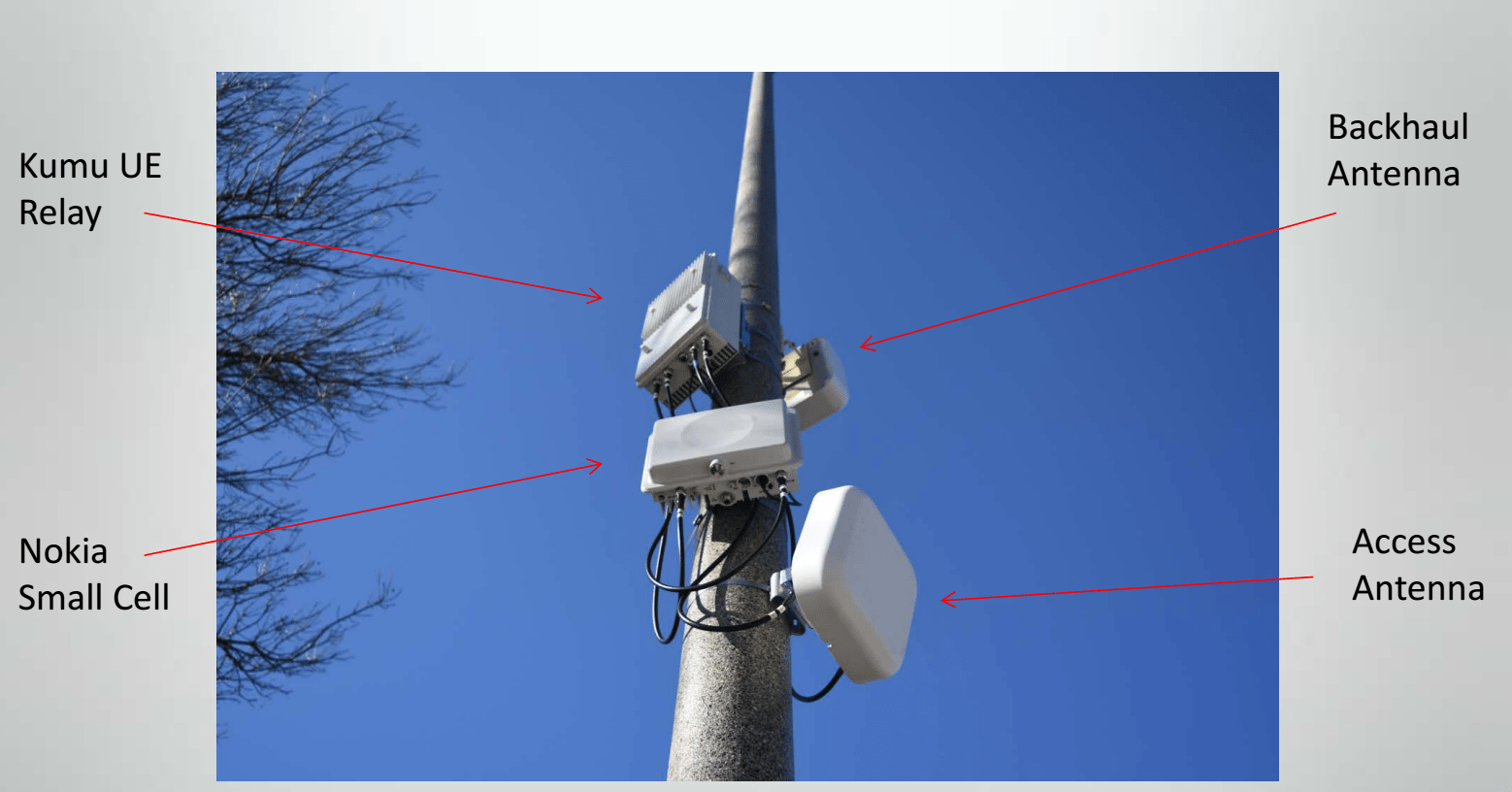
kumu networks small cells
This pictures, courtesy of Kumu Networks, shows how the company's full-duplex relay tech fits into a small cell deployment.
252

CommScope director of engineering: ‘When densification [of small cells] increases […] so does the amount of power’

In the U.S., operators are expected to deploy five to 10 times more small cells than macro cells, and CTIA has forecasted that by 2026, more than 800,000 small cells will be deployed in the U.S., up from around 86,000 in 2018.

For Tom Craft, director of engineering, MetroCell Solutions at CommScope, this scale creates a problem: “Everything is focused on densification and getting services out to users, but when that densification increases by a factor of 10, so does the amount of power,” he said.

In fact, Craft believes that getting enough power reliably and cost effectively to the “tens, if not hundreds of thousands” small cells that will be deployed across the U.S. is the “biggest challenge” facing small cell densification.

Power availability for small cells

CommScope estimated in 2018 that the total time to deploy small cells is 18 to 24 months, due mostly to power constraints. According to the company, this timeline is a result of prioritizing coverage when designing new network sites, leaving power as an afterthought. Once the infrastructure design is in place and it is discovered that no electrical power exists nearby, approval to tap nearby buildings for power must be sought—a process that can take several months.

“We’re seeing today that it already takes months for the utility to get out there to turn power up on each one of those poles,” Craft continued. “And we see that problem only growing as the number of small cells increases not just from a connection standpoint, but from an operational or maintenance standpoint.”

Therefore, as these deployments go from small to large scale, CommScope is encouraging operators to pay attention to power, both from a planning and consumption perspective, and to do so early. 

A typical three-sector small cell can require 200–1,000 watts of power, according to CommScope, and small cell networks must be incredibly dense to provide adequate coverage, meaning there will need to be a lot of individual installations, and each one will require power.

Power reliability for small cells

Worse, though, is the fact that the traditional model of powering a cell site — in which the site is powered by the AC power grid, with a backup power source available as a fallback— cannot be applied to small cells, as these sites do not currently come with power backup, and therefore, would go down during a power outage.

“The AC grid is known to have outages every year,” commented Craft, adding that once in place, people will begin to rely on these small cell systems for critical communication, making such outages potentially disastrous. 

AC electrical feeds can be interrupted by a variety of anomalies from lightning strikes to blown transformers to rodent activity.

“The only way to fix that,” he continued, “is to have a centralized system that has some level of backup that keeps the system available in the traditional telecom network.”

The traditional telecom network reliability is around five nines today or 99.999% reliable, while the AC network can only claim around three nines, or 99.9% reliability.

“So, about .1% of the time the AC system is down and when the system is not available, that equates to a tremendous amount in cost, but also the loss of critical functions during things like storms when a phone is needed,” said Craft.

Power prices for small cells

The last piece of the power challenges, said Craft, is the rising cost of energy.

“We see that the cost is going to double in the next five years and then double again in another five years,” he claimed, citing market research.

He went on to explain that when you combine this information with the prediction that in 2025, the Information and communications technology (ICT) network will use about four thousand terawatt hours, you’re looking at an energy bill of roughly three hundred billion dollars for that year to run the network.

He added that while CommScope has yet to calculate what the cost of energy might be in 2030, it has been estimated that by that date, the ICT network will use about eight thousand terawatt hours, demonstrating the dire need to cut energy costs moving forward.

The good news, Craft continued, is that by leveraging advanced tools like artificial intelligence to manage those communications systems that will require more and more electricity— like small cells — those costs can be reduced.

From CommScope’s perspective, the other pressing power challenges faced by operators as they build out their small cell networks can only be solved by “centralizing the small cell layer as much as possible.”

“This means developing a power hub cabinet that boosts power and distributes that power from a centralized location,” Craft explained. “With our PowerShift Metro solution, for instance, we want to bring AC service to a single location within a small cell network, as opposed to going to multiple small cell site locations, each with individual meters or AC connection points. And then we distribute the power with fiber to each one of those small cell locations in that communications space.”

Craft further described the need to “balance centralizing and distributing small cells.” 

“All the work that’s being done to distribute equipment out to the edge, there’s always a cost benefit for some level of centralization,” he said, adding that a centralized location for the distribution of power and connectivity for small cells, reduces cost for the number of components on each pole.

With fewer unknown variables to concern themselves with, operators have more control over how, when and where to add small cell coverage, allowing them to more swiftly respond to new market opportunities and reduce time to market.

To read more about small cells, check out What is a small cell, really?

You Might Also Like
  • Telstra targets AI-driven growth with 5G, digital infrastructure push
  • Rakuten confirms KDDI roaming will be reduced as own network expands
  • Deutsche Telekom expands AI, fiber investment as growth continues
  • Tuesday (telco diary) | More about ISAC – on battlefields and sportsfields
  • From missiles to pizzas – why 6G drone sensing has been fast-tracked for 5G
  • Cellnex sees AI, 5G and digital sovereignty driving Europe’s next infrastructure cycle

Table of Contents

  • CommScope director of engineering: ‘When densification [of small cells] increases […] so does the amount of power’
      • Power availability for small cells
      • Power reliability for small cells
      • Power prices for small cells
Share 0 LinkedinEmail
Catherine Sbeglia Nin

Catherine Sbeglia Nin is the Managing Editor for RCR Wireless News, where she covers topics such as Wi-Fi, network infrastructure, AI and edge computing. She also produced and hosted Arden Media's podcast Well, technically... After studying English and Film & Media Studies at The University of Rochester, she moved to Madison, WI. Having already lived on both coasts, she thought she’d give the middle a try. So far, she likes it very much.

previous post
What are the three big losses in manufacturing and can 5G help?
next post
Huawei urges industry to adopt energy-efficient networks as 5G expands

White Papers

  • Norton eBook: The 2026 Telco Playbook

  • Enea White Paper: Why Intelligent AAA is the Swiss Army Knife of Telecom

  • CSG White Paper: Telco AI Enabler: Mediation’s Defining Role

  • Enea White Paper: Scalable Database Design for 5G and Beyond

  • Supermicro and NVIDIA Whitepaper: Powering sovereign AI at scale

Editorial Reports

  • Report: NTN in motion — evolving standards, expanding services

  • Market Pulse Report: Telco AI in 2026 – Trends, Challenges and Opportunities

  • Nvidia Report: The State of AI in Telecommunications: 2026 Trends

Webinars

  • Webinar: Building 6G — aligning technology, policy and purpose

  • SIMCom Webinar: Scaling your next deployment – from plastic to provisioning

  • Webinar: Rethinking the RAN as AI, cloud and openness converge

  • Webinar: Scale-Up, Scale-Out, Scale-Across – Building AI-Era Network Fabrics

  • Webinar: NTN in motion – evolving standards, expanding services

Since 1982, RCR Wireless News has been providing wireless and mobile industry news, insights, and analysis to mobile and wireless industry professionals, decision makers, policy makers, analysts and investors.

Facebook Twitter Youtube Linkedin Envelope Rss

Useful Links

  • Subscribe
  • About RCR Wireless News
  • Contact Us
  • Advertise
  • Editorial Calendar
  • Archive
  • RSS
  • Wireless News Archive
  • Subscribe
  • About RCR Wireless News
  • Contact Us
  • Advertise
  • Editorial Calendar
  • Archive
  • RSS
  • Wireless News Archive

Edtior's Picks

Lockheed’s NetSense turns Verizon’s 5G network into a drone-tracking system
Criss-cross comms – Lumen bets on east-west AI, while the edge keeps north-south...
Fighting talk (and team spirit) – Celona preps private 5G/Wi-Fi for AI scramble...

Latest Articles

Lockheed’s NetSense turns Verizon’s 5G network into a drone-tracking system
Criss-cross comms – Lumen bets on east-west AI, while the edge keeps north-south in play
Fighting talk (and team spirit) – Celona preps private 5G/Wi-Fi for AI scramble in Industry 4.0
The Agentic Network — T-Mobile US on aligning AI initiatives with customer outcomes

© 2026 RCR Wireless News All Right Reserved. Developed by Eight Hats.

Cookie Policy | Privacy Policy

RCR Wireless
  • News
  • Channels
    • 5G
    • 6G
    • BSS OSS
    • Carriers
    • IoT
    • Network Infrastructure
    • Open RAN
    • Private 5G
    • Telco AI
    • Telco Cloud
    • Test & Measurement
  • Resources
    • Reports
    • Webinars
    • White papers
    • AI Fundamentals
    • Analyst Angle
    • Editorial Calendar
    • Fundamentals
      • 5G NR Release 17
      • AI
        • Telco AI in 2025
    • Podcasts
      • Let’s Get Digital with Carrie Charles
      • Wireless Connectivity to Enable Industry 4.0 for the Middleprise
      • Well Technically…
      • Will 5G Change the World
      • Accelerating Industry 4.0 Digitalization
  • AI Infrastructure
  • Programs
  • Events
  • RCRtv
  • Advertise
  • Subscribe
RCR Wireless
  • News
  • Channels
    • 5G
    • 6G
    • BSS OSS
    • Carriers
    • IoT
    • Network Infrastructure
    • Open RAN
    • Private 5G
    • Telco AI
    • Telco Cloud
    • Test & Measurement
  • Resources
    • Reports
    • Webinars
    • White papers
    • AI Fundamentals
    • Analyst Angle
    • Editorial Calendar
    • Fundamentals
      • 5G NR Release 17
      • AI
        • Telco AI in 2025
    • Podcasts
      • Let’s Get Digital with Carrie Charles
      • Wireless Connectivity to Enable Industry 4.0 for the Middleprise
      • Well Technically…
      • Will 5G Change the World
      • Accelerating Industry 4.0 Digitalization
  • AI Infrastructure
  • Programs
  • Events
  • RCRtv
  • Advertise
  • Subscribe
@2020 - All Right Reserved. Designed and Developed by PenciDesign
