

RCR Wireless
  • News
  • Channels
    • 5G
    • 6G
    • BSS OSS
    • Carriers
    • IoT
    • Network Infrastructure
    • Open RAN
    • Private 5G
    • Telco AI
    • Telco Cloud
    • Test & Measurement
  • Resources
    • Reports
    • Webinars
    • White papers
    • AI Fundamentals
    • Analyst Angle
    • Editorial Calendar
    • Fundamentals
      • 5G NR Release 17
      • AI
        • Telco AI in 2025
    • Podcasts
      • Let’s Get Digital with Carrie Charles
      • Wireless Connectivity to Enable Industry 4.0 for the Middleprise
      • Well Technically…
      • Will 5G Change the World
      • Accelerating Industry 4.0 Digitalization
  • AI Infrastructure
  • Programs
  • Events
  • RCRtv
  • Advertise
  • Subscribe
Thursday, September 10, 2026
RCR Wireless
  • News
  • Channels
    • 5G
    • 6G
    • BSS OSS
    • Carriers
    • IoT
    • Network Infrastructure
    • Open RAN
    • Private 5G
    • Telco AI
    • Telco Cloud
    • Test & Measurement
  • Resources
    • Reports
    • Webinars
    • White papers
    • AI Fundamentals
    • Analyst Angle
    • Editorial Calendar
    • Fundamentals
      • 5G NR Release 17
      • AI
        • Telco AI in 2025
    • Podcasts
      • Let’s Get Digital with Carrie Charles
      • Wireless Connectivity to Enable Industry 4.0 for the Middleprise
      • Well Technically…
      • Will 5G Change the World
      • Accelerating Industry 4.0 Digitalization
  • AI Infrastructure
  • Programs
  • Events
  • RCRtv
  • Advertise
  • Subscribe
Add RCR Wireless as a preferred source on Google
  • Qualcomm 6G Insights
  • Huawei Content Hub
  • Qualcomm – 6G Vision
  • OSS/BSS Channel
  • RCRTech Roundtable: AI Infrastructure
RCR Wireless
RCR Wireless
  • Advanced Mimo
  • Mobile mmWave
  • 5G Positioning
  • Green Networks
  • Metaverse
  • Automotive
  • Industrial and Wide-area IoT
Copyright 2021 - All Right Reserved
Home - Autonomous public safety robots on patrol, connected by Verizon
Carriers

Autonomous public safety robots on patrol, connected by Verizon

by Kelly Hill November 15, 2024
written by Kelly Hill November 15, 2024 Share
LinkedinEmail
Share 0LinkedinEmail
public safety robot Knightscope Verizon
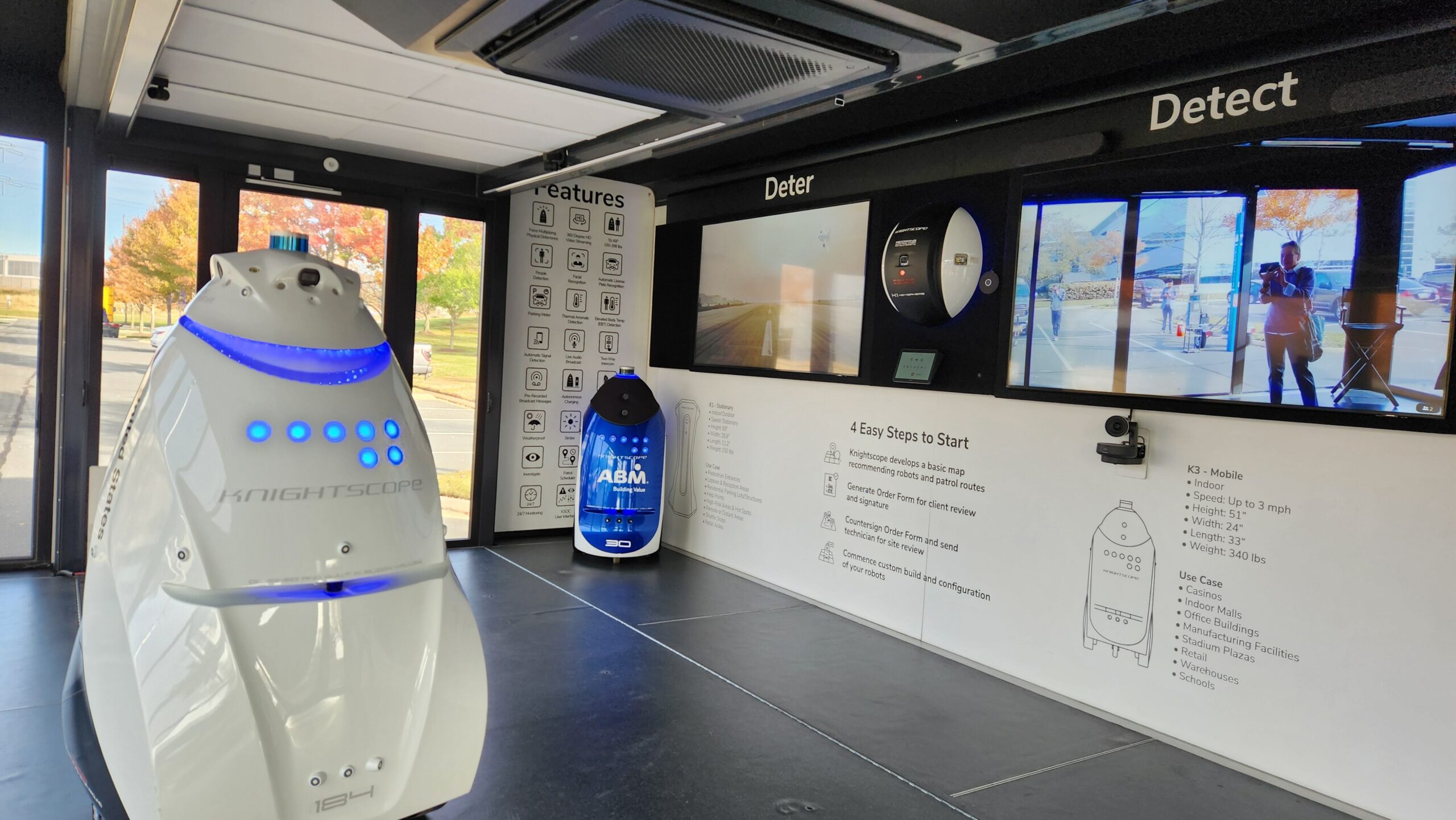
Knightscope's K5 public safety robot is already deployed across the country. Image: K. Hill/RCR Wireless
474

KnightScope deal means Verizon will connect a fleet of autonomous public safety robots

ASHBURN, Virginia—Stacy Stephens was watching the Sandy Hook school shooting unfold on television in 2012 and listening to his friend William Li get increasingly agitated about why officers were taking so long to go inside the building and confront the shooter. Stephens, who has a background in law enforcement, had to explain the reasons for such a delay: with no idea where a gunman was, in a large building, police were at a disadvantage. What officers needed was eyes and ears inside a building to gain actionable intelligence that would help them counter the gunman’s tactical advantage.

Watching that tragedy unfold and trying to figure out how to get law enforcement that kind of actionable intelligence faster, was what spurred the two partners to form public safety technology company Knightscope. The California-based company offers connected emergency callboxes, gunshot detection and also designed a mobile, autonomous public safety robot with capabilities that are meant to replicate human senses: cameras, thermal imaging and facial recognition for visuals, audio and calling capabilities for broadcasting public messages or to be used as a moving call box, lidar for sensing at a distance, sonar for up-close sensing, GPS for orientation and direction and wheel sensors for maneuverability and stability.

Knightscope has an existing deployed base of about 10,000 devices, which mostly consists of its wirelessly connected call boxes—but the company also has a deployed fleet of its autonomous public safety robots, which can patrol parking lots, malls, loading docks, outdoor utility installations and other such scenarios that for people, would mean hours of boring work that nonetheless puts constant pressure on human attentiveness.

“If you tell a human, ‘Hey, go drive through that parking lot for eight hours a day’—that’s a terrible job. Nobody wants to do that,” said Stephens, who is EVP and chief client officer of Knightscope. The Knightscope K5 mobile autonomous public safety robot offers an alternative: The robots can be deployed singly or in groups, on pre-defined patrols, and can detect things such as people in places or at times when they shouldn’t be there, heat that can signal machinery issues or a fire, and so on.

Verizon Frontline is connecting those devices, providing prioritized connectivity to guarantee that the devices are able to connect when and where they need to.

At a showcase event outside a Verizon office in Ashburn, Virginia, the K5 (the fifth generation of Knightscope’s robot) trundled along leisurely on its four wheels within a temporary demo space with floor-to-ceiling windows. The robot’s design has evolved over time, from a more cone-like shape that Stephens compares to the Weeble Wobble toy, to one with a slightly wider base.

It stands 65 inches tall and nearly four feet side, with a weight of more than 400 pounds, and moves at a “walking speed” rate of roughly 1-3 miles per hour. Since the robot first debuted on Star Wars Day in 2025, its cameras have shifted higher in order to better capture people’s faces if they are close to it. Its crisp white and black color scheme were inspired by the space shuttle Discovery, with blue lights lining the sleek curves of its front and back. Knightscope offers its solutions as-a-service rather than selling the robots, so it upgrades its entire fleet as it improves upon its design.
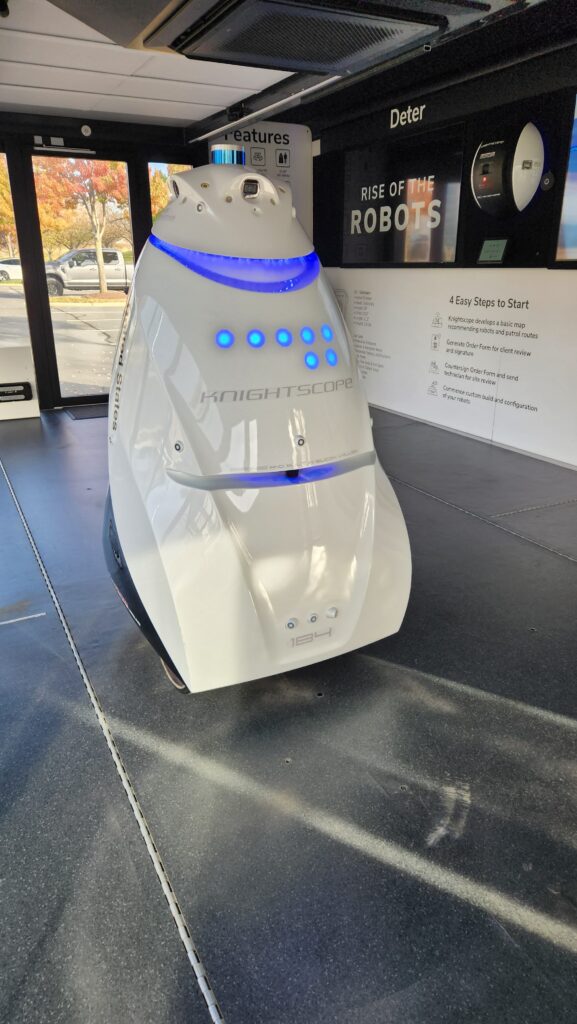
Knightscope public safety robots

Stephens steps into the K5’s path as he speaks. The robot pauses, then changes its path to move around him. When he places a hand on it, it stops immediately—as it does when he slams a hand on its shiny, plastic shell.

Verizon said in a release that the collaboration with Knightscope to connect its public safety robots “marks a significant advancement in autonomous security technology.”

“Verizon is committed to enhancing public safety by providing seamless and secure connectivity to the latest in autonomous security technology,” said Tom Long, an associate director for Verizon’s federal business, in a statement. “Our partnership with Knightscope is a testament to the importance of secure, reliable connectivity in helping safeguard public spaces, and we look forward to further elevating these capabilities through 5G integration.”

The public safety robot is designed to patrol large outdoor spaces, from hospital and college campuses to lots and property perimeters. Knightscope holds a Federal Risk and Authorization Management Program (FedRAMP) Moderate Authority to Operate (ATO) designation from the U.S. Department of Veterans Affairs, and Verizon said that the K5’s ability to patrol outdoor spaces even in extreme weather make it “well-suited for securing government facilities.”

Currently, the public safety robots are equipped with 4G connectivity, but Verizon said that there are plans to integrate 5G “in the near future.” Knightscope also has at least one new form factor in the works, with the displays showing images of a smaller, more smoothly-moving K7 prototype that looks like a robotic vehicle, with four large wheels. It is aimed at patrolling more rugged terrain such as airport or prison perimeters, or international borders.

Verizon added that its partnership with Knightscope is the latest milestone in the its push to to serve as the go-to technology partner for the U.S. Department of Veterans Affairs. The telco won part of a nearly $450 million nine-year expansion

“With Verizon’s connectivity, Knightscope’s autonomous security robots are transforming safety and security for organizations like the VA,” said Knightscope CEO William Santana Li. “Additionally, Verizon is enabling Knightscope to provide one-touch access to services such as police, fire, and EMS at hospitals, universities, and corporate campuses in times of danger, personal crisis, or medical emergencies.”

Verizon’s partnership with Knightscope is the latest milestone in the company’s efforts to serve as the go-to technology partner for the U.S. Department of Veterans Affairs. Last year, Verizon was awarded part of a $448.3 million, nine-year expansion contract with VA medical centers and health care facilities to supply mobile devices and mission-critical emergency communications through Verizon Frontline.

“Verizon has a long-standing partnership with the U.S. Department of Veterans Affairs, including connecting the first fully 5G-connected hospital at the VA facility in Palo Alto and the VA Video Connect telehealth service, which provides over 80,000 veterans with free, unlimited access to health care consultations,” said Maggie Hallbach, SVP Public Sector at Verizon, said at the time.


You Might Also Like
  • Ericsson says telco-grade AI RAN must deliver measurable gains at scale
  • Deutsche Telekom and T-Mobile poach from AWS, GE Vernova – as AI talent loop widens
  • India weighs rip-and-replace of legacy Chinese telecoms equipment
  • VodafoneThree intros tiered 5G SA slicing portfolio for consumers, enterprises, critical services
  • Indosat, Nvidia launch AI center as telco expands AI infra
  • Telstra targets AI-driven growth with 5G, digital infrastructure push
Share 0 LinkedinEmail
Kelly Hill

Kelly Hill reports on network test and measurement, AI infrastructure and regulatory issues, including spectrum, for RCR Wireless News. She began covering the wireless industry in 2005, focusing on carriers and MVNOs, then took a few years’ hiatus and returned to RCR Wireless News to write about heterogeneous networks (remember those?) and network infrastructure. Kelly is an Ohio native with a masters degree in journalism from the University of California, Berkeley, where she focused on science writing and multimedia. She has written for the San Francisco Chronicle, The Oregonian and The Canton Repository. She lives in northern Virginia, not far from Data Center Alley.

previous post
RealWear buys Almer in bid to ‘reshape the industrial AR market’
next post
Is OTFS the best waveform for 6G?

White Papers

  • Norton eBook: The 2026 Telco Playbook

  • Enea White Paper: Why Intelligent AAA is the Swiss Army Knife of Telecom

  • CSG White Paper: Telco AI Enabler: Mediation’s Defining Role

  • Enea White Paper: Scalable Database Design for 5G and Beyond

  • Supermicro and NVIDIA Whitepaper: Powering sovereign AI at scale

Editorial Reports

  • Report: Building 6G — Aligning technology, policy and purpose

  • Report: Rethinking the RAN

  • Report: Building AI-Era Network Fabrics

Webinars

  • Appledore Webinar: Closing the Agent-Ready Data Gap for Autonomous Networks

  • Mimosa Webinar – Build the Right Network

  • Webinar: Building 6G — aligning technology, policy and purpose

  • SIMCom Webinar: Scaling your next deployment – from plastic to provisioning

  • Webinar: Rethinking the RAN as AI, cloud and openness converge

Since 1982, RCR Wireless News has been providing wireless and mobile industry news, insights, and analysis to mobile and wireless industry professionals, decision makers, policy makers, analysts and investors.

Facebook Twitter Youtube Linkedin Envelope Rss

Useful Links

  • Subscribe
  • About RCR Wireless News
  • Contact Us
  • Advertise
  • Editorial Calendar
  • Archive
  • RSS
  • Wireless News Archive
  • Subscribe
  • About RCR Wireless News
  • Contact Us
  • Advertise
  • Editorial Calendar
  • Archive
  • RSS
  • Wireless News Archive

Edtior's Picks

High bandwidth, high fidelity: Vertex 6.0 delivers emulation for ISAC, 6G and more
New Matter API puts the operator gateway back in the smart home (Analyst...
AT&T strikes deal with Amazon Leo – as EU operators seek D2D stake,...

Latest Articles

High bandwidth, high fidelity: Vertex 6.0 delivers emulation for ISAC, 6G and more
New Matter API puts the operator gateway back in the smart home (Analyst Angle)
AT&T strikes deal with Amazon Leo – as EU operators seek D2D stake, US opens D2D tap
Nokia says AI pushes optical networks into the scale-across era

© 2026 RCR Wireless News All Right Reserved. Developed by Eight Hats.

Cookie Policy | Privacy Policy

RCR Wireless
  • News
  • Channels
    • 5G
    • 6G
    • BSS OSS
    • Carriers
    • IoT
    • Network Infrastructure
    • Open RAN
    • Private 5G
    • Telco AI
    • Telco Cloud
    • Test & Measurement
  • Resources
    • Reports
    • Webinars
    • White papers
    • AI Fundamentals
    • Analyst Angle
    • Editorial Calendar
    • Fundamentals
      • 5G NR Release 17
      • AI
        • Telco AI in 2025
    • Podcasts
      • Let’s Get Digital with Carrie Charles
      • Wireless Connectivity to Enable Industry 4.0 for the Middleprise
      • Well Technically…
      • Will 5G Change the World
      • Accelerating Industry 4.0 Digitalization
  • AI Infrastructure
  • Programs
  • Events
  • RCRtv
  • Advertise
  • Subscribe
RCR Wireless
  • News
  • Channels
    • 5G
    • 6G
    • BSS OSS
    • Carriers
    • IoT
    • Network Infrastructure
    • Open RAN
    • Private 5G
    • Telco AI
    • Telco Cloud
    • Test & Measurement
  • Resources
    • Reports
    • Webinars
    • White papers
    • AI Fundamentals
    • Analyst Angle
    • Editorial Calendar
    • Fundamentals
      • 5G NR Release 17
      • AI
        • Telco AI in 2025
    • Podcasts
      • Let’s Get Digital with Carrie Charles
      • Wireless Connectivity to Enable Industry 4.0 for the Middleprise
      • Well Technically…
      • Will 5G Change the World
      • Accelerating Industry 4.0 Digitalization
  • AI Infrastructure
  • Programs
  • Events
  • RCRtv
  • Advertise
  • Subscribe
@2020 - All Right Reserved. Designed and Developed by PenciDesign