

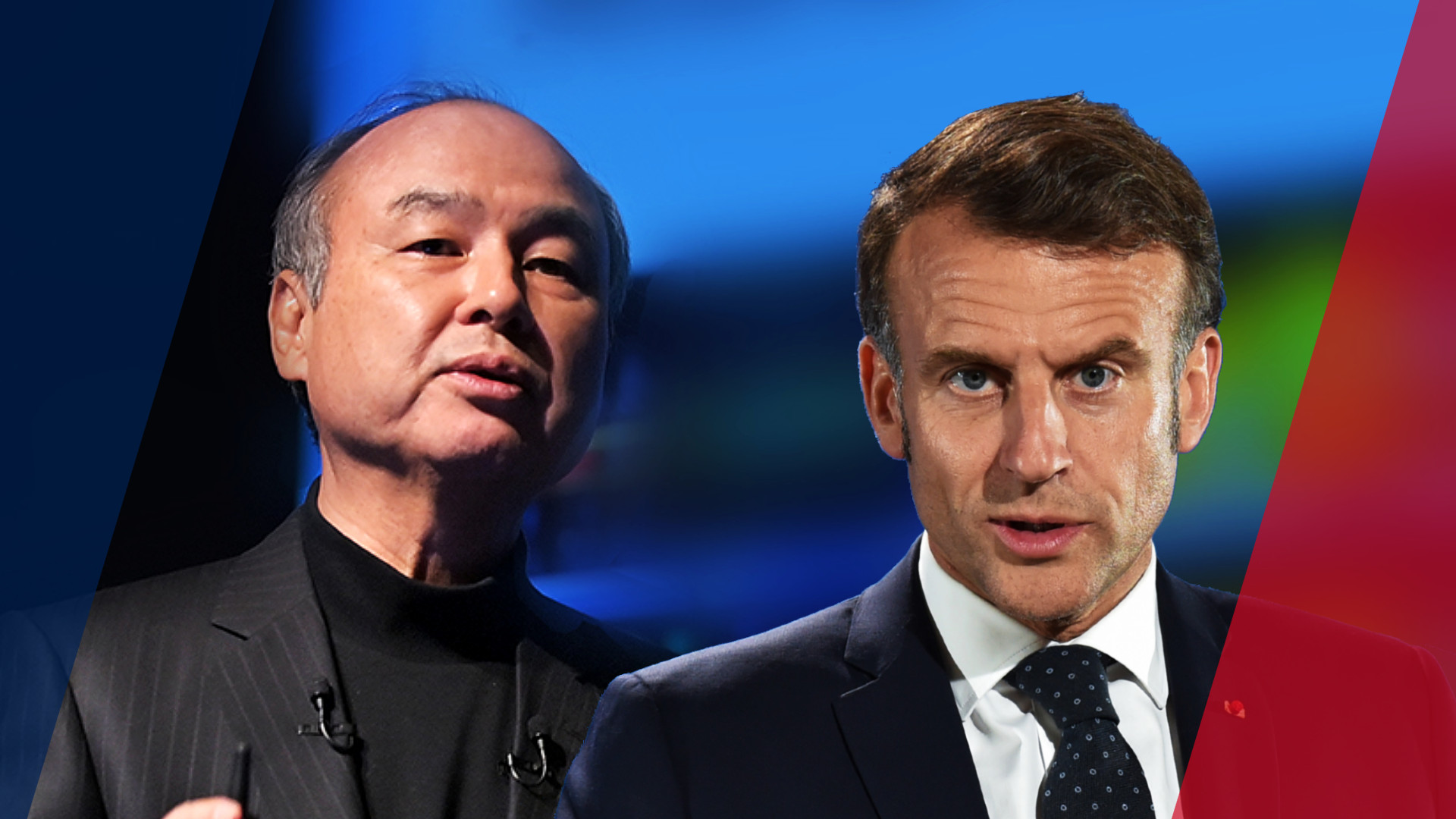
Softbank’s €75bn plan to build 5GW of AI data center capacity in France is being hailed in Paris as a breakthrough for European digital sovereignty. But the scale of foreign capital – despite the absence of US hyperscalers – raises (the same) questions about whether Europe is gaining control over AI infrastructure, or simply hosting it.
In sum – what to know:
Mega investment – Softbank will invest up to €75bn to build 5GW of AI data center capacity in France. It is the largest single foreign investment at the Choose France summit, and Softbank’s largest AI investment in Europe.
EU sovereignty – The project is being framed by Paris as a win for EU digital sovereignty, but its biggest sovereign achievement is to leverage France’s nuclear-powered grid and industrial land to attract AI infrastructure.
Foreign money – Despite the sovereignty narrative, the investment is led by Japan’s Softbank, and will involve its US-headquartered SB Energy unit, highlighting Europe’s reliance on external capital and global AI ecosystems.
The announcement that Softbank is invest up to €75 billion to build AI data center capacity in France is being framed in Paris as a landmark moment for Europe’s AI ambitions, and for France’s in particular, and a concrete expression also of the EU’s push for digital sovereignty, covered at length in these pages recently. And at face value, it appears to align quite neatly with that agenda: large-scale compute infrastructure anchored on European soil, powered by France’s nuclear electricity, integrated into an industrial cluster model that links energy, manufacturing, and AI grunt.
But the sovereignty question is more complex. The investment is led by Japan’s Softbank, and not by a US hyperscaler (Microsoft, Google, or Amazon), nor by a US model builder (Anothropic, OpenAI, Google, Meta) – an absence that may itself be significant given the geopolitical sensitivity around US dominance in cloud and AI infrastructure. Instead, Europe is attracting capital from a non-European, non-US actor that is deeply embedded in global AI financing and partnerships, mostly notably with OpenAI.
Which raises the (same old) question: is this a step toward European control over its AI future, or a strategic relocation of infrastructure built and financed by external players? The deal suggests a form of sovereignty just through location – where Europe hosts, manages, and regulates the physical infrastructure, even while ownership, financing, and platform ecosystems are globally distributed. The question doing the rounds right now – with lots of these hybrid mix-and-match setups, all paying lip service to sovereignty – is whether Europe is building genuine autonomy, or not.
The framing from the French government is right on, entirely consistent with broader EU strategy – to attract hyperscale AI infrastructure via ready subsidies and quicker permits, anchor data centers in countries with strong low-carbon baseload power (like nuclear in France, via EDF), and build industrial “clusters” that tie together energy, manufacturing, and compute. But it is more like a sovereign hosting strategy rather than sovereign ownership of the AI stack, and this looks like a (very fair) attempt by France to be AI-infrastructure landlord in Europe.
To the country’s credit, its real sovereignty lever is energy, rather than data or systems, or straight tech-tech. The country’s old industrial sites, probably former power stations and industrial land, well placed (in the country’s northernmost region) to get across European sea and land borders, are being repurposed Bouchain, say, is an EDF-linked industrial energy site, and EDF is France’s main nuclear operator. The government, with the government owned energy sector, is tying the project to the country’s low-carbon, nuclear-heavy electricity system.
Anyway, here’s a straighter news report. Lots in here to chew over.
…
Softbank Group is to invest €75 billion to build and manage 5 GW of AI data center capacity in France, starting with a €45 billion tranche to deliver 3.1 GW of capacity across three new data centers in the Hauts-de-France region in northern France, which borders Belgium and the English Channel. It is the single largest investment announced today (June 1) at the 2026 Choose France summit, the annual business forum hosted by French President Emmanuel Macron at the Palace of Versailles. The summit has drawn €93 billion of foreign investment in total.
As such, the initial Softbank investment represents almost half of the total – and the rest is shared between 71 different projects, marking a record year for foreign investment into the country, according to Macron. The projects will create 15,600 jobs, he suggested – at a time when the unemployment rate in France is eight percent, a couple of points higher than the EU average. Macron is looking to leverage the country’s nuclear capacity to make it a global AI leader, using also the EU sovereignty drive to corral European industrial activity in the country.
The investment could rise to €75 billion, with new sites “across France”, according to a press note, issued at the weekend (May 30), prior to Macron’s summit. Either way, the sums would make it the Japanese group’s largest AI infrastructure investment in Europe. The confirmed build-out, of 3.1 GW of capacity in Hauts-de-France, will be at sites in Dunkirk, Bosquel, and Bouchain. They are scheduled to be completed in 2031.
Softbank has a deal with Schneider Electric to use its energy technology solutions in the sites, and also, interestingly, to develop a large-scale industrial data-center production “cluster” at the Port of Dunkirk. These will include two facilities, it said: one operated by Softbank to manufacture enclosures, and one operated by Schneider Electric to integrate data center power modules. The cluster effect will be to “combine Softbank Group’s robotics and automation capabilities with Schneider Electric’s industrial expertise and local supply chain network”.
The Softbank factory in Dunkirk will be a “robotized plant”, said the French government in a press statement. Softbank said: “By pairing AI infrastructure with advanced manufacturing, SoftBank Group and Schneider Electric aim to build a stronger, more localized and more resilient supply chain for data center infrastructure in France and Europe. The industrial cluster will also support Dunkirk’s ambition to become a leading hub for robotics, advanced manufacturing and industrial innovation.”
US-based AI energy infrastructure provider SB Energy, carved out of a Softbank-founded domestic renewable energy business of the same name (since sold to Toyota Tsusho) is a “strategic partner”, also. Softbank still owns SB Energy, which has been working as a partner for major US tech and AI companies, and has brought in heavy-hitting co-investors including Ares Management in 2022 (up to $600 million) and OpenAI in 2026 ($500 million). SB Energy is leading the infrastructure buildout for OpenAI’s 1.2 GW Stargate initiative in Milam County, in Texas.
Softbank is also leading the financing of the $500 billion Stargate project. SB Energy is also engaged in a new public-private data center partnership, announced in March by Softbank, the US Departments of Energy (DOE) and Commerce at a 3,700-acre former uranium enrichment complex in Piketon, Ohio – worth up to $30-$40 billion. has so far invested over $30 billion in OpenAI, taking an 11 percent stake in the ChatGPT developer; it has agreed to invest a further $30 billion in the company over the course of 2026.
Reuters quoted Masayoshi Son, chief executive at Softbank: “We have the model, we have the momentum, and we can make France the center of Europe (for AI). And Europe needs this kind of AI technology… The US is going fast. China is going fast. Europe, Japan, Asia have to also go fast, not to be left out.”
He said in a press note: “AI is entering a new era, and the countries that build the infrastructure for this transformation will shape the future of technology, industry and society. SoftBank is proud to make this major commitment to France. With its industrial capabilities, talent base and national ambition, France is uniquely positioned to become a leading AI infrastructure hub in Europe.”
French state-owned energy company EDF talked about the data center site at Bouchain. Bernard Fontana, chairman and chief executive at EDF, said: “The project selected for the Bouchain site demonstrates France’s ability to host large-scale digital infrastructure, supported by competitive, sovereign and low-carbon electricity. It reflects EDF’s commitment to selecting projects that combine industrial excellence, high environmental standards and long-term value creation for local communities, while giving a new purpose to its former industrial sites.”
Roland Lescure, minister of the economy, said: “Softbank’s decision to invest massively in AI data centers in France – a first for the group in Europe – is testament to President Emmanuel Macron’s ambition to position France as a leading destination all along the AI value chain. It reflects our country’s substantial assets: fast access to the most reliable electrical grid in Europe, a strong digital and industrial ecosystem with a skilled workforce, and a government that works in unison with local authorities and stakeholders to fast track procedures for strategic projects.”

