

RCR Wireless
  • News
  • Channels
    • 5G
    • 6G
    • BSS OSS
    • Carriers
    • IoT
    • Network Infrastructure
    • Open RAN
    • Private 5G
    • Telco AI
    • Telco Cloud
    • Test & Measurement
  • Resources
    • Reports
    • Webinars
    • White papers
    • AI Fundamentals
    • Analyst Angle
    • Editorial Calendar
    • Fundamentals
      • 5G NR Release 17
      • AI
        • Telco AI in 2025
    • Podcasts
      • Let’s Get Digital with Carrie Charles
      • Wireless Connectivity to Enable Industry 4.0 for the Middleprise
      • Well Technically…
      • Will 5G Change the World
      • Accelerating Industry 4.0 Digitalization
  • AI Infrastructure
  • Programs
  • Events
  • RCRtv
  • Advertise
  • Subscribe
Tuesday, August 18, 2026
RCR Wireless
  • News
  • Channels
    • 5G
    • 6G
    • BSS OSS
    • Carriers
    • IoT
    • Network Infrastructure
    • Open RAN
    • Private 5G
    • Telco AI
    • Telco Cloud
    • Test & Measurement
  • Resources
    • Reports
    • Webinars
    • White papers
    • AI Fundamentals
    • Analyst Angle
    • Editorial Calendar
    • Fundamentals
      • 5G NR Release 17
      • AI
        • Telco AI in 2025
    • Podcasts
      • Let’s Get Digital with Carrie Charles
      • Wireless Connectivity to Enable Industry 4.0 for the Middleprise
      • Well Technically…
      • Will 5G Change the World
      • Accelerating Industry 4.0 Digitalization
  • AI Infrastructure
  • Programs
  • Events
  • RCRtv
  • Advertise
  • Subscribe
Add RCR Wireless as a preferred source on Google
  • Qualcomm 6G Insights
  • Huawei Content Hub
  • Qualcomm – 6G Vision
  • OSS/BSS Channel
  • RCRTech Roundtable: AI Infrastructure
RCR Wireless
RCR Wireless
  • Advanced Mimo
  • Mobile mmWave
  • 5G Positioning
  • Green Networks
  • Metaverse
  • Automotive
  • Industrial and Wide-area IoT
Copyright 2021 - All Right Reserved
Home - The IIoT interview (pt1): “It’s a two-speed market; the US doesn’t get it,” says Hitachi
Data AnalyticsInternet of Things (IoT)News & Event CoveragePolicySmart CitiesSmart Factory

The IIoT interview (pt1): “It’s a two-speed market; the US doesn’t get it,” says Hitachi

by James Blackman May 24, 2018
written by James Blackman May 24, 2018 Share
LinkedinEmail
Share 0LinkedinEmail
167

The industrial ‘internet of things’ (IoT) market is geographically skewed, reckons one of its leading protagonists. Greg Kinsey, vice president of Japan-based Hitachi’s Vantara business, says the US is way behind, fixated on sensors in factories, while European countries rewrite the industrial rule-book with open technologies and collaborative working.

“We are witnessing a two-speed market,” explains Greg Kinsey, vice president at Hitachi Vantara, in an extensive interview with Enterprise IoT Insights, which will be published over several instalments. “The EU is about the digitisation of manufacturing operations and processes; the US is very focused on IoT.”

There are important differences, he notes. “The US is engaged in this conversation around IT stacks, which is very different to what we are talking about in Europe. Here, in Europe, the dialogue is about open-source collaboration and innovation.”

The differences are fundamental, he says. “The Americans just think digital is a new name for IT. And it’s not; it’s completely different. Europe understands that, and particularly France and Germany, and Sweden and Switzerland – where the really strong use cases are materialising.”

He adds: “I don’t see digital as a boardroom topic among American manufacturers to the same extent I see it in Europe. In Europe digital has been made a key strategic objective for every major executive. For CEOs in Europe, it is the most important thing they’re doing right now.”
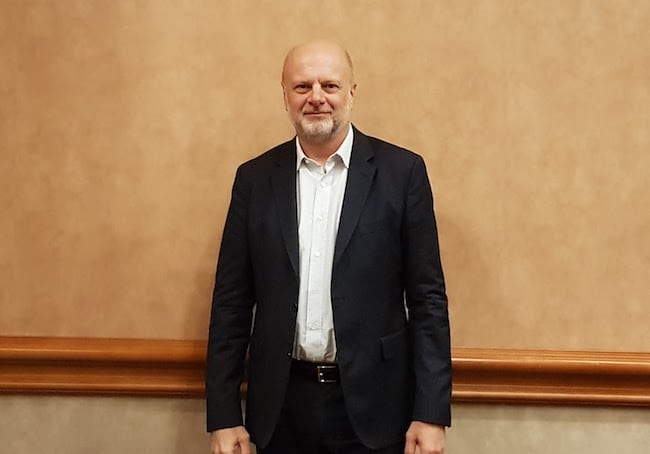
greg kinsey

Greg Kinsey – the US is focused on IoT sensors; Europe is untangling a new way of working

Kinsey, an American in Paris, cites PwC research, that around 60 per cent of French corporations have appointed a chief digital officer; just 20 per cent of US firms have done the same, he says. “There is a deeper understanding of the difference between digital and IoT.”

The IoT messaging from technology firms does not resonate (“at all”) among the top 500 companies in Europe, says Kinsey. It doesn’t work in Hitachi’s home country, either. “Japan is more closely aligned with EU innovation.”

What about the UK, in search of a new industrial identity with its European divorce in process? “Yes, well, the UK sits, as it often does, somewhere between the EU and US; a kind of half-way orientation between the European and American models.”

The digital agenda has not just been raised up to boardroom level in Europe; it sits as a permanent fixture on government desks, a part of the political discussion about economic transformation. Kinsey points to Germany’s Industrie 4.0 movement, which makes industrial transformation a central part of the German government’s economic policy, and France’s parallel Alliance du Futur scheme.

French President Emmanuel Macron’s has pursued close alignment with the tech sector, as well, drawing it close with both fierce backing and gentle hectoring. He has just hosted certain members of the so-called ‘GAFA’-set – describing the US tech elite; nominally Google, Apple, Facebook and Amazon – to hammer out issues of data privacy and corporate tax.

His smartly presented €1.5 billion ($1.8bn) package on artificial intelligence (AI) at the end of March appears to have kicked the global political elite into action, or the European contingent at least.

The European Commission (EC) said in April it wants €20 billion ($23.9bn) of new innovation funds from governments and private enterprises to supplement its Horizon 2020 programme and stimulate the AI industry within the EU. The Brexit-bound UK announced a £1 billion ($1.4bn) joint investment shortly after to stimulate its own AI industry.

Meanwhile, an exploratory White House summit on AI earlier this month, which follows a general unravelling of former President Barack Obama’s early state guidance on AI, is yet to produce any clear policy or investment promises on tech-harnessed industrial strategy in the US. “There is such a high degree of government sponsorship of digital in Europe, which we don’t see at all in the US, where we don’t see any government sponsorship of digital at all,” says KInsey.

He goes on: “Automation and the connection of assets – that story has gone. The story in Europe is about what to do with the data – about the analytics and machine learning, and the business value from it. That’s the basis of the projects we’re doing in Europe and Japan.”

For Kinsey, Europe is able to innovate more freely in industrial settings precisely because it is culturally removed from the major ‘over-the-top’ (OTT) internet brands in the consumer market. “The US is very, very advanced in consumer digital – and all things related to GAFA, and advertising and selling things online. In Europe, we don’t have that, and the helps focus the mind-set, and think more clearly about industrial strategy.”

The US economic footprint is deeply divided as the digital elite congregate around a few high-tech clusters, notably in Silicon Valley, Seattle, Boston, and Austin, while old industrial ‘rust belt’ states like Ohio, Pennsylvania, and West Virginia fall behind.

“The culture is different; the politics are different – you see red states and blue states. The level of innovation is different, the education is different, even the way the money flows is different,” explains Kinsey.

“You know, there’s not a lot of venture-capital money chasing rust-belt innovations. Contrast that to what’s happening in Europe – in Paris, or Stuttgart, or Turin – where mechanical engineering and software are coming together, and money is being invested in tech specifically for manufacturing.”

“There’s not this cultural divide between high tech and low tech. In Europe, it’s all just industry – and it blends together the digital with the physical.”

This is an excerpt from a wide-ranging interview with Hitachi Vantara vice president Greg Kinsey. For more from the interview, check out the links below.

The IIoT interview (pt2): “Three is the magic number for digital ROI,” says Hitachi

The IIoT interview (pt3) “We’re selling innovations, not solutions,” says Hitachi

Drugs, steel and tyres: Three ‘predictive quality’ use cases from Hitachi

Planes, computers and books: Three ‘dynamic scheduling’ use cases from Hitachi

Motor cars and gas turbines: Two ‘predictive downtime’ use cases from Hitachi


You Might Also Like
  • Physical AI is exposing a data sovereignty gap (Reader Forum)
  • Japan’s private 5G market is finally moving beyond demo experiments (Analyst Angle)
  • Monday (telco diary) | Sovereign AI for Industry 4.0
  • When the push becomes the pull – private 5G and physical AI
  • Subsea shift – ITU and FCC redraw rules for global cable resilience
  • Fast-growing private 5G offers blueprint for AI-era telecoms

Table of Contents

  • This is an excerpt from a wide-ranging interview with Hitachi Vantara vice president Greg Kinsey. For more from the interview, check out the links below.
  • The IIoT interview (pt2): “Three is the magic number for digital ROI,” says Hitachi
  • The IIoT interview (pt3) “We’re selling innovations, not solutions,” says Hitachi
  • Drugs, steel and tyres: Three ‘predictive quality’ use cases from Hitachi
  • Planes, computers and books: Three ‘dynamic scheduling’ use cases from Hitachi
  • Motor cars and gas turbines: Two ‘predictive downtime’ use cases from Hitachi
Share 0 LinkedinEmail
James Blackman
James Blackman

James Blackman has been writing about the technology and telecoms sectors for over a decade. He has edited and contributed to a number of European news outlets and trade titles. He has also worked at telecoms company Huawei, leading media activity for its devices business in Western Europe. He is based in London.

previous post
Understanding in-building technology buyers: An interview with SQUAN, Cheytec
next post
DAS for hotels: Three case studies

White Papers

  • Norton eBook: The 2026 Telco Playbook

  • Enea White Paper: Why Intelligent AAA is the Swiss Army Knife of Telecom

  • CSG White Paper: Telco AI Enabler: Mediation’s Defining Role

  • Enea White Paper: Scalable Database Design for 5G and Beyond

  • Supermicro and NVIDIA Whitepaper: Powering sovereign AI at scale

Editorial Reports

  • Report: NTN in motion — evolving standards, expanding services

  • Market Pulse Report: Telco AI in 2026 – Trends, Challenges and Opportunities

  • Nvidia Report: The State of AI in Telecommunications: 2026 Trends

Webinars

  • Webinar: Building 6G — aligning technology, policy and purpose

  • SIMCom Webinar: Scaling your next deployment – from plastic to provisioning

  • Webinar: Rethinking the RAN as AI, cloud and openness converge

  • Webinar: Scale-Up, Scale-Out, Scale-Across – Building AI-Era Network Fabrics

  • Webinar: NTN in motion – evolving standards, expanding services

Since 1982, RCR Wireless News has been providing wireless and mobile industry news, insights, and analysis to mobile and wireless industry professionals, decision makers, policy makers, analysts and investors.

Facebook Twitter Youtube Linkedin Envelope Rss

Useful Links

  • Subscribe
  • About RCR Wireless News
  • Contact Us
  • Advertise
  • Editorial Calendar
  • Archive
  • RSS
  • Wireless News Archive
  • Subscribe
  • About RCR Wireless News
  • Contact Us
  • Advertise
  • Editorial Calendar
  • Archive
  • RSS
  • Wireless News Archive

Edtior's Picks

The bulk-managed Wi-Fi threat didn’t die – it fragmented (Analyst Angle)
Indosat, Nvidia launch AI center as telco expands AI infra
Lockheed’s NetSense turns Verizon’s 5G network into a drone-tracking system

Latest Articles

The bulk-managed Wi-Fi threat didn’t die – it fragmented (Analyst Angle)
Indosat, Nvidia launch AI center as telco expands AI infra
Lockheed’s NetSense turns Verizon’s 5G network into a drone-tracking system
Criss-cross comms – Lumen bets on east-west AI, while the edge keeps north-south in play

© 2026 RCR Wireless News All Right Reserved. Developed by Eight Hats.

Cookie Policy | Privacy Policy

RCR Wireless
  • News
  • Channels
    • 5G
    • 6G
    • BSS OSS
    • Carriers
    • IoT
    • Network Infrastructure
    • Open RAN
    • Private 5G
    • Telco AI
    • Telco Cloud
    • Test & Measurement
  • Resources
    • Reports
    • Webinars
    • White papers
    • AI Fundamentals
    • Analyst Angle
    • Editorial Calendar
    • Fundamentals
      • 5G NR Release 17
      • AI
        • Telco AI in 2025
    • Podcasts
      • Let’s Get Digital with Carrie Charles
      • Wireless Connectivity to Enable Industry 4.0 for the Middleprise
      • Well Technically…
      • Will 5G Change the World
      • Accelerating Industry 4.0 Digitalization
  • AI Infrastructure
  • Programs
  • Events
  • RCRtv
  • Advertise
  • Subscribe
RCR Wireless
  • News
  • Channels
    • 5G
    • 6G
    • BSS OSS
    • Carriers
    • IoT
    • Network Infrastructure
    • Open RAN
    • Private 5G
    • Telco AI
    • Telco Cloud
    • Test & Measurement
  • Resources
    • Reports
    • Webinars
    • White papers
    • AI Fundamentals
    • Analyst Angle
    • Editorial Calendar
    • Fundamentals
      • 5G NR Release 17
      • AI
        • Telco AI in 2025
    • Podcasts
      • Let’s Get Digital with Carrie Charles
      • Wireless Connectivity to Enable Industry 4.0 for the Middleprise
      • Well Technically…
      • Will 5G Change the World
      • Accelerating Industry 4.0 Digitalization
  • AI Infrastructure
  • Programs
  • Events
  • RCRtv
  • Advertise
  • Subscribe
@2020 - All Right Reserved. Designed and Developed by PenciDesign
