

Kyocera lays out reasons why ruggedized devices can actually be less expensive to use for enterprise mobility needs
Businesses have relied upon field force mobility devices to increase productivity and on-the-job communication for more than 20 years. In particular, purpose-built ruggedized handheld, tablet and laptop solutions have allowed information to be entered and utilized at the point of data capture, resulting in the ability to communicate on the job, collaborate with colleagues and document projects. Technology and engineering have advanced, mobile operating systems have evolved and user interfaces have vastly improved. However, the traditionally steep price of these hardened devices – typically $1,000 to $2,000 each – has remained the same. Until now.
Historically, these rugged devices have only been offered to businesses and enterprises by specialized manufacturers like Motorola Solutions, Intermec and Honeywell. Today, migration of enterprise-grade ruggedization into mass-market, carrier-subsidized mobile devices is changing the game for business managers, allowing them to equip their field force mobility teams with devices designed to withstand virtually any environment, any job and nearly any application at a fraction of the cost.
The mobility equation
These days, mobile productivity is no longer a luxury; it is an essential element of a productive workforce. As employees are increasingly expected to work from anywhere with unconstrained access to information and communication, adoption of mobile devices in the workplace has become ubiquitous. This has increased efficiency and productivity while reducing costs and improving bottom lines. Some estimates predicted that in 2015 almost 500 million mobile devices were in use by enterprise mobile workers, so a business’ decision about what type of device to deploy – rugged or consumer-grade – has never been more important or timely.
For industries that rely on teams in the field, such as construction, health care, logistics and manufacturing, there is a need to consider several variables in a purchase decision, including environment, application and price. Workers in these industries spend their days in demanding, noisy and often dirty environments where not all mobile devices will be up to the task, and some may have a high risk for jobsite failures that directly impact productivity.
Rugged mobile devices – those that can withstand the elements and physical abuse while providing straightforward workability that does not hinder the task at hand – address these needs and demands. However, until recently, specialized, enterprise-focused rugged devices have been available only from niche-focused manufacturers at a very steep cost, with many configured to address only one solution or industry and not a breadth of needs.
More recently, many businesses have tried to avoid these steep investments by turning to wireless service providers for subsidized, consumer-grade mobile devices – also known as commercial off-the-shelf – for critical line-of-business applications. An iPhone costing $750, for example, seems more appealing (even after adding a costly case) than a true rugged smartphone for $2,000. Unfortunately, research is clearly showing that this mindset comes at a steep price when it comes to total cost of ownership for mobile solutions despite the upfront cost savings.
Although the consumer devices are not rugged or shock-, drop-, water- or element-proof, the devices are dramatically cheaper, even when paired with an external rugged case from brands like OtterBox or LifeProof. The logic is simple: At less than half the cost of the traditional rugged device, a company could replace the consumer device every year and still come out ahead. Consumer devices also have the draw of being functional and user interface-friendly as well as being conveniently available at retailers. Many IT decision makers are drawn to COTS device solutions by the upfront financial gain that carrier-subsidized devices provide.
However, looking beyond the initial purchase, the use of consumer devices in demanding work settings leads to myriad functional issues and quickly erodes the presumed cost savings. Traditional consumer-grade mobile devices – those not designed for enterprise use – introduce unforeseen complexities and hidden costs such as:
• Lack of bandwidth to accommodate increasing SKU and inventory management needs.
• Increased incidence of breakage, leading to downtime and productivity loss along with higher need for IT support.
• More frequent replacement costs.
• Rapid device and technology obsolescence.
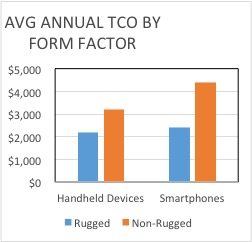
According to a study by VDC Research, TCO for rugged devices in business settings – which includes not only the initial investment but also subsequent costs associated with failures and breakage – is significantly lower in comparison to nonrugged devices. According to the study, “many [nonrugged] devices are not designed for use in many line-of-business environments, and hardware failure is a major issue. It is not uncommon for enterprises to report failure rates in excess of 50%.”
According to VDC’s data, annual TCO for nonrugged devices – approximately $4,000 – is actually almost double that of rugged devices, which are approximately $2,000. This makes the use of consumer-grade devices a financial liability over time.
Carrier-subsidized phones enable lower TCO
Especially in demanding work settings, the success of a mobility strategy is contingent upon businesses and enterprises choosing devices that are functional, durable and powerful with capabilities and features that truly fit their needs. While cost is important, it becomes irrelevant if the devices don’t include specialized features like:
• Rugged, waterproof designs meeting ingress protection and Military Standard 810G certifications for hazards such as dust, shock, vibration, temperature extremes, blowing rain, high altitude, solar radiation, salt fog, humidity and full immersion in water.
• Not just “survivability,” but continuous productivity in all environments with features like glove and wet touchscreen operation, which allows workers to use the touchscreen when it’s wet or while wearing gloves.
• Support for preloaded and over-the-top push-to-talk solutions for one-to-one and one-to-many communications over cellular networks, a technology evolving rapidly and poised to replace many existing land mobile radio deployments in many settings.
• FIPS 140-2 compliance for secure device encryption, providing data leakage prevention and protection.
• Occupational Safety and Health Administration certification for hazardous locations – for example a rating of “nonincendive, class I, division 2, group A-D, T4” is certified safe for use in work environments where concentrations of flammable gases, vapors or mists are not normally present in explosive concentrations, but may exist.
• Hardened, impact-resistant and scratch-resistant touchscreen displays made from materials like specially engineered glass or even pure sapphire.
• Large batteries with added power-management and power-saving controls.
• Advanced security and enterprise mobile device management support along with highly configurable VPN capabilities with extensive authentication protocol and VPNC-compliant solutions support to protect corporate data.
Drive business value with rugged smartphones
For many years, businesses wanting to adopt a mobility strategy were forced to choose between the lesser of two evils: niche rugged devices costing thousands of dollars each or more affordable consumer-tier devices simply not built to meet those businesses’ durability and technology demands.
For the first time, businesses with field forces have affordable options for equipping their employees with productivity- and efficiency-driving devices that are designed to function in even the most demanding environments, adding value to both the top and bottom lines and changing the game forever.
Editor’s Note: In an attempt to broaden our interaction with our readers we have created this Reader Forum for those with something meaningful to say to the wireless industry. We want to keep this as open as possible, but we maintain some editorial control to keep it free of commercials or attacks. Please send along submissions for this section to our editors at: [email protected].
Table of Contents

