
RCR Wireless
  • News
  • Channels
    • 5G
    • 6G
    • BSS OSS
    • Carriers
    • IoT
    • Network Infrastructure
    • Open RAN
    • Private 5G
    • Telco AI
    • Telco Cloud
    • Test & Measurement
  • Resources
    • Reports
    • Webinars
    • White papers
    • AI Fundamentals
    • Analyst Angle
    • Editorial Calendar
    • Fundamentals
      • 5G NR Release 17
      • AI
        • Telco AI in 2025
    • Podcasts
      • Let’s Get Digital with Carrie Charles
      • Wireless Connectivity to Enable Industry 4.0 for the Middleprise
      • Well Technically…
      • Will 5G Change the World
      • Accelerating Industry 4.0 Digitalization
  • AI Infrastructure
  • Programs
  • Events
  • RCRtv
  • Advertise
  • Subscribe
Thursday, August 20, 2026
RCR Wireless
  • News
  • Channels
    • 5G
    • 6G
    • BSS OSS
    • Carriers
    • IoT
    • Network Infrastructure
    • Open RAN
    • Private 5G
    • Telco AI
    • Telco Cloud
    • Test & Measurement
  • Resources
    • Reports
    • Webinars
    • White papers
    • AI Fundamentals
    • Analyst Angle
    • Editorial Calendar
    • Fundamentals
      • 5G NR Release 17
      • AI
        • Telco AI in 2025
    • Podcasts
      • Let’s Get Digital with Carrie Charles
      • Wireless Connectivity to Enable Industry 4.0 for the Middleprise
      • Well Technically…
      • Will 5G Change the World
      • Accelerating Industry 4.0 Digitalization
  • AI Infrastructure
  • Programs
  • Events
  • RCRtv
  • Advertise
  • Subscribe
Add RCR Wireless as a preferred source on Google
  • Qualcomm 6G Insights
  • Huawei Content Hub
  • Qualcomm – 6G Vision
  • OSS/BSS Channel
  • RCRTech Roundtable: AI Infrastructure
RCR Wireless
RCR Wireless
  • Advanced Mimo
  • Mobile mmWave
  • 5G Positioning
  • Green Networks
  • Metaverse
  • Automotive
  • Industrial and Wide-area IoT
Copyright 2021 - All Right Reserved
Home - As 5G scales, can an open approach open up the vendor market?
5GNetwork InfrastructureSoftware

As 5G scales, can an open approach open up the vendor market?

by Sean Kinney, Principal Analyst September 10, 2019
written by Sean Kinney, Principal Analyst September 10, 2019 Share
LinkedinEmail
Share 0LinkedinEmail
mavenir 5G
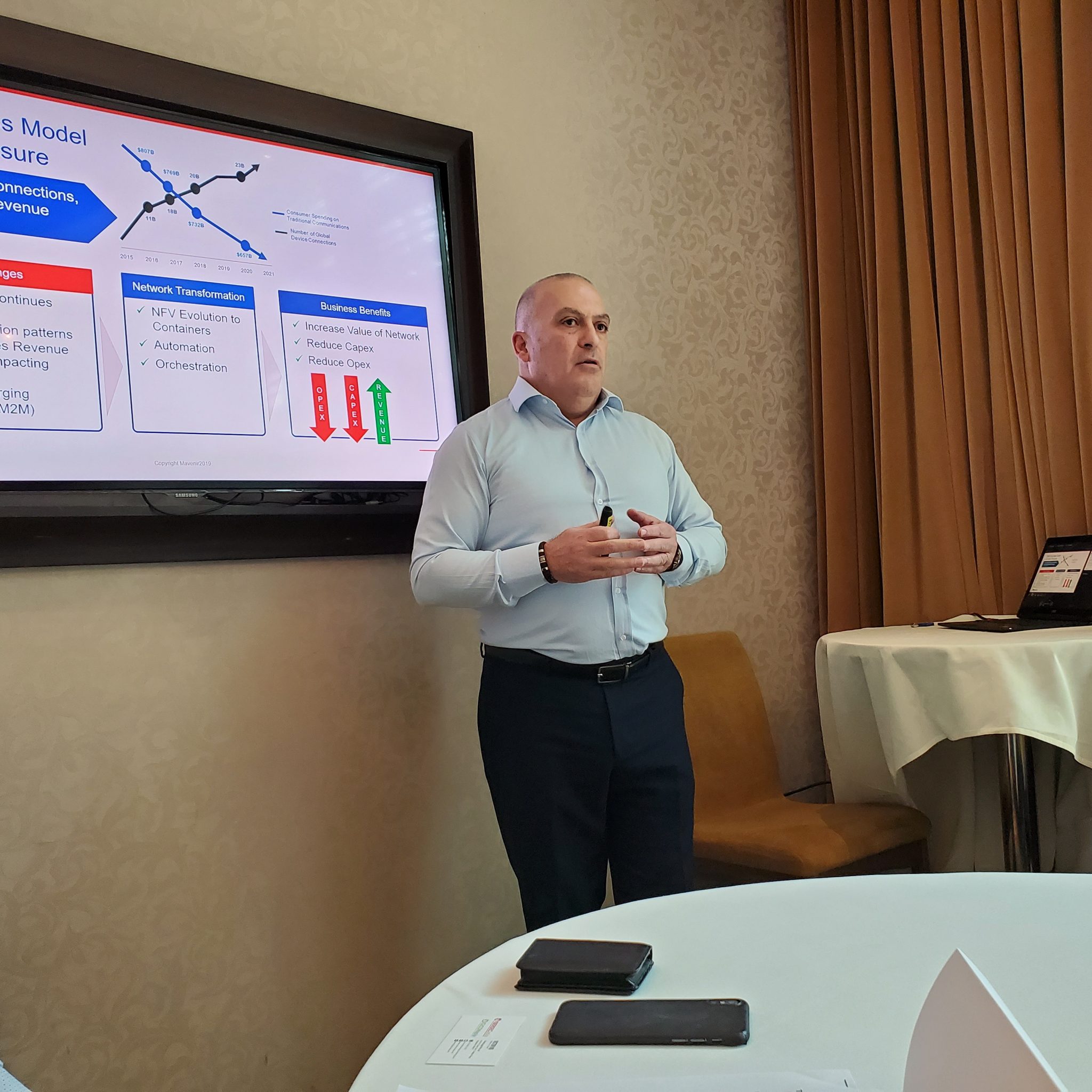
Mavenir's Sam Saba discusses the state of network economics during a meeting with press in Singapore.
210

Mavenir focused on upending network economics

SINGAPORE–Discussions of 5G are typically focused on the new applications that consumers and enterprises can use. The other side of that coin is the money operators have to spend to do that. Think of operators as manufacturers of capacity–5G makes better use of network and spectral resources thereby making it cheaper to produce bits per hertz per second. Facing a data explosion or data tsunami or whatever disaster comparison you like, 5G gives carriers the opportunity to better serve customers in a way that could help them save money while opening up new revenue streams. But getting from today to that particular tomorrow involves a number of careful considerations.

Sam Saba, Mavenir’s vice president and head of APAC, expects 5G to reach “critical mass” next year but, for operators, it’s a huge challenge to turn 5G into a positive business case. He reflected on how LTE gave over-the-top, webscale players the ability to use networks they spent no money building to make money. “We cannot continue to do the same with 5G. If we continue…repeating what we’ve done before,” it won’t work. He said the past four generations of cellular were all about connecting people whereas 5G is about connecting people and everything else.

So how do operators connect everything in a way that helps offset the billions that go into doing that? You need three things, Saba said: An infrastructure migration to NFV and cloud; adopting open radio access network solutions; and a cloud-native core network.

He called out Japan’s Rakuten, an e-commerce provider that’s poised to enter the market as a fourth MNO. “They’re effectively a fully open source, cloud-native network from core all the way to the access. They’re real pioneers in this space. They’re taking full advantage in essence of everything I talked about.” Saba said Rakuten, a Mavenir customer, is “seen as a proof point for all of this virtualization and the way we now want to change the way we’ve been building mobile networks.” And that aligns with venture-backed Mavenir’s mission–to be a “software-driven, end-to-end mobile network provider.”

Extending virtualization from the core to the RAN

According to research from GSMA Intelligence, AT&T reported Q3 2018 capex of $5.9 billion against $45.7 billion in revenue; Verizon spent $12 billion year-to-date in Q3 last year against quarterly revenue of $32.6 billion in revenue. “RAN is where all the dollars are spent,” Mavenir SVP John Baker said. And, in the U.S., those RAN dollars primarily go to two vendors–Nokia and Ericsson, he said.

Base stations today are a cabinet and radio with the necessary plumbing, he said. With a virtualized RAN, you swap out those proprietary boxes for general-purpose servers running specialized software. “We’re looking at exploiting how virtual RAN changes the cost make up of building a network.” This can amount to something in the neighborhood of 40% savings, he said. “That’s really what’s driving the network operators to focus on this. It’s all about openness in the future.”

With 5G, the big differentiator for operators will be the ability to quickly spin-up new services. But if they’re all using the exact same equipment, “It makes it very hard for the operators to compete. The operators have a lot of hard decision-making to do. If they have a problem, they give it to Nokia and Ericsson. If operators focused on forcing open interfaces, there’d be a lot more vendors in the market. Something’s got to change to ensure the future of the mobile industry.”

Jefferson Airplane or Jefferson Starship? 

“We built this city, we built this city on” ubiquitous connectivity? That’s borrowed from one of Mavenir CTO of APAC Paul Jesemann’s slides. His analogy was predicated on 5G’s built-in support for massive IoT–the latest generation of cellular can support 1 million devices per square kilometer as compared to 60,000-ish devices per square kilometer on LTE.

In many ways, smart cities are the ultimate application of 5G in that, from a macro-view, a full-on smart city would combine enhanced mobile broadband, massive IoT and low latency to turn data points into actionable insight in service of everything from transportation and environmental quality to improving municipal services and increasing access to those services. “The city of the next century,” as Jesemann put it, “will be built on ubiquitous connectivity.”

Now, for my own tortured Jefferson Airplane is to LTE as Jefferson Starship is to 5G analogy: Jefferson Airplane pioneered psychedelic rock just as LTE pioneered high-quality personal connectivity. Jefferson Starship, fronted by Grace Slick like its predecessor but without Jorma Kaukonen’s smooth, intricate guitar playing, refined that raw, psychedelic sound into the seventies and arena-rock eighties–honing what made Airplane great and bringing loads more fans (devices) into the fold. In response to a question from RCR Wireless News, Jesemann revealed that he prefers Jefferson Airplane. (For those of you still reading, totally worth it, right?)


 

You Might Also Like
  • Omdia sees RAN growth outside China despite weak global market
  • Criss-cross comms – Lumen bets on east-west AI, while the edge keeps north-south in play
  • Thursday (telco diary) | Ghosts in the machine – Wanted: more humans to build AI
  • Telstra targets AI-driven growth with 5G, digital infrastructure push
  • Lumen ready for AI traffic rush – with programmable fabric and “more fiber than anyone”
  • Rakuten confirms KDDI roaming will be reduced as own network expands
Share 0 LinkedinEmail
Sean Kinney
Sean Kinney, Principal Analyst

Sean focuses on multiple subject areas including 5G, 6G, Open RAN, hybrid cloud, edge computing, and Industry 4.0. Prior to his work at RCR, Sean studied journalism and literature at the University of Mississippi then spent six years based in Key West, Florida, working as a reporter for the Miami Herald Media Company. He currently lives in Fayetteville, Arkansas.

previous post
FCC rural broadband funding makes its way to Oregon
next post
Electro Rent White Paper: 5 Steps to Coexistence Testing for IoT Devices

White Papers

  • Norton eBook: The 2026 Telco Playbook

  • Enea White Paper: Why Intelligent AAA is the Swiss Army Knife of Telecom

  • CSG White Paper: Telco AI Enabler: Mediation’s Defining Role

  • Enea White Paper: Scalable Database Design for 5G and Beyond

  • Supermicro and NVIDIA Whitepaper: Powering sovereign AI at scale

Editorial Reports

  • Report: Building AI-Era Network Fabrics

  • Quantum Safe Networks Market Pulse Report

  • Report: NTN in motion — evolving standards, expanding services

Webinars

  • Webinar: Building 6G — aligning technology, policy and purpose

  • SIMCom Webinar: Scaling your next deployment – from plastic to provisioning

  • Webinar: Rethinking the RAN as AI, cloud and openness converge

  • Webinar: Scale-Up, Scale-Out, Scale-Across – Building AI-Era Network Fabrics

  • Webinar: NTN in motion – evolving standards, expanding services

Since 1982, RCR Wireless News has been providing wireless and mobile industry news, insights, and analysis to mobile and wireless industry professionals, decision makers, policy makers, analysts and investors.

Facebook Twitter Youtube Linkedin Envelope Rss

Useful Links

  • Subscribe
  • About RCR Wireless News
  • Contact Us
  • Advertise
  • Editorial Calendar
  • Archive
  • RSS
  • Wireless News Archive
  • Subscribe
  • About RCR Wireless News
  • Contact Us
  • Advertise
  • Editorial Calendar
  • Archive
  • RSS
  • Wireless News Archive

Edtior's Picks

KT unveils NPU LLM Station, a fully on-premise sovereign AI server
Report: Building AI-Era Network Fabrics
Quantum Safe Networks Market Pulse Report

Latest Articles

KT unveils NPU LLM Station, a fully on-premise sovereign AI server
Report: Building AI-Era Network Fabrics
Quantum Safe Networks Market Pulse Report
Telecom AI ambition far outpaces execution, HCLTech pulse survey finds

© 2026 RCR Wireless News All Right Reserved. Developed by Eight Hats.

Cookie Policy | Privacy Policy

RCR Wireless
  • News
  • Channels
    • 5G
    • 6G
    • BSS OSS
    • Carriers
    • IoT
    • Network Infrastructure
    • Open RAN
    • Private 5G
    • Telco AI
    • Telco Cloud
    • Test & Measurement
  • Resources
    • Reports
    • Webinars
    • White papers
    • AI Fundamentals
    • Analyst Angle
    • Editorial Calendar
    • Fundamentals
      • 5G NR Release 17
      • AI
        • Telco AI in 2025
    • Podcasts
      • Let’s Get Digital with Carrie Charles
      • Wireless Connectivity to Enable Industry 4.0 for the Middleprise
      • Well Technically…
      • Will 5G Change the World
      • Accelerating Industry 4.0 Digitalization
  • AI Infrastructure
  • Programs
  • Events
  • RCRtv
  • Advertise
  • Subscribe
RCR Wireless
  • News
  • Channels
    • 5G
    • 6G
    • BSS OSS
    • Carriers
    • IoT
    • Network Infrastructure
    • Open RAN
    • Private 5G
    • Telco AI
    • Telco Cloud
    • Test & Measurement
  • Resources
    • Reports
    • Webinars
    • White papers
    • AI Fundamentals
    • Analyst Angle
    • Editorial Calendar
    • Fundamentals
      • 5G NR Release 17
      • AI
        • Telco AI in 2025
    • Podcasts
      • Let’s Get Digital with Carrie Charles
      • Wireless Connectivity to Enable Industry 4.0 for the Middleprise
      • Well Technically…
      • Will 5G Change the World
      • Accelerating Industry 4.0 Digitalization
  • AI Infrastructure
  • Programs
  • Events
  • RCRtv
  • Advertise
  • Subscribe
@2020 - All Right Reserved. Designed and Developed by PenciDesign
