

RCR Wireless
  • News
  • Channels
    • 5G
    • 6G
    • BSS OSS
    • Carriers
    • IoT
    • Network Infrastructure
    • Open RAN
    • Private 5G
    • Telco AI
    • Telco Cloud
    • Test & Measurement
  • Resources
    • Reports
    • Webinars
    • White papers
    • AI Fundamentals
    • Analyst Angle
    • Editorial Calendar
    • Fundamentals
      • 5G NR Release 17
      • AI
        • Telco AI in 2025
    • Podcasts
      • Let’s Get Digital with Carrie Charles
      • Wireless Connectivity to Enable Industry 4.0 for the Middleprise
      • Well Technically…
      • Will 5G Change the World
      • Accelerating Industry 4.0 Digitalization
  • AI Infrastructure
  • Programs
  • Events
  • RCRtv
  • Advertise
  • Subscribe
Sunday, August 16, 2026
RCR Wireless
  • News
  • Channels
    • 5G
    • 6G
    • BSS OSS
    • Carriers
    • IoT
    • Network Infrastructure
    • Open RAN
    • Private 5G
    • Telco AI
    • Telco Cloud
    • Test & Measurement
  • Resources
    • Reports
    • Webinars
    • White papers
    • AI Fundamentals
    • Analyst Angle
    • Editorial Calendar
    • Fundamentals
      • 5G NR Release 17
      • AI
        • Telco AI in 2025
    • Podcasts
      • Let’s Get Digital with Carrie Charles
      • Wireless Connectivity to Enable Industry 4.0 for the Middleprise
      • Well Technically…
      • Will 5G Change the World
      • Accelerating Industry 4.0 Digitalization
  • AI Infrastructure
  • Programs
  • Events
  • RCRtv
  • Advertise
  • Subscribe
Add RCR Wireless as a preferred source on Google
  • Qualcomm 6G Insights
  • Huawei Content Hub
  • Qualcomm – 6G Vision
  • OSS/BSS Channel
  • RCRTech Roundtable: AI Infrastructure
RCR Wireless
RCR Wireless
  • Advanced Mimo
  • Mobile mmWave
  • 5G Positioning
  • Green Networks
  • Metaverse
  • Automotive
  • Industrial and Wide-area IoT
Copyright 2021 - All Right Reserved
Home - Global standard setting at 3GPP endangered with Russia’s invasion of Ukraine (Analyst Angle)
Analyst AnglePolicy

Global standard setting at 3GPP endangered with Russia’s invasion of Ukraine (Analyst Angle)

by Keith Mallinson March 14, 2022
written by Keith Mallinson March 14, 2022 Share
LinkedinEmail
Share 0LinkedinEmail
3GPP
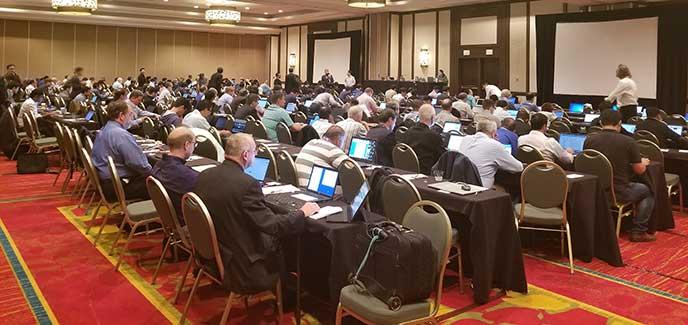
3GPP meets work on the 5G NR specification.
246

It took the industry 30 years to consolidate mobile communications developments into a single 4G standard with the introduction of LTE and the demise of WiMAX.  That attainment—also in 5G—should be cherished; but it is imperiled by geopolitical developments.

While the international response to Russia’s invasion of Ukraine and long-standing concerns about cyber threats and national security are splitting markets and disrupting supply chains for network equipment and devices geographically, use of global technical standards and their underlying intellectual property are largely continuing unabated. It is impossible to stop that if someone supplies standard-compliant product. 

Standards setting has also continued with technical contributions from firms blacklisted—as a threat to U.S. national security—from trading in products with U.S. firms. However, as war sanctions are applied with numerous firms including Ericsson and Nokia refusing to supply to Russia, those that continue to supply equipment there may find the former reluctant or unwilling to work with them in standard setting. 

Consolidation of cellular standards 

As I have written here before, the globalization of technology standards is no more evident than in mobile communications. The 1G analog standards were largely national—France, Germany, the UK and Scandinavia had different standards. While these were harmonized in Europe with 2G GSM, the US adopted several 2G standards including a couple that were based on TDMA and another that was based on CDMA technology. While two different CDMA-based standards competed for operator adoption in many nations, China also implemented another CDMA-based standard it favored called TD-SCDMA, for which there were never any takers elsewhere. 

For the time being it seems that mobile standards, including 4G and 5G are truly global. While China initially favoured LTE-TDD over LTE-FDD which was being deployed in most nations, both modes of 4G are now employed extensively all over the world.

This unity is being beneficially preserved and reinforced as 5G evolves with new 3GPP Releases including R17 due for completion in 2022 and R18 (5G-Advanced) underway since the end of 2021.

Economies of scale and scope

3GPP’s standardization of cellular including 3G, 4G LTE and 5G is the most successful example of organizational coordination on a very large and global scale that has ever occurred. It includes hundreds of companies, many thousands of individuals and millions of contributions to the standards. Enormous amounts knowledge and value flows to those who implement the standards in their manufactures.

There are great benefits from having 3GPP’s single suite of cellular standards. This fosters interoperability among different manufacturers, networks and end users. It maximises economies of scale with global manufacturing volumes and of scope with 5G servicing the widest range of applications—from virtual reality for consumers to industrial IoT.

Vendors of components and finished goods are provided a lot of support and value in their implementations of the standards. This is through the combination of published technical specifications, public patent filings, and standard-essentiality declarations. All that is being asked in return is that an adequate reward is paid in fair, reasonable and non-discriminatory (FRAND) royalties to those who develop the standard-essential technologies.

By the end of 2021, cumulative numbers of standards contributions and patent  families declared potentially essential to 2G, 3G, 4G and 5G standards were more than 1.4 million and 60,000 respectively.

Fractured supply

Cyber threats and national security concerns have justified curtailing use and supply of certain technology products and services. For example, since around 2019, various nations have banned use of Huawei’s cellular network equipment. This is being ripped out and replaced. The U.S. also bans supply of its hardware and software technologies to manufacturers it identifies on its Entity List.

Most recently, Ericsson and Nokia among numerous others are ceasing supply to Russia following its unprovoked invasion of Ukraine. 

However, when in 2019 the U.S. imposed restrictions on firms working with Huawei and other Entity List companies, the White House issued licenses to allow companies to participate in certain industry associations and standards-setting organizations. Consequently, unified global standard setting has continued in organizations such as 3GPP. Entity List companies continue to participate in 3GPP meetings, contribute to the standards and declare patents as essential to these.

Huawei remains a leading contributor, along with Ericsson, Nokia, Qualcomm and China Mobile.

The standards genie is out of the bottle

While many might like to stop certain miscreant nations and companies from implementing standards, this is not generally possible. As already indicated, standards are widely published and openly available. Absent an injunction by a national court, technical specifications and their underlying intellectual property cannot be withheld or effectively prohibited. 

Accordingly, even when implementers are under sanctions not to receive manufacturing inputs such as chip components or use of specialized manufacturing machines (e.g. for semiconductor chip lithography), obligation to pay patent licensing charges on manufactures that use the standards and their underlying intellectual property remain.

War with Ukraine is a step too far

Those who continue to support Vladimir Putin’s warring regime should be shamed and otherwise pressured into not doing so. 

While Russian companies are not significant contributors to 3GPP standards, Russia with its 144 million population is a major purchaser of cellular equipment. As Nokia and Ericsson are ceasing equipment supply to Russia, it seems Huawei has not yet decided to do so, and has not condemned the invasion of Ukraine by Russia. Two non-executive directors of Huawei UK have resigned over the firm’s stance.

If the war in Ukraine continues for months or more, those companies that continue to fulfil existing supply contracts in Russia might soon also substitute for supply from companies that have curtailed their own supply there.

3GPP is a very neutral organization. I was unsurprised to find no mention of the war in Ukraine on its web site. Nevertheless, how long will 3GPP members—who condemn Putin’s actions and are ceasing supply in Russia—be willing to collaborate in standards setting with competitors that continue supplying there? 

You Might Also Like
  • ‘We think of them as hometown ISPs’ – WISPA chief on BEAD, Starlink, CBRS
  • Wi-Fi carries over 80% of traffic; monetizing it is not a done deal (Analyst Angle)
  • Japan’s private 5G market is finally moving beyond demo experiments (Analyst Angle)
  • The 6G AI uplink panic (Analyst Angle)
  • Network agents are “ready” for commercial use, but are telcos? (Analyst Angle)
  • Monday (telco diary) | Sovereign AI for Industry 4.0

Table of Contents

  • Consolidation of cellular standards 
  • Economies of scale and scope
  • Fractured supply
  • The standards genie is out of the bottle
  • War with Ukraine is a step too far
Share 0 LinkedinEmail
Keith Mallinson

Keith Mallinson is a leading industry analyst, commercial consultant and testifying expert witness. Solving business problems in wireless and mobile communications, he founded consulting firm WiseHarbor in 2007.

previous post
The Sunday Brief: The new (yet old) AT&T
next post
Kagan: Qualcomm sees enormous metaverse growth opportunities

White Papers

  • Norton eBook: The 2026 Telco Playbook

  • Enea White Paper: Why Intelligent AAA is the Swiss Army Knife of Telecom

  • CSG White Paper: Telco AI Enabler: Mediation’s Defining Role

  • Enea White Paper: Scalable Database Design for 5G and Beyond

  • Supermicro and NVIDIA Whitepaper: Powering sovereign AI at scale

Editorial Reports

  • Report: NTN in motion — evolving standards, expanding services

  • Market Pulse Report: Telco AI in 2026 – Trends, Challenges and Opportunities

  • Nvidia Report: The State of AI in Telecommunications: 2026 Trends

Webinars

  • Webinar: Building 6G — aligning technology, policy and purpose

  • SIMCom Webinar: Scaling your next deployment – from plastic to provisioning

  • Webinar: Rethinking the RAN as AI, cloud and openness converge

  • Webinar: Scale-Up, Scale-Out, Scale-Across – Building AI-Era Network Fabrics

  • Webinar: NTN in motion – evolving standards, expanding services

Since 1982, RCR Wireless News has been providing wireless and mobile industry news, insights, and analysis to mobile and wireless industry professionals, decision makers, policy makers, analysts and investors.

Facebook Twitter Youtube Linkedin Envelope Rss

Useful Links

  • Subscribe
  • About RCR Wireless News
  • Contact Us
  • Advertise
  • Editorial Calendar
  • Archive
  • RSS
  • Wireless News Archive
  • Subscribe
  • About RCR Wireless News
  • Contact Us
  • Advertise
  • Editorial Calendar
  • Archive
  • RSS
  • Wireless News Archive

Edtior's Picks

Lockheed’s NetSense turns Verizon’s 5G network into a drone-tracking system
Criss-cross comms – Lumen bets on east-west AI, while the edge keeps north-south...
Fighting talk (and team spirit) – Celona preps private 5G/Wi-Fi for AI scramble...

Latest Articles

Lockheed’s NetSense turns Verizon’s 5G network into a drone-tracking system
Criss-cross comms – Lumen bets on east-west AI, while the edge keeps north-south in play
Fighting talk (and team spirit) – Celona preps private 5G/Wi-Fi for AI scramble in Industry 4.0
The Agentic Network — T-Mobile US on aligning AI initiatives with customer outcomes

© 2026 RCR Wireless News All Right Reserved. Developed by Eight Hats.

Cookie Policy | Privacy Policy

RCR Wireless
  • News
  • Channels
    • 5G
    • 6G
    • BSS OSS
    • Carriers
    • IoT
    • Network Infrastructure
    • Open RAN
    • Private 5G
    • Telco AI
    • Telco Cloud
    • Test & Measurement
  • Resources
    • Reports
    • Webinars
    • White papers
    • AI Fundamentals
    • Analyst Angle
    • Editorial Calendar
    • Fundamentals
      • 5G NR Release 17
      • AI
        • Telco AI in 2025
    • Podcasts
      • Let’s Get Digital with Carrie Charles
      • Wireless Connectivity to Enable Industry 4.0 for the Middleprise
      • Well Technically…
      • Will 5G Change the World
      • Accelerating Industry 4.0 Digitalization
  • AI Infrastructure
  • Programs
  • Events
  • RCRtv
  • Advertise
  • Subscribe
RCR Wireless
  • News
  • Channels
    • 5G
    • 6G
    • BSS OSS
    • Carriers
    • IoT
    • Network Infrastructure
    • Open RAN
    • Private 5G
    • Telco AI
    • Telco Cloud
    • Test & Measurement
  • Resources
    • Reports
    • Webinars
    • White papers
    • AI Fundamentals
    • Analyst Angle
    • Editorial Calendar
    • Fundamentals
      • 5G NR Release 17
      • AI
        • Telco AI in 2025
    • Podcasts
      • Let’s Get Digital with Carrie Charles
      • Wireless Connectivity to Enable Industry 4.0 for the Middleprise
      • Well Technically…
      • Will 5G Change the World
      • Accelerating Industry 4.0 Digitalization
  • AI Infrastructure
  • Programs
  • Events
  • RCRtv
  • Advertise
  • Subscribe
@2020 - All Right Reserved. Designed and Developed by PenciDesign
