
RCR Wireless
  • News
  • Channels
    • 5G
    • 6G
    • BSS OSS
    • Carriers
    • IoT
    • Network Infrastructure
    • Open RAN
    • Private 5G
    • Telco AI
    • Telco Cloud
    • Test & Measurement
  • Resources
    • Reports
    • Webinars
    • White papers
    • AI Fundamentals
    • Analyst Angle
    • Editorial Calendar
    • Fundamentals
      • 5G NR Release 17
      • AI
        • Telco AI in 2025
    • Podcasts
      • Let’s Get Digital with Carrie Charles
      • Wireless Connectivity to Enable Industry 4.0 for the Middleprise
      • Well Technically…
      • Will 5G Change the World
      • Accelerating Industry 4.0 Digitalization
  • AI Infrastructure
  • Programs
  • Events
  • RCRtv
  • Advertise
  • Subscribe
Saturday, August 15, 2026
RCR Wireless
  • News
  • Channels
    • 5G
    • 6G
    • BSS OSS
    • Carriers
    • IoT
    • Network Infrastructure
    • Open RAN
    • Private 5G
    • Telco AI
    • Telco Cloud
    • Test & Measurement
  • Resources
    • Reports
    • Webinars
    • White papers
    • AI Fundamentals
    • Analyst Angle
    • Editorial Calendar
    • Fundamentals
      • 5G NR Release 17
      • AI
        • Telco AI in 2025
    • Podcasts
      • Let’s Get Digital with Carrie Charles
      • Wireless Connectivity to Enable Industry 4.0 for the Middleprise
      • Well Technically…
      • Will 5G Change the World
      • Accelerating Industry 4.0 Digitalization
  • AI Infrastructure
  • Programs
  • Events
  • RCRtv
  • Advertise
  • Subscribe
Add RCR Wireless as a preferred source on Google
  • Qualcomm 6G Insights
  • Huawei Content Hub
  • Qualcomm – 6G Vision
  • OSS/BSS Channel
  • RCRTech Roundtable: AI Infrastructure
RCR Wireless
RCR Wireless
  • Advanced Mimo
  • Mobile mmWave
  • 5G Positioning
  • Green Networks
  • Metaverse
  • Automotive
  • Industrial and Wide-area IoT
Copyright 2021 - All Right Reserved
Home - 6G is about smarter systems and smarter spectrum use
MWC 256G

6G is about smarter systems and smarter spectrum use

by Qualcomm and RCR Wireless News (Sponsored) April 1, 2025
written by Qualcomm and RCR Wireless News (Sponsored) April 1, 2025 Share
LinkedinEmail
Share 0LinkedinEmail
510

Qualcomm is demonstrating low-band capacity gains and infrastructure reuse in the upper-mid band

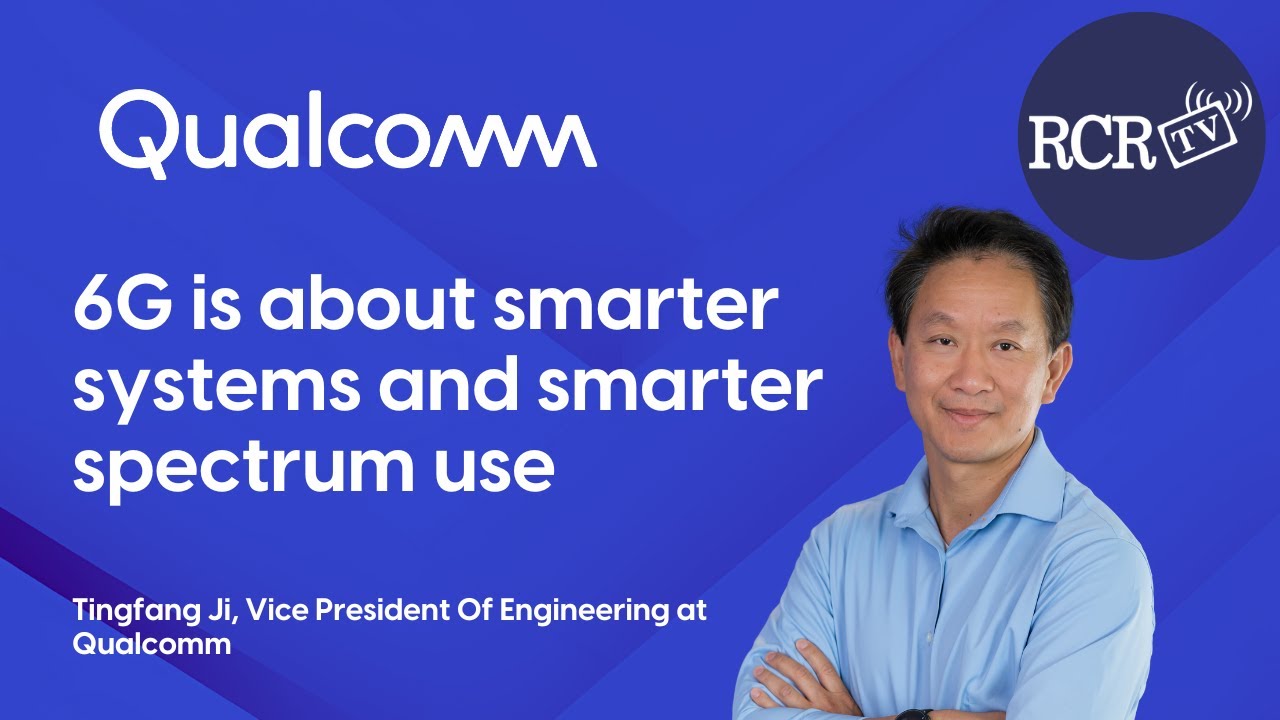
The story of 6G isn’t just about new spectrum—it’s about making better use of what we already have. In an interview at Mobile World Congress, Qualcomm VP of Engineering Tingfang Ji outlined how 6G will drive massive efficiency gains across all layers of the wireless system. From novel antenna architectures to AI-designed protocols, Qualcomm’s research shows a path to lower deployment costs, smarter networks, and more adaptable air interfaces.

Ji emphasized, “A new G is not just the new band…Actually, when you upgrade, you should even [upgrade] existing bands to see some performance benefit.” For instance, 1-2 GHz spectrum has valuable propagation characteristics but is capacity constrained. He said that with a baseband upgrade, Qualcomm has seen at least 2x increases in coverage.

6G targets a 50% to 70% gain in FDD bands without replacing cell site RF equipment. This can be accomplished using a number of techniques, including:

– Spectrum confinement and numerology alignment–higher bandwidth occupancy for 6G FDD bands and tighter coordination with TDD bands.
– Downlink MIMO–advanced channel state feedback design to achieve high performance beamforming in 6G FDD.
– Uplink antenna/Tx power management–advanced antenna/power management accounting for uplink/downlink imbalance, and MPE.
– Modulation, coding and MIMO mapping–evolved 5G coding, modulation to 6G LDPC, constellation shaping, MIMO mapping design.
– Uplink waveform adjustments–DFT-S with MIMO to yield gain over 5G NR single-layer DFT-S uplink.
– Reference signal and HARQ design–combine the best of LTE CRS and NR DMRS, HARQ design.

“6G, so far, we’re labeling as the high efficiency G,” Ji said. “It’s not just energy efficiency to save money, but also spectral efficiency.”

Moving from low-band to upper-mid-band spectrum—specifically the 7–8 GHz range, which is seen as key to early 6G deployments—Ji discussed Qualcomm’s work on Giga-MIMO. The idea here is an evolution of massive MIMO for mid-band 5G, typically around 3.5 GHz, that would allow operators to deploy new spectrum and deliver comparable coverage while reusing existing sites.

“That’s one problem we have to solve for the community, for the ecosystem,” Ji said of infrastructure reuse. To overcome propagation losses at higher frequencies, Giga-MIMO arrays scale up to 4,096 elements—far beyond the 256-element arrays used in today’s massive MIMO systems. In over the air testing, Qualcomm has compared massive MIMO at 3.5 GHz with Giga-MIMO at 13 GHz. The result showed a 2.3x downlink device throughput gain and 2.4x uplink device throughput gain with Giga-MIMO.

“You can reuse the same site,” Ji said. “There’s no need to densify and yet, you can have good indoor coverage at higher frequencies.” On the UE side, Ji said Qualcomm plans to move from two to four transmit antennas, incorporating coherent beamforming. “All those things will help in terms of reducing the capital investment of these new systems.”

The conversation then turned to wireless AI, which Ji described as a key enabler of 6G’s adaptability and intelligence. There are two ways of applying AI to wireless systems, he said. “One is just to implement better devices and [a] better network using AI technology.” That’s happening today with Qualcomm’s Snapdragon-powered devices, as well as on the network side with the introduction of AI into service management and orchestration (SMO) and Open RAN systems.

The second way, Ji said, “is to actually use AI to design the air interface. The air interface is a specification that clearly defines what the base station is transmitting or what the UE is receiving, or the other way around. So wireless AI is a new design approach that says, ‘Let’s not just put down exactly how the code words are defined.’ Instead, it should be data-driven. We’ll learn from the data we collect and let AI to spell out how this protocol works.”

Working with Nokia Bell Labs, Qualcomm demonstrated the performance of wireless AI models in different physical environments, measuring throughput gains of 15% to 95% compared with 3GPP-specific channel state information (CSI) feedback. The collaboration showed the flexibility of sequential learning, which can facilitate network decoder-first or device encoder-first training.

Qualcomm also worked with Rohde & Schwarz to validate machine learning-based CSI feedback compression for 5G-Advanced networks. The companies achieved interoperability between ML models running on mobile form factor reference devices. According to the companies, the validation work “enables efficient compression of the channel state based on CSI reference signal…measurements, optimizing massive MIMO operations critical for 5G networks…the throughput performance improved by 51% compared to Type 1 feedback followed by wideband precoding, as defined in 3GPP Release 15.”

This wireless AI approach represents a fundamental shift in network design. Rather than the network dictating user experience, the experience itself shapes the network. “Instead of having specified, specific behavior based on what the designers at the standardization stage think [it] should do, you can let AI take actual user performance into consideration, make it more performance-driven behavior instead of specification-driven behavior. Leaving this flexibility in the protocol will allow both the network side and UE side to be more efficient and get better performance.”

Ji’s perspective makes clear that 6G is not a rip-and-replace proposition—it’s about embedding intelligence at every layer to extend the value of existing investments, spectrum, and infrastructure. As wireless AI matures and Giga-MIMO scales, Qualcomm is betting on a version of 6G where smarter means better—not just faster.


You Might Also Like
  • From missiles to pizzas – why 6G drone sensing has been fast-tracked for 5G
  • AI-RAN takes shape as Open RAN, Cloud RAN and AI converge
  • Monday (telco diary) | Consolidation, orchestration, automation
  • Webinar: Building 6G — aligning technology, policy and purpose
  • Mimosa Networks and Viaero Wireless demonstrate scalable 5 GHz and 6 GHz fixed wireless broadband with AFC
  • Building the 6G standard: What 3GPP’s June 2026 plenary decisions mean for device makers
Share 0 LinkedinEmail
Qualcomm and RCR Wireless News (Sponsored)

previous post
UPS signs NTT Data on 10-year deal to overhaul AI infra and apps 
next post
Global gen AI spending to surge 76% in 2025, topping $640 billion: Gartner

White Papers

  • Norton eBook: The 2026 Telco Playbook

  • Enea White Paper: Why Intelligent AAA is the Swiss Army Knife of Telecom

  • CSG White Paper: Telco AI Enabler: Mediation’s Defining Role

  • Enea White Paper: Scalable Database Design for 5G and Beyond

  • Supermicro and NVIDIA Whitepaper: Powering sovereign AI at scale

Editorial Reports

  • Report: NTN in motion — evolving standards, expanding services

  • Market Pulse Report: Telco AI in 2026 – Trends, Challenges and Opportunities

  • Nvidia Report: The State of AI in Telecommunications: 2026 Trends

Webinars

  • Webinar: Building 6G — aligning technology, policy and purpose

  • SIMCom Webinar: Scaling your next deployment – from plastic to provisioning

  • Webinar: Rethinking the RAN as AI, cloud and openness converge

  • Webinar: Scale-Up, Scale-Out, Scale-Across – Building AI-Era Network Fabrics

  • Webinar: NTN in motion – evolving standards, expanding services

Since 1982, RCR Wireless News has been providing wireless and mobile industry news, insights, and analysis to mobile and wireless industry professionals, decision makers, policy makers, analysts and investors.

Facebook Twitter Youtube Linkedin Envelope Rss

Useful Links

  • Subscribe
  • About RCR Wireless News
  • Contact Us
  • Advertise
  • Editorial Calendar
  • Archive
  • RSS
  • Wireless News Archive
  • Subscribe
  • About RCR Wireless News
  • Contact Us
  • Advertise
  • Editorial Calendar
  • Archive
  • RSS
  • Wireless News Archive

Edtior's Picks

Lockheed’s NetSense turns Verizon’s 5G network into a drone-tracking system
Criss-cross comms – Lumen bets on east-west AI, while the edge keeps north-south...
Fighting talk (and team spirit) – Celona preps private 5G/Wi-Fi for AI scramble...

Latest Articles

Lockheed’s NetSense turns Verizon’s 5G network into a drone-tracking system
Criss-cross comms – Lumen bets on east-west AI, while the edge keeps north-south in play
Fighting talk (and team spirit) – Celona preps private 5G/Wi-Fi for AI scramble in Industry 4.0
The Agentic Network — T-Mobile US on aligning AI initiatives with customer outcomes

© 2026 RCR Wireless News All Right Reserved. Developed by Eight Hats.

Cookie Policy | Privacy Policy

RCR Wireless
  • News
  • Channels
    • 5G
    • 6G
    • BSS OSS
    • Carriers
    • IoT
    • Network Infrastructure
    • Open RAN
    • Private 5G
    • Telco AI
    • Telco Cloud
    • Test & Measurement
  • Resources
    • Reports
    • Webinars
    • White papers
    • AI Fundamentals
    • Analyst Angle
    • Editorial Calendar
    • Fundamentals
      • 5G NR Release 17
      • AI
        • Telco AI in 2025
    • Podcasts
      • Let’s Get Digital with Carrie Charles
      • Wireless Connectivity to Enable Industry 4.0 for the Middleprise
      • Well Technically…
      • Will 5G Change the World
      • Accelerating Industry 4.0 Digitalization
  • AI Infrastructure
  • Programs
  • Events
  • RCRtv
  • Advertise
  • Subscribe
RCR Wireless
  • News
  • Channels
    • 5G
    • 6G
    • BSS OSS
    • Carriers
    • IoT
    • Network Infrastructure
    • Open RAN
    • Private 5G
    • Telco AI
    • Telco Cloud
    • Test & Measurement
  • Resources
    • Reports
    • Webinars
    • White papers
    • AI Fundamentals
    • Analyst Angle
    • Editorial Calendar
    • Fundamentals
      • 5G NR Release 17
      • AI
        • Telco AI in 2025
    • Podcasts
      • Let’s Get Digital with Carrie Charles
      • Wireless Connectivity to Enable Industry 4.0 for the Middleprise
      • Well Technically…
      • Will 5G Change the World
      • Accelerating Industry 4.0 Digitalization
  • AI Infrastructure
  • Programs
  • Events
  • RCRtv
  • Advertise
  • Subscribe
@2020 - All Right Reserved. Designed and Developed by PenciDesign
