


RCR Wireless
  • News
  • Channels
    • 5G
    • 6G
    • BSS OSS
    • Carriers
    • IoT
    • Network Infrastructure
    • Open RAN
    • Private 5G
    • Telco AI
    • Telco Cloud
    • Test & Measurement
  • Resources
    • Reports
    • Webinars
    • White papers
    • AI Fundamentals
    • Analyst Angle
    • Editorial Calendar
    • Fundamentals
      • 5G NR Release 17
      • AI
        • Telco AI in 2025
    • Podcasts
      • Let’s Get Digital with Carrie Charles
      • Wireless Connectivity to Enable Industry 4.0 for the Middleprise
      • Well Technically…
      • Will 5G Change the World
      • Accelerating Industry 4.0 Digitalization
  • AI Infrastructure
  • Programs
  • Events
  • RCRtv
  • Advertise
  • Subscribe
Thursday, September 17, 2026
RCR Wireless
  • News
  • Channels
    • 5G
    • 6G
    • BSS OSS
    • Carriers
    • IoT
    • Network Infrastructure
    • Open RAN
    • Private 5G
    • Telco AI
    • Telco Cloud
    • Test & Measurement
  • Resources
    • Reports
    • Webinars
    • White papers
    • AI Fundamentals
    • Analyst Angle
    • Editorial Calendar
    • Fundamentals
      • 5G NR Release 17
      • AI
        • Telco AI in 2025
    • Podcasts
      • Let’s Get Digital with Carrie Charles
      • Wireless Connectivity to Enable Industry 4.0 for the Middleprise
      • Well Technically…
      • Will 5G Change the World
      • Accelerating Industry 4.0 Digitalization
  • AI Infrastructure
  • Programs
  • Events
  • RCRtv
  • Advertise
  • Subscribe
Add RCR Wireless as a preferred source on Google
  • Qualcomm 6G Insights
  • Huawei Content Hub
  • Qualcomm – 6G Vision
  • OSS/BSS Channel
  • RCRTech Roundtable: AI Infrastructure
RCR Wireless
RCR Wireless
  • Advanced Mimo
  • Mobile mmWave
  • 5G Positioning
  • Green Networks
  • Metaverse
  • Automotive
  • Industrial and Wide-area IoT
Copyright 2021 - All Right Reserved
Home - Three scenarios for global 6 GHz adoption — always ‘a degree of fragmentation’
Wi-FiFundamentalsSpectrum

Three scenarios for global 6 GHz adoption — always ‘a degree of fragmentation’

by Catherine Sbeglia Nin December 16, 2025
written by Catherine Sbeglia Nin December 16, 2025 Share
LinkedinEmail
Share 0LinkedinEmail
wi-fi 8 6 ghz
1.6K

Global 6 GHz harmonization will be a key determinant of Wi-Fi 8’s performance, adoption curve, and competitiveness

The 6 GHz band (5925–7125 MHz) has become the defining spectrum layer for next-generation Wi-Fi, enabling the performance, reliability, and intelligence required for emerging AI-driven and latency-sensitive applications. Its importance began in April 2020, when the U.S. Federal Communications Commission (FCC) opened the entire band for unlicensed Wi-Fi use. That decision enabled Wi-Fi 6E and unlocked a clean, interference-free swath of spectrum capable of supporting faster speeds, lower latency, and dramatically increased capacity.

While Wi-Fi 6E introduced access to the band, Wi-Fi 7 maximized its potential through wider 320 MHz channels — double the 160 MHz available in Wi-Fi 6E — and through Multi-Link Operation (MLO), and now, Wi-Fi 8, or IEEE 802.11bn, builds on this evolution by rearchitecting how 6 GHz is used.

Spectrum policy, however, remains a crucial variable. Global 6 GHz harmonization will be a key determinant of Wi-Fi 8’s performance, adoption curve, and competitiveness against 5G/NR-U. Markets that align early on policy and certification will capture the earliest and most valuable benefits.

Broadcom’s Director of Product Marketing, Chris Szymanski, told RCR Wireless News that all realistic outcomes related to 6 GHz adoption involve “a degree of fragmentation.” What does differ is how far regulators move toward opening or sharing the band.

Scenario 1: Fragmentation persists (the status quo)

In this scenario, the world largely stays where it is today:

  • Some countries authorize the full 1200 MHz,
  • Others allow only the lower 500 MHz,
  • And some (such as China) make no allocation at all.

“There may be movement between the camps where a country or two decides to go from partial band to full band, or vice versa, but mainly the same state of play,” Szymanski said.

Scenario 2: Shared-use expansion in the upper 6 GHz

Here, regulators in regions such as Europe and Brazil allow Wi-Fi operations in the upper 6 GHz band on a best-effort, non-interference basis alongside IMT systems. This approach doesn’t create full harmonization, but Szymanski explained that it makes more of the band usable globally, particularly for standard power Wi-Fi under carefully managed coexistence rules.

Scenario 3: China opens the lower 6 GHz band

If China were to authorize the lower use of the band or unlicensed use — following Hong Kong’s lead — the global ecosystem would reach a minimum viable level of harmonization, unlocking far better alignment in device, chipset, and AP design.

ABI Research’s Principal Analyst Andrew Spivey noted this would also catalyze momentum across Asia-Pacific, where current policies range from the U.S.-aligned (South Korea) to partial-band (Japan) to fully licensed (China).

Trends to watch 

Szymanski highlighted several regulatory decisions that could reshape the next decade of Wi-Fi capabilities:

  • China’s lower 6 GHz decision. China’s move would be the single most consequential harmonization event. He noted that Hong Kong’s adoption raises expectations that Beijing may eventually follow.
  • Mexico’s potential alignment with the U.S. and Canada. Full-band authorization would solidify the Americas as a unified 1200 MHz region.
  • Europe and Brazil’s stance on upper-band sharing. If coexistence frameworks prove “conducive to sharing,” Szymanski said, regulators may allow broader unlicensed use in the upper band — unlocking new capacity for Wi-Fi 7 and Wi-Fi 8.
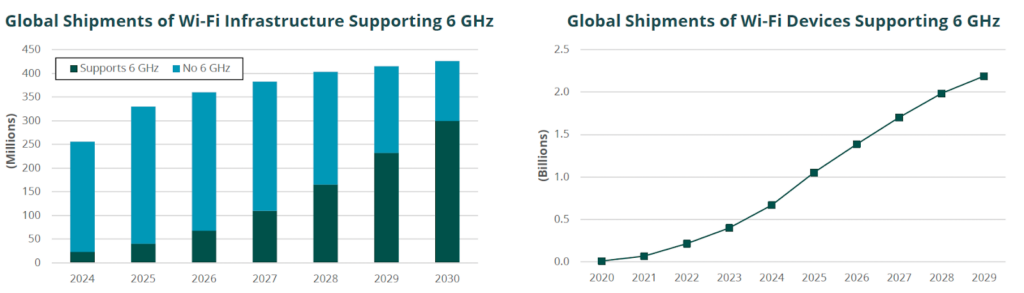
image 3
Three scenarios for global 6 GHz adoption — always ‘a degree of fragmentation’ 7

Spivey believes that the maturing hardware ecosystem — including radios capable of switching between 5 GHz and 6 GHz — will “drive the transition to 6 GHz infrastructure” even in the cases of partial access. His outlook is that early 6 GHz penetration will remain low through 2025 before accelerating closer to 2028, when 6 GHz infrastructure becomes “mainstream,” following “a greater penetration of 6 GHz devices” and “expanded access to 6 GHz.”

In practice, the most likely outcome is not global harmonization, but managed fragmentation — mitigated by more flexible radios, smarter coexistence frameworks, and gradual policy convergence rather than sweeping regulatory alignment.


You Might Also Like
  • Regional carriers face tech and spectrum tests to remain competitive, says CCA
  • ‘We think of them as hometown ISPs’ – WISPA chief on BEAD, Starlink, CBRS
  • Wi-Fi carries over 80% of traffic; monetizing it is not a done deal (Analyst Angle)
  • Netgear’s quiet reinvention as a B2B and SaaS company (Analyst Angle)
  • Why consolidation will reshape MDU connectivity (part 3/3) – Analyst Angle
  • Why consolidation will reshape MDU connectivity (part 2/3) – Analyst Angle
Share 0 LinkedinEmail
Catherine Sbeglia Nin

Catherine Sbeglia Nin is the Managing Editor for RCR Wireless News, where she covers topics such as Wi-Fi, network infrastructure, AI and edge computing. She also produced and hosted Arden Media's podcast Well, technically... After studying English and Film & Media Studies at The University of Rochester, she moved to Madison, WI. Having already lived on both coasts, she thought she’d give the middle a try. So far, she likes it very much.

previous post
Connectivity at a crossroads: Why the industry must get AI right (Reader Forum)
next post
Privacy vs innovation: How will telcos manage data in the AI era?

White Papers

  • Norton eBook: The 2026 Telco Playbook

  • Enea White Paper: Why Intelligent AAA is the Swiss Army Knife of Telecom

  • CSG White Paper: Telco AI Enabler: Mediation’s Defining Role

  • Enea White Paper: Scalable Database Design for 5G and Beyond

  • Supermicro and NVIDIA Whitepaper: Powering sovereign AI at scale

Editorial Reports

  • Report: Building 6G — Aligning technology, policy and purpose

  • Report: Rethinking the RAN

  • Report: Building AI-Era Network Fabrics

Webinars

  • Appledore Webinar: Closing the Agent-Ready Data Gap for Autonomous Networks

  • Mimosa Webinar – Build the Right Network

  • Webinar: Building 6G — aligning technology, policy and purpose

  • SIMCom Webinar: Scaling your next deployment – from plastic to provisioning

  • Webinar: Rethinking the RAN as AI, cloud and openness converge

Since 1982, RCR Wireless News has been providing wireless and mobile industry news, insights, and analysis to mobile and wireless industry professionals, decision makers, policy makers, analysts and investors.

Facebook Twitter Youtube Linkedin Envelope Rss

Useful Links

  • Subscribe
  • About RCR Wireless News
  • Contact Us
  • Advertise
  • Editorial Calendar
  • Archive
  • RSS
  • Wireless News Archive
  • Subscribe
  • About RCR Wireless News
  • Contact Us
  • Advertise
  • Editorial Calendar
  • Archive
  • RSS
  • Wireless News Archive

Edtior's Picks

Crown Castle sees spectrum, AI supporting tower growth
When the vendor disappears – what the Cambium collapse means for MDUs (Analyst...
Deep sea to low orbit – telcos can’t build fast enough (Telco Diary)

Latest Articles

Crown Castle sees spectrum, AI supporting tower growth
When the vendor disappears – what the Cambium collapse means for MDUs (Analyst Angle)
Deep sea to low orbit – telcos can’t build fast enough (Telco Diary)
Samsung and Verizon complete first AI-powered ISAC trial on vRAN

© 2026 RCR Wireless News All Right Reserved. Developed by Eight Hats.

Cookie Policy | Privacy Policy

RCR Wireless
  • News
  • Channels
    • 5G
    • 6G
    • BSS OSS
    • Carriers
    • IoT
    • Network Infrastructure
    • Open RAN
    • Private 5G
    • Telco AI
    • Telco Cloud
    • Test & Measurement
  • Resources
    • Reports
    • Webinars
    • White papers
    • AI Fundamentals
    • Analyst Angle
    • Editorial Calendar
    • Fundamentals
      • 5G NR Release 17
      • AI
        • Telco AI in 2025
    • Podcasts
      • Let’s Get Digital with Carrie Charles
      • Wireless Connectivity to Enable Industry 4.0 for the Middleprise
      • Well Technically…
      • Will 5G Change the World
      • Accelerating Industry 4.0 Digitalization
  • AI Infrastructure
  • Programs
  • Events
  • RCRtv
  • Advertise
  • Subscribe
RCR Wireless
  • News
  • Channels
    • 5G
    • 6G
    • BSS OSS
    • Carriers
    • IoT
    • Network Infrastructure
    • Open RAN
    • Private 5G
    • Telco AI
    • Telco Cloud
    • Test & Measurement
  • Resources
    • Reports
    • Webinars
    • White papers
    • AI Fundamentals
    • Analyst Angle
    • Editorial Calendar
    • Fundamentals
      • 5G NR Release 17
      • AI
        • Telco AI in 2025
    • Podcasts
      • Let’s Get Digital with Carrie Charles
      • Wireless Connectivity to Enable Industry 4.0 for the Middleprise
      • Well Technically…
      • Will 5G Change the World
      • Accelerating Industry 4.0 Digitalization
  • AI Infrastructure
  • Programs
  • Events
  • RCRtv
  • Advertise
  • Subscribe
@2020 - All Right Reserved. Designed and Developed by PenciDesign