
RCR Wireless
  • News
  • Channels
    • 5G
    • 6G
    • BSS OSS
    • Carriers
    • IoT
    • Network Infrastructure
    • Open RAN
    • Private 5G
    • Telco AI
    • Telco Cloud
    • Test & Measurement
  • Resources
    • Reports
    • Webinars
    • White papers
    • AI Fundamentals
    • Analyst Angle
    • Editorial Calendar
    • Fundamentals
      • 5G NR Release 17
      • AI
        • Telco AI in 2025
    • Podcasts
      • Let’s Get Digital with Carrie Charles
      • Wireless Connectivity to Enable Industry 4.0 for the Middleprise
      • Well Technically…
      • Will 5G Change the World
      • Accelerating Industry 4.0 Digitalization
  • AI Infrastructure
  • Programs
  • Events
  • RCRtv
  • Advertise
  • Subscribe
Monday, September 7, 2026
RCR Wireless
  • News
  • Channels
    • 5G
    • 6G
    • BSS OSS
    • Carriers
    • IoT
    • Network Infrastructure
    • Open RAN
    • Private 5G
    • Telco AI
    • Telco Cloud
    • Test & Measurement
  • Resources
    • Reports
    • Webinars
    • White papers
    • AI Fundamentals
    • Analyst Angle
    • Editorial Calendar
    • Fundamentals
      • 5G NR Release 17
      • AI
        • Telco AI in 2025
    • Podcasts
      • Let’s Get Digital with Carrie Charles
      • Wireless Connectivity to Enable Industry 4.0 for the Middleprise
      • Well Technically…
      • Will 5G Change the World
      • Accelerating Industry 4.0 Digitalization
  • AI Infrastructure
  • Programs
  • Events
  • RCRtv
  • Advertise
  • Subscribe
Add RCR Wireless as a preferred source on Google
  • Qualcomm 6G Insights
  • Huawei Content Hub
  • Qualcomm – 6G Vision
  • OSS/BSS Channel
  • RCRTech Roundtable: AI Infrastructure
RCR Wireless
RCR Wireless
  • Advanced Mimo
  • Mobile mmWave
  • 5G Positioning
  • Green Networks
  • Metaverse
  • Automotive
  • Industrial and Wide-area IoT
Copyright 2021 - All Right Reserved
Home - China Telecom built its own AI models with home-grown hardware
Telco AI

China Telecom built its own AI models with home-grown hardware

by Christian de Looper January 20, 2026
written by Christian de Looper January 20, 2026 Share
LinkedinEmail
Share 0LinkedinEmail
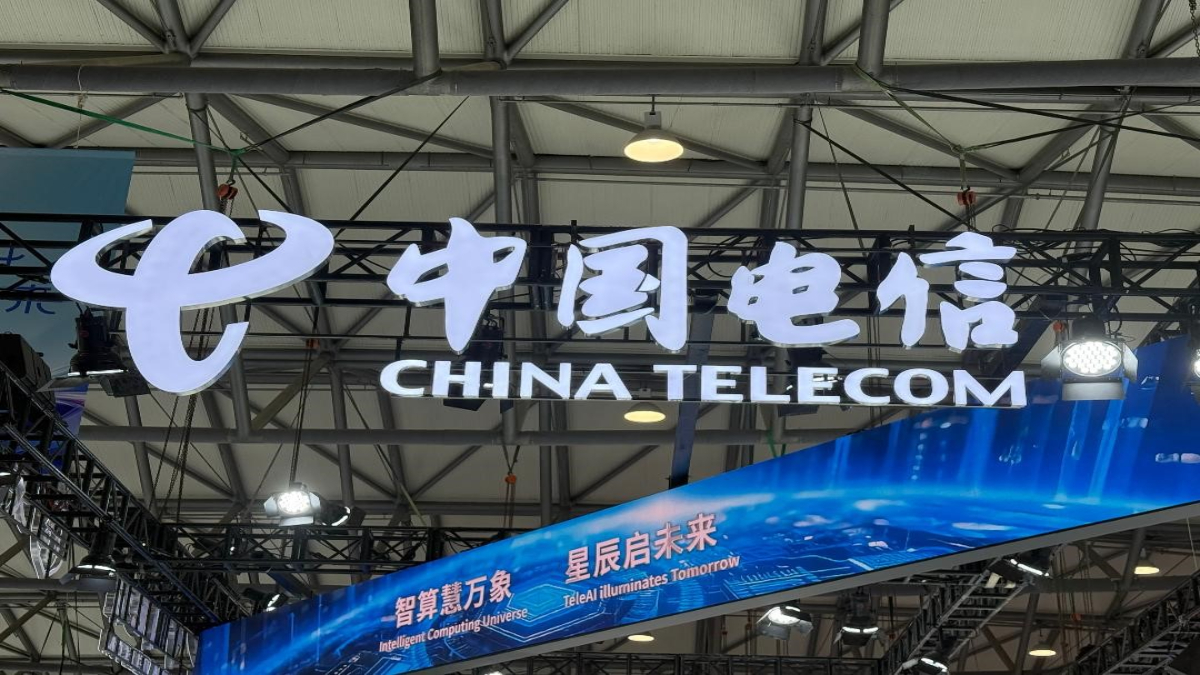
China Telecom
Image: RCR Wireless News
1.1K

The new Mixture-of-Experts series runs on the open-source Huawei MindSpore framework

In sum – what we know:

TeleChat3 series – China Telecom’s TeleAI released the first large-scale Mixture-of-Experts (MoE) models trained entirely on domestically designed semiconductors.

Domestic hardware stack – Training was conducted exclusively on Huawei’s Ascend 910B AI chips and the open-source MindSpore framework, validating the feasibility of the domestic ecosystem.

Thinking mode – The models introduce a “Thinking” mechanism that makes reasoning processes traceable, aiming to improve logic and accuracy in complex tasks.

China may not have access to some of the U.S.-designed hardware as easily as it might like, but it’s still clearly able to develop high-end large language models. China Telecom’s AI research arm, TeleAI, has open-sourced the TeleChat3 series of large language models, which are China’s first large-scale Mixture-of-Experts models trained entirely on domestically designed semiconductors.

It’s somewhat of a big deal for China’s homegrown AI efforts. Gaining access to Nvidia and other American-designed GPUs has been difficult for Chinese companies at best, but it seems as though it’s possible that China’s homegrown AI stack can actually support frontier-scale model development. 

A massive model

The TeleChat3 lineup includes several model sizes, with the flagship being TeleChat3-105B-A4.7B-Thinking — a fine-grained MoE architecture packing 105 billion parameters. That naming convention highlights that only 4.7 billion parameters activate during any given inference pass, which is the core advantage of MoE designs. You get high performance without the computational overhead of running a dense model at that scale. There’s also TeleChat3-36B-Thinking, a dense architecture that likely offers different trade-offs depending on deployment needs.

Training happened at computing infrastructure in Shanghai Lingang, with the models consuming 15 trillion tokens along the way. The entire stack runs on Huawei’s Ascend 910B AI chips paired with the MindSpore deep learning framework — another Huawei-developed project, this one open-source. China Telecom is keen to emphasize full compatibility with the broader Huawei Ascend ecosystem, including Ascend Atlas800T A2 training servers. According to the company, Huawei’s hardware handled the “severe demands” of large-scale MoE training, though details about training efficiency, failure rates, or how this all stacks up against Nvidia hardware haven’t been shared.

China Telecom, which developed the model, was the first telco to adopt DeepSeek — but it makes sense the company would be looking to build its own model instead.

“Thinking Mode”

One of the features in TeleChat3 is called “Thinking Mode” — a mechanism that exposes the model’s reasoning process to users. The implementation works through specific guiding symbols in dialogue templates, prompting the model to generate intermediate reasoning steps before producing a final answer. This sounds a lot like chain-of-thought prompting techniques that have become standard practice in the field, though China Telecom positions it as a distinct architectural capability.

The goal is better performance on complex tasks involving logical deduction. China Telecom points to knowledge questions, mathematical reasoning, content creation, code generation, and intelligent agent applications as areas where this thinking mode should deliver advantages. The company claims performance across six core dimensions approaches “advanced international levels.” That said, no direct benchmark comparisons against GPT-5 or Claude have surfaced, so those claims deserve some skepticism until third-party evaluations emerge.

Geopolitics

There’s no way to understand the TeleChat3 release without considering the geopolitical backdrop. U.S. sanctions have cut both China Telecom and Huawei off from advanced semiconductors manufactured using American technology, which has pushed China’s tech sector to accelerate work on viable alternatives. TeleChat3 is the first public validation from a Chinese developer that large-scale MoE training can actually happen on domestic chips alone. To be clear, some of the bans of chip exports to China have been eased, but those chips still aren’t as easily available, and come at a high price.

Whether this amounts to genuine technological self-sufficiency or a workaround carrying hidden costs is harder to say. Critics of China’s semiconductor push have argued that Huawei’s chips remain less efficient than Nvidia’s latest hardware, potentially demanding more silicon, more power, and more time to hit equivalent results. China Telecom hasn’t released the kind of detailed comparisons that would let anyone assess these trade-offs independently.

The release also slots into China’s broader “Artificial Intelligence+” initiative — a government-backed push to deploy AI across sectors like government services, communications, energy, and finance. TeleChat3 looks positioned as part of that effort, offering a domestically-produced model that sidesteps reliance on foreign technology for sensitive applications.

In a departure from some other Chinese AI projects, China Telecom has made the model weights, inference code, and usage examples available on GitHub and ModelScope. Going open-source opens the door for academic researchers and commercial developers alike, potentially speeding adoption while also enabling some degree of independent scrutiny. Of course, it remains to be seen how much traction the models gain outside China.

You Might Also Like
  • Microsoft and AWS launch a managed multicloud interconnect
  • Ericsson Adaptive Inventory
  • AT&T takes OTel 2.0 into production
  • Verizon and Google Cloud expand AI partnership across service, network, and data
  • Lightyear launches Dispatch, an agentic AI platform for enterprise telecom
  • KT unveils NPU LLM Station, a fully on-premise sovereign AI server

Table of Contents

  • The new Mixture-of-Experts series runs on the open-source Huawei MindSpore framework
    • A massive model
    • “Thinking Mode”
    • Geopolitics
Share 0 LinkedinEmail
Christian de Looper

previous post
The AI platform shift is here and inertia is unacceptable
next post
Viasat, BSNL deepen partnership to boost Indian Navy’s SATCOM capabilities

White Papers

  • Norton eBook: The 2026 Telco Playbook

  • Enea White Paper: Why Intelligent AAA is the Swiss Army Knife of Telecom

  • CSG White Paper: Telco AI Enabler: Mediation’s Defining Role

  • Enea White Paper: Scalable Database Design for 5G and Beyond

  • Supermicro and NVIDIA Whitepaper: Powering sovereign AI at scale

Editorial Reports

  • Report: Rethinking the RAN

  • Report: Building AI-Era Network Fabrics

  • Quantum Safe Networks Market Pulse Report

Webinars

  • Appledore Webinar: Closing the Agent-Ready Data Gap for Autonomous Networks

  • Mimosa Webinar – Build the Right Network

  • Webinar: Building 6G — aligning technology, policy and purpose

  • SIMCom Webinar: Scaling your next deployment – from plastic to provisioning

  • Webinar: Rethinking the RAN as AI, cloud and openness converge

Since 1982, RCR Wireless News has been providing wireless and mobile industry news, insights, and analysis to mobile and wireless industry professionals, decision makers, policy makers, analysts and investors.

Facebook Twitter Youtube Linkedin Envelope Rss

Useful Links

  • Subscribe
  • About RCR Wireless News
  • Contact Us
  • Advertise
  • Editorial Calendar
  • Archive
  • RSS
  • Wireless News Archive
  • Subscribe
  • About RCR Wireless News
  • Contact Us
  • Advertise
  • Editorial Calendar
  • Archive
  • RSS
  • Wireless News Archive

Edtior's Picks

Microsoft and AWS launch a managed multicloud interconnect
Private 5G docks in Hamburg – as Deutsche Telekom and Ericsson scratch a...
India weighs rip-and-replace of legacy Chinese telecoms equipment

Latest Articles

Microsoft and AWS launch a managed multicloud interconnect
Private 5G docks in Hamburg – as Deutsche Telekom and Ericsson scratch a seven-year itch
India weighs rip-and-replace of legacy Chinese telecoms equipment
SK Telecom’s Topdda turns work vans into an AI inspection fleet

© 2026 RCR Wireless News All Right Reserved. Developed by Eight Hats.

Cookie Policy | Privacy Policy

RCR Wireless
  • News
  • Channels
    • 5G
    • 6G
    • BSS OSS
    • Carriers
    • IoT
    • Network Infrastructure
    • Open RAN
    • Private 5G
    • Telco AI
    • Telco Cloud
    • Test & Measurement
  • Resources
    • Reports
    • Webinars
    • White papers
    • AI Fundamentals
    • Analyst Angle
    • Editorial Calendar
    • Fundamentals
      • 5G NR Release 17
      • AI
        • Telco AI in 2025
    • Podcasts
      • Let’s Get Digital with Carrie Charles
      • Wireless Connectivity to Enable Industry 4.0 for the Middleprise
      • Well Technically…
      • Will 5G Change the World
      • Accelerating Industry 4.0 Digitalization
  • AI Infrastructure
  • Programs
  • Events
  • RCRtv
  • Advertise
  • Subscribe
RCR Wireless
  • News
  • Channels
    • 5G
    • 6G
    • BSS OSS
    • Carriers
    • IoT
    • Network Infrastructure
    • Open RAN
    • Private 5G
    • Telco AI
    • Telco Cloud
    • Test & Measurement
  • Resources
    • Reports
    • Webinars
    • White papers
    • AI Fundamentals
    • Analyst Angle
    • Editorial Calendar
    • Fundamentals
      • 5G NR Release 17
      • AI
        • Telco AI in 2025
    • Podcasts
      • Let’s Get Digital with Carrie Charles
      • Wireless Connectivity to Enable Industry 4.0 for the Middleprise
      • Well Technically…
      • Will 5G Change the World
      • Accelerating Industry 4.0 Digitalization
  • AI Infrastructure
  • Programs
  • Events
  • RCRtv
  • Advertise
  • Subscribe
@2020 - All Right Reserved. Designed and Developed by PenciDesign

