

Celona is folding Wi-Fi 7, private 5G, public cellular and satellite into one AI-managed platform, targeting the complexity, cost and device shortages that have held back enterprise wireless adoption.
In sum – what to know:
Wi-Fi and 5G converge – Celona’s new Orion bundle introduces Wi-Fi 7 access points into the private 5G mix, plus public cellular and satellite, and positions Celona also against established Wi-Fi vendors and not just the legacy telco set.
AI takes complexity out – The firm’s new Orchestrator AI platform uses Celona’s net-ops AI agents and AI model to automate configuration, provisioning, diagnosis and remediation for faster 5G/Wi-Fi deployments and simpler management.
Physical AI ecosystem – New open-source AerConnect initiative will provide software and developer kits for robotics and IoT makers, with Digi and Telit first up, embedding multi-network connectivity into industrial devices.
In one go, US private 5G specialist Celona has released a rush of AI integrations and upgrades, plus a new Wi-Fi product line, to solve a trio of problems that have dogged the sector since day one, and which are now rated as critical as enterprises seek to upgrade their comms systems to run physical AI applications: enterprise Wi-Fi versus private 5G, and how to bankroll a brand new system; inherent 5G radio complexity for enterprise IT teams; and a fundamental lack of compatible industrial 5G devices. With the launch, Celona has effectively extricated itself from a straight fight with legacy telco vendors like Nokia and Ericsson in an enterprise market where they hardly exist, to do battle with legacy Wi-Fi vendors like Cisco and HPE in a market where they already thrive. Or so it seems.
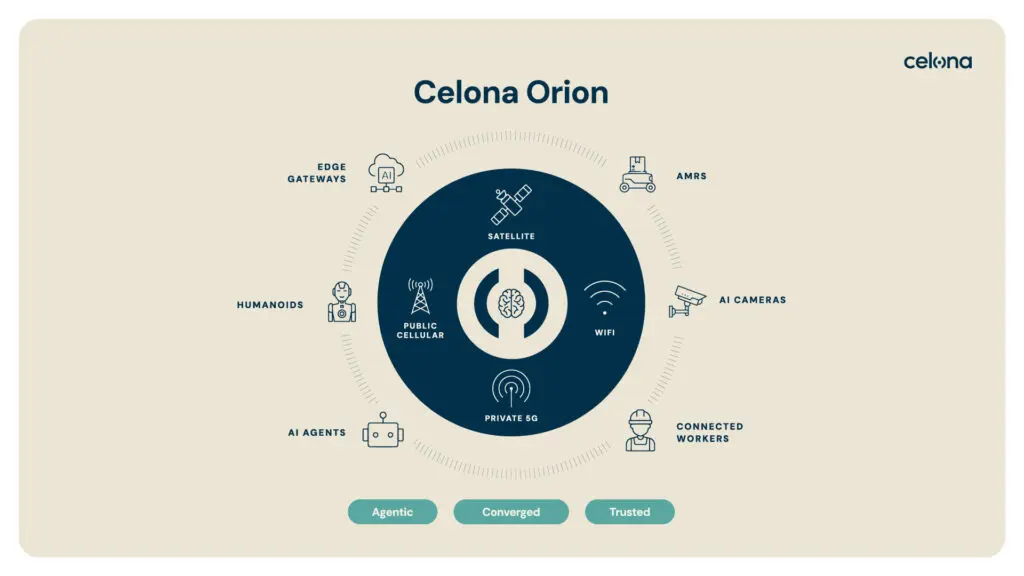
Celona tells it a little differently. But first the news: Celona has introduced a new line of Wi-Fi 7 access points to be bundled with its private 5G solution and integrated with its network-operations (net-ops) platform as a converged system, nominally for new agentic AI and physical AI workloads in industrial (and “semi-industrial”) enterprises. The solution has been rebranded as Celona Orion (from Celona 5G LAN); its cloud-based management platform (Celona Orchestrator) is being offered alternatively as an all-agentic system called Orchestrator AI. The firm’s new line of Wi-Fi 7 access points are Celona-made, like its 5G radios (designed in-house, manufactured by third parties) and are available on the same Orion subscription – “at no additional cost” officially, as a major “value prop” besides.
Public cellular and satellite comms (Starlink, at least; for backhaul at remote and temporary ‘campus’ sites) can be managed on the same platform, as well. Orchestrator AI, billed as an “agentic OS for converged wireless”, is now riddled with AI net-ops trickery to simplify converged Wi-Fi and 5G management for stretched industrial IT teams. It “packages” a set of agentic tools, presented as “skills”, into an enterprise’s preferred LLM (“Claude or ChatGPT, or whatever”) to work with a custom net-ops AI model in the platform, called Celona Brain, which codifies its in-house engineering and deployment knowhow to “configure, provision, diagnose, and fix” its networks for enterprise workloads. These agents/skills also “collaborate with other agents across the… enterprise”, says Celona.
The firm has something else, a little vague (listening back), called an “agent playground”, which may or may not refer to the reach across the agentic enterprise, that goes to “define workflows between humans and agents”. Besides, it is to release open-source software and developer kits, also agent-based, to robotics and IoT makers to embed 5G and Wi-Fi (and satellite) into modules. The initiative is called AerConnect. Digi International and Telit Cinterion will be the first with the new kits. On a call, Rajeev Shah, co-founder and chief, said: “It allows them to use all the networks – on any infrastructure. It is not restricted. It is a genuine [acknowledgement] there is a gap in the market – where devices don’t have the capabilities. We want to be a part of the solution, to grow the market by plugging the gap.”
Celona Orion will be available from the fourth quarter of 2026, apparently – with “key capabilities introduced on a phased basis”. A press note said Orion “unifies private 5G, Wi-Fi, public cellular, and satellite into a single deterministic, secure fabric and operates it as an intelligent participant in the organization’s emerging agentic mesh”. It allows enterprises to “use every megahertz of spectrum available to them”, it said. It talks about the need to connect robots, cameras, and sundry IoT devices and AI software “around the clock”. “Unlike people, machines cannot compensate for latency, jitter, or dropped packets,” it said. “Orion is purpose-built for this shift, giving software agents, physical AI systems, and the people working alongside them a single connectivity fabric they can all rely on.”
The Orchestrator AI platform “elevates wireless teams from network operators to orchestrators”, it said. “From one platform, teams can bring up private 5G, Wi-Fi, and satellite-backed connectivity wherever operations need to run. New sites can be brought online in hours rather than weeks or months, using the same operating model everywhere.” It references SIM-based identity, micro-segmentation for OT, and air-gapped IT/OT separation – provisioned across network technologies in a single platform. The release provided quotes from a customer (the US division of Italian tile manufacturer Del Conca), an integrator (US-based firm INS), and an analyst (IDC). For the rest of the conversation with Shah, in Q&A, including about the stuff that made the intro section, go here (from tomorrow).
Luca Chichiarelli, head of IT operations at Del Conca USA, said: “Our operations rely on multiple wireless technologies, each serving a different purpose across environments. As we expand automation, we’re connecting more devices, systems, workflows, and workers in more places than ever before. Bringing those networks together under a common platform can simplify operations while maintaining the security, reliability, and control our business requires.”
Lane Wooldridge, business development lead for advanced wireless solutions at INS, said: “Based on our experience deploying networks with Celona, we’ve seen that most require Wi-Fi and private cellular to work together, with each matched to the applications it supports best – typically Wi-Fi for IT use cases and private cellular for OT. These use cases increasingly overlap in the same physical spaces, and as IT and OT converge, those environments only grow more complex. Celona’s Orchestrator AI agents can help network teams simplify operations while maintaining the visibility and performance those applications depend on.”
Brandon Butler, senior research manager for network infrastructure and services at IDC, said: “Wi-Fi and private 5G have matured into essential but largely disconnected enterprise connectivity technologies. Yet as AI workloads and edge computing reshape operational networks, enterprises increasingly need both – not as separate silos, but as a unified, intelligently managed system. In an AI-driven era where connectivity is foundational to business innovation, platforms that converge Wi-Fi and private 5G management, coupled with AI-driven orchestration and insights, address a real operational challenge. Celona Orion helps define this emerging category of enterprise wireless platforms designed to simplify management and orchestration while allowing enterprises to leverage the strengths of each technology.”


