

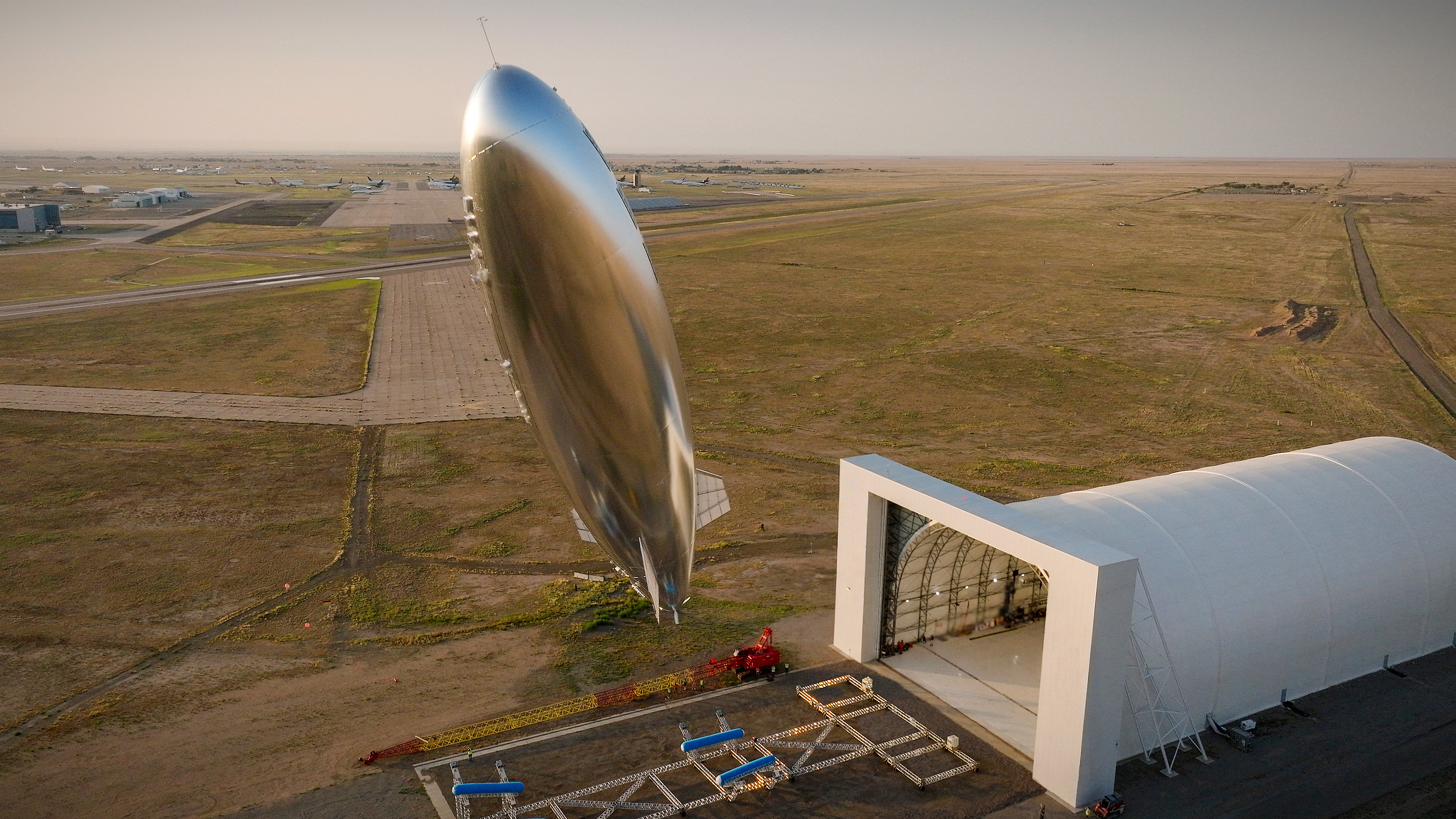
Softbank’s latest HAPS trial suggests the stratosphere could become more than a way to fill coverage gaps – potentially combining wide-area cellular, private networks, drones, and edge computing in one airborne platform.
In sum – what to know:
Comms apps – Softbank and Sceye have demonstrated smartphone and drone connectivity from the stratosphere over Japan, including voice, messaging, video, emergency alerts, and remote drone control.
Airborne edge – HAPS held position within a 5km radius and hosted its own mobile core and web server, producing a 68ms round-trip response that Softbank says is 40% faster than equivalent internet/cloud processing.
Middle layer – A persistent, regional platform sitting between terrestrial 5G and LEO satellites, with potential applications spanning private 5G, drones, disaster recovery, and physical-AI edge computing.
An interesting update on HAPS – which might ring bells if you have your head in the trenches with private 5G, on the horizon with physical AI, or in the clouds with D2D, or you just happen to be looking for the next hair-brained networking fad. Except this could be more than that, if Softbank’s latest pre-commercial tests of high-altitude platform stations (HAPS) with US-based aerospace and material science company Sceye are anything to go by. The Japanese telco, its fingers in just about every innovation seam in every layer of the tech stack, says it has demonstrated common-or-garden smartphone comms from a blimp-style airship 20 kilometers above Japan – including voice calls, text messages, video streams, plus disaster alerts and maritime calls.
More than that, it fixed the platform within a five-kilometer radius of its terrestrial target area, despite stratospheric winds – and put a mobile core and a web server on board the aircraft to boot. As a consequence, Softbank reckons it recorded a round-trip latency of 68 milliseconds for traffic processed through the onboard edge – more than 40 percent lower than equivalent internet traffic routed via the cloud. The trial also linked the HAPS to drones, allowing remote flight control, location tracking, and video transmission. Which is a lot of stuff, right there – and makes HAPS look less like an eccentric alternative to Starlink et al and more like a missing layer in the new network stack, with terrestrial RAN below, LEO satellites above, and edge computing somewhere in the stratosphere.
Softbank called it the “first” test of HAPS-to-smartphone/drone comms in Japan – “based on public information”. But the firm promoted similar-sounding HAPS experiments in 2020 and 2023, NTT and NTT Docomo have histories of the same, and Airbus has a dedicated HAPS business based on its Zephyr platform, plus a $100 million investment (in AALTO) to commercialize it in Asia. More profoundly, then, Softbank’s “world-first” test of HAPS-enabled edge-computing – to process smartphone traffic high up above Muroto City, Kochi Prefecture, without going via a terrestrial network – is the new component, which might prick-up industry ears. Certainly, the airborne edge – talked about in academic HAPS papers (see here and here, say), and talked up of course in satellite companies’ IPO brochures – might prick-up industry ears.
And it is already quite a jump from where the firm was only a few weeks ago, when it talked ahead of the trial about the “milestone” just of a sovereign Japanese HAPS project. It is much more, suddenly – like a third generation of the tech, going from flying cell towers, to flying network nodes, to flying edge stations. The HAPS Alliance, it might be noted, is now talking about regenerative payloads, local breakout, dynamic capacity allocation, and onboard computing – and positioning HAPS as a programmable node between ground and space systems; less like low-LEO, typically hundreds of kilometers up, and more like a rather-elevated and quite-stationary terrestrial node, closer to the Earth, with a shorter radio path than the former and a larger radio footprint than the latter.
Comms firmament
Softbank fixes HAPS this way in the new comms firmament, closer to terrestrial 5G in terms of performance and application than to trendy satellite systems. HAPS should provide “high-quality, high-capacity communications comparable to terrestrial mobile networks”, it said in July, rather than the low-to-mid capacity it associates with Starlink – which it is selling in Japan as Softbank Starlink Direct. The argument (repeated lately by telco bosses to temper the telco jeopardy stirred up by the Starlink hype) goes that satellite D2D is primarily for filling coverage blackspots in the country, up mountains, out at sea. Whereas HAPS is positioned as a stratospheric kind of middle layer or space bridge for (potentially) higher-capacity and lower-latency, closer to users in a defined area.
It might just do some of the computing as well, it seems. Softbank’s description of the end game is ambitious. Masayuki Kamimura, senior director in its ‘ubiquitous network planning division’ states: “Our vision is to expand today’s 2D communications infrastructure into a 3D communication network extending into space.” The idea is to connect multiple HAPS platforms with LEO satellites, including through optical links, creating what it describes as a multi-layered 3D network. What do analysts make of the broader HAPS pitch? There is no shortage of forecasts, although they should be handled with some care. Grand View Research put the global HAPS market at $1.54 billion in 2023, rising to $2.66 billion by 2030, at an 8.4 percent compound annual growth rate.
A more recent estimate by a company called 360iResearch puts the market at $1.82 billion in 2026 and $3.03 billion in 2032. Which sounds big, and rapidly expansive. But these forecasts include everything on top: surveillance, intelligence, monitoring, and whatever-other applications, alongside the straighter comms. HAPS connectivity alone, then, is not a $3 billion market, just waiting to be harvested; the better view, probably, is about what HAPS might actually do inside the comms market. ABI Research said in 2024 that HAPS could be used for fixed broadband, direct-to-cellular, backhaul, disaster recovery, and even inter-HAPS connectivity. ABI reckons the addressable market for “connecting the unconnected” via satellite broadband is 330 million SME offices and household premises.
HAPS could provide lower-latency access, and be integrated with GEO/LEO systems and edge computing, it says. ABI Research cites an example: Space Compass, the joint venture between NTT and Japanese satellite operator JSAT (variously behind the $100 million investment in Zephyr) envisages integrating HAPS with GEO satellites to create a “space integrated computing network” with HAPS providing the lower-latency access layer and GEO handling longer-distance traffic and additional capacity.
Softbank is prepping for a commercial HAPS service in 2027. But HAPS has also been “almost ready” for commercialisation for a very long time. Analysys Mason’s assessment for the UK’s Broadband Stakeholder Group in 2021 described the technology as “still maturing as a commercial broadband solution”, with low technological maturity and a prediction that it would become mainstream “at some point in the next decade”. It’s late in the day, and the industry is still kicking the tires. It also identified aviation regulation, spectrum approvals, platform endurance, and the practicalities of getting HAPS ships into and out of the stratosphere as barriers. So the question is not whether HAPS can make a radio connection; it plainly can. The question is whether somebody can operate a fleet of them reliably, affordably and safely enough to sell connectivity as a service.
Tacking obstacles
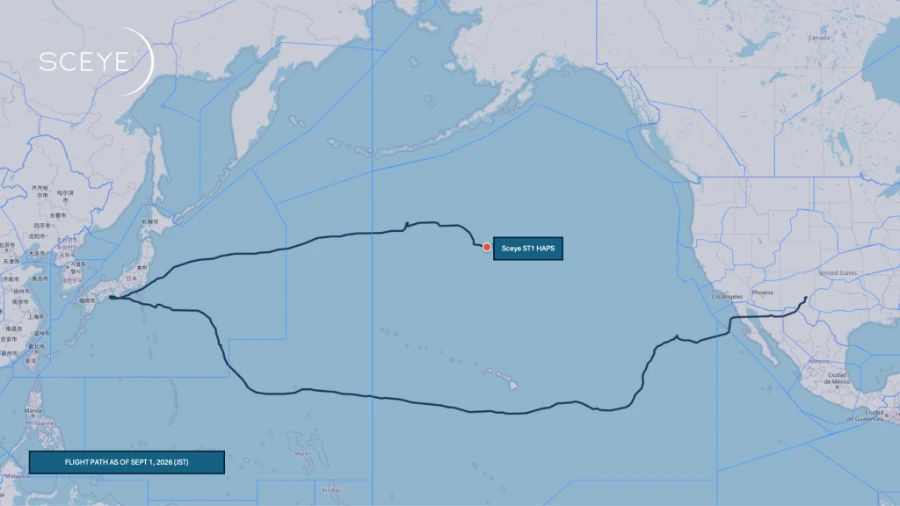
But Softbank’s tests tackle some of these obstacles. Sceye’s LTA-”type” (‘lighter-than-air’) HAPS, used for the trial, departed from New Mexico in the US on August 9 and flew more than 15,000 kilometers across the Pacific Ocean in the stratosphere, reaching its destination 13 days later on August 23, and spent more than seven days in Japanese-controlled airspace, maintaining its position over the test area – despite stratospheric winds, with the station-keeping radius reduced to as little as five kilometres. An important detail, then – not just about getting an airship up there, but about making it stick, so the stratosphere works more like a terrestrial network location. And then what? It processed smartphone traffic entirely on the platform, and remote-controlled a drone.
Softbank claims it recorded an average round-trip latency of 68 milliseconds with the on-board edge setup, 40-odd percent lower than the equivalent internet/cloud configuration, and orchestrated drone control, location information, and video transmission. All of which crosses very neatly with private 5G and physical AI, of course. The private 5G case for HAPS is not new. Airbus and Saudi operator Salam were talking about developing private 5G and IoT for disaster-management services using the Zephyr platform back in 2022. Salam’s chief exec at the time called Zephyr “a key asset to provide private network services”. The architecture makes sense if the 5G network is not just inside a factory or warehouse – but across a wider geography, for wind farms, oil fields, open mines, construction sites.
Machines and sensors might be spread over tens or hundreds of square kilometers. A terrestrial 5G network works like a collection of sites and backhaul links, whereas a HAPS setup could serve an entire operating area, and make the drone demo look less like a side experiment – for remote controlled asset inspections, and so on. Instead of sending video traffic via a distant terrestrial core and cloud, some of the processing might be done on or close to the HAPS. Again, the HAPS Alliance is already describing this sort of model. Its 2026 work on terrestrial/aerial/satellite coexistence explicitly includes HAPS connectivity for private networks, and discusses shared-network and neutral-host models where a HAPS operator provides an as-a-service infrastructure to multiple parties.
The neutral-host service model seems interesting. A single platform could provide public cellular coverage for contractors and non-work tasks, private network connectivity for industrial workflows, plus channels or slices for drones, machines, emergency comms. There is already a European version on the ground. The ESA-backed CROFT project, say, combines private 5G, satellite backhaul, ‘multi-access’ edge computing, and HAPS-enabled wide-area 5G in a drone-delivery architecture. Its stated objective is to create a resilient network for remote and island communities, while making the architecture reusable for medical deliveries and emergency response. Which brings us back to this 68 milliseconds record; applications will have to be selected.
Certain applications
It is not the kind of latency figure that competes with fiber, or even closely-controlled on-prem 5G; but it suggests HAPS does not have to be just the access link between a device and a terrestrial network. It can be part of the new ‘grid’-compute topology, perhaps – which is the big distributed networking project in the era of physical AI. If AI-enabled drones, robots, vehicles, and machines are going to make decisions based on live video and sensor feeds, then the network must move closer to the action. As it is, that mostly means an edge server in a factory, an edge node at a network site, or a compute rack at a local data center. But for some applications, at some point in the future, the edge could conceivably be 20 kilometers up in the air.
As often, the tech is really clever; as always, the question is: what it’s for, exactly? What problems will it solve, and are those problems expensive enough to bankroll the solution?


