


As mmWave moves beyond hotspot deployments, the challenge is extending high-frequency coverage without simply adding more base stations. Kyocera’s multi-hop repeater validation points to a more flexible network architecture for difficult NLOS environments.
Over the past few years, network strategies among mobile network operators (MNOs) have undergone a significant shift. As 5G deployment has matured, investment priorities have moved away from nationwide coverage expansion toward delivering capacity more efficiently in areas where traffic demand is highest. Despite this shift, the importance of 5G millimeter-wave (mmWave) technology has not diminished. In environments where network traffic is concentrated and users expect consistently high-quality connectivity, mmWave remains one of the most effective radio access technologies for delivering ultra-high-speed, high-capacity, and low-latency wireless communications.
The key question today is no longer whether mmWave can deliver its promised performance. That capability has been well established. Instead, the challenge is how to extend that performance across a wider service area in a way that is practical to deploy, simple to operate, and economically sustainable over the long term. Given the propagation characteristics of high-frequency spectrum—including limited coverage range and susceptibility to blockage—it is clear that network expansion strategies relying solely on additional base stations are reaching their practical limits. The industry is therefore shifting its focus toward new network architectures that can extend mmWave coverage more efficiently while maintaining service quality and optimizing total cost of ownership (TCO).
Kyocera Corporation (Kyocera) conducted a real-world validation of a multi-hop mmWave repeater architecture at the Qualcomm Technologies campus in San Diego, California. Rather than focusing solely on product performance, the validation was designed to evaluate how repeater technology could serve as an architectural building block to extend mmWave coverage in practical deployment scenarios.
Enterprise campuses provide an ideal testbed for evaluating high-frequency networks under realistic operating conditions. They combine wide-area coverage requirements with propagation challenges caused by buildings, vegetation, and other physical obstructions, creating both line-of-sight (LOS) and non-line-of-sight (NLOS) environments. In addition, the rapid growth of AI-driven video analytics, machine vision, and real-time transmission of high-resolution video is driving demand for high-capacity wireless connectivity across enterprise campuses, making them an increasingly important deployment scenario for mmWave networks. Because these environments closely resemble urban districts, enterprise facilities, and research campuses where high-frequency networks are expected to be deployed, they provide a practical and representative field for validating new network architectures.
This article explores the architectural insights gained through real-world deployment and discusses how they can contribute to the evolution of 5G mmWave network architecture while laying the foundation for future high-frequency wireless networks.
1 | Challenges facing mmWave networks
5G mmWave is recognized as a key radio access technology capable of delivering ultra-high-speed, high-capacity, and low-latency communications by leveraging the wide bandwidth available in high-frequency spectrum. Its advantages are particularly evident in high-traffic environments where large numbers of users are connected simultaneously. However, because mmWave operates in high-frequency spectrum, it is characterized by limited propagation range and a high sensitivity to physical obstructions such as buildings and trees.
In addition, quality can degrade significantly in NLOS environments. As a result, maintaining consistent service quality across a coverage area typically requires dense base station deployment and careful radio network planning.
In recent years, the expansion of Fixed Wireless Access (FWA) services and private 5G deployments for enterprise applications has broadened the role of mmWave from localized hotspot coverage to wider-area service delivery. As a result, the challenge is no longer simply to deliver ultra-high-speed connectivity, but to make that performance available where it is needed most in an efficient and economically scalable manner.
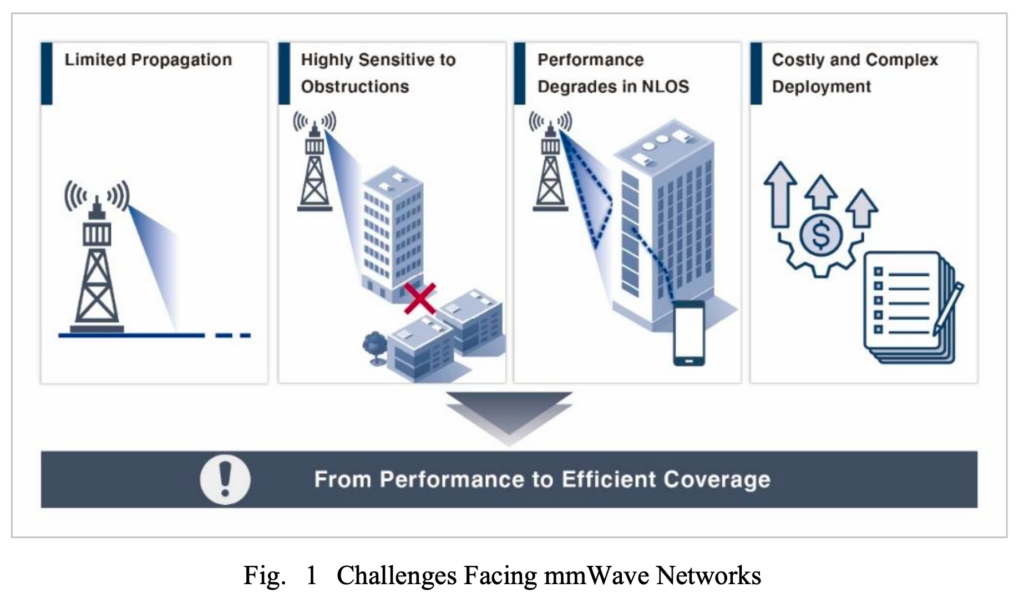
The challenge today is no longer whether mmWave can deliver exceptional performance, but how to deploy high-frequency networks in a way that efficiently expands coverage, maintains consistent service quality, and remains economically sustainable for MNOs.
2 | The limits of conventional network deployment
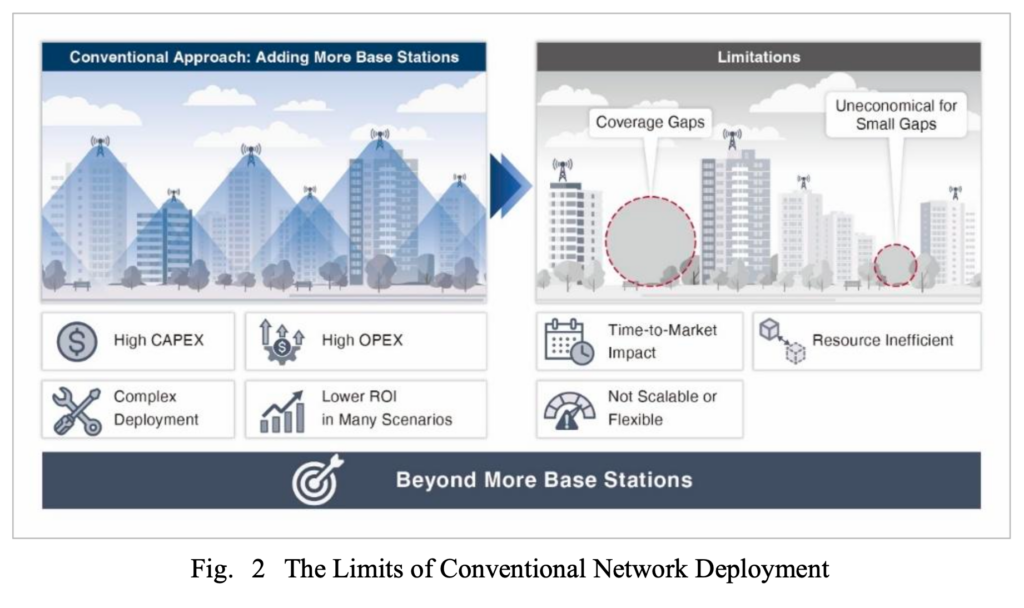
The most straightforward way to expand 5G mmWave coverage is to deploy additional base stations. But deploying a new base station requires significant time and investment, including securing suitable sites, provisioning fiber backhaul and power infrastructure, obtaining regulatory approvals, and completing civil engineering and installation work. As the number of base stations increases, MNOs must also contend with not only higher capital expenditure but also rising operational expenditure associated with network maintenance and day-to-day operations.
Adoption of FWA and private 5G networks has expanded the potential applications of mmWave beyond dense urban areas to suburban environments, enterprise campuses, and industrial facilities. However, deploying base stations at the density required to provide ubiquitous mmWave coverage across all of these environments is difficult to justify from an ROI perspective. Moreover, in high-frequency spectrum, localized coverage gaps can easily occur due to physical obstructions such as buildings and trees.
Deploying additional base stations solely to eliminate these isolated coverage gaps is often difficult to justify given the required capital investment. As a result, MNOs are increasingly seeking network architectures that can maximize the use of existing infrastructure while extending coverage more efficiently. Advancing high-frequency networks requires a fundamental shift in thinking—from deploying more base stations to a network architecture that maximizes existing infrastructure while flexibly extending coverage to where it is needed.
3 | A new approach to network architecture
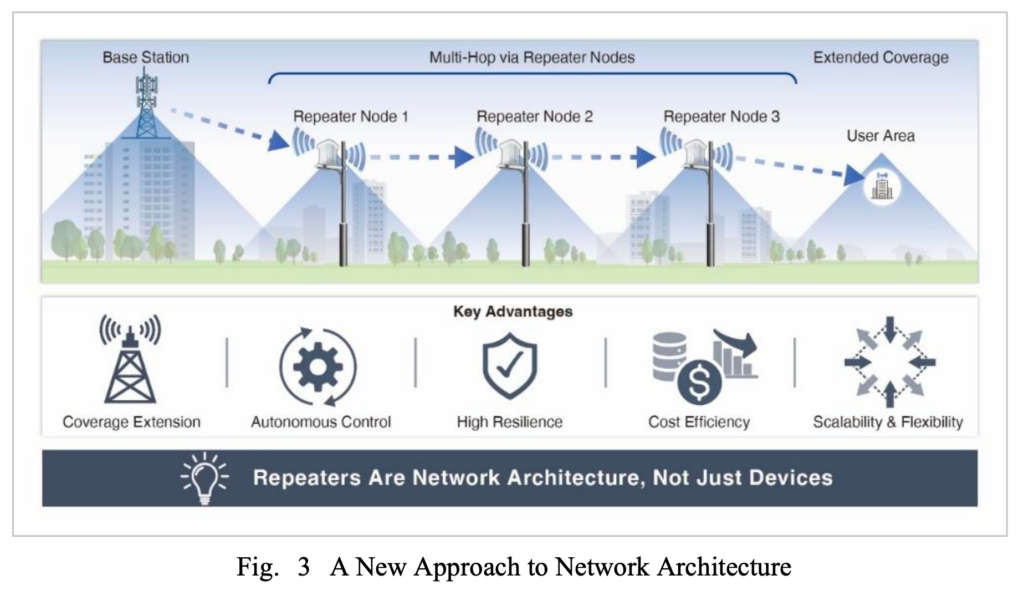
One promising approach is an architecture in which base stations and repeater nodes work together to form and extend network coverage as an integrated system. In this architecture, repeater nodes receive signals transmitted from a base station and relay them to subsequent nodes using a multi-hop configuration. This enables coverage to be extended incrementally into areas where direct radio propagation from the base station is difficult or impossible.
As a result, locations that would traditionally require the deployment of new base stations can instead be served more efficiently by leveraging existing infrastructure while expanding network coverage in a flexible and cost-effective manner. Furthermore, repeater nodes can autonomously detect signals transmitted from the base station and automatically establish the optimal relay path, simplifying installation and reducing operational overhead.
If a path becomes unavailable, traffic can be rerouted through an alternative path, improving the resilience of the overall network. These autonomous control capabilities are essential for delivering stable and reliable service in real-world environments. The value of multi-hop networking and autonomous control lies not in the individual technologies themselves, but in how they work together as integral elements of a broader network architecture.
The key is to view repeater nodes not as standalone coverage devices, but as architectural building blocks that contribute to the flexibility, scalability, and resilience of the overall network. Adopting this architectural perspective enables MNOs to maximize the value of existing infrastructure while extending coverage efficiently, maintaining consistent service quality, and improving the economic sustainability of high-frequency network deployment.
4 | Insights from real-world validation
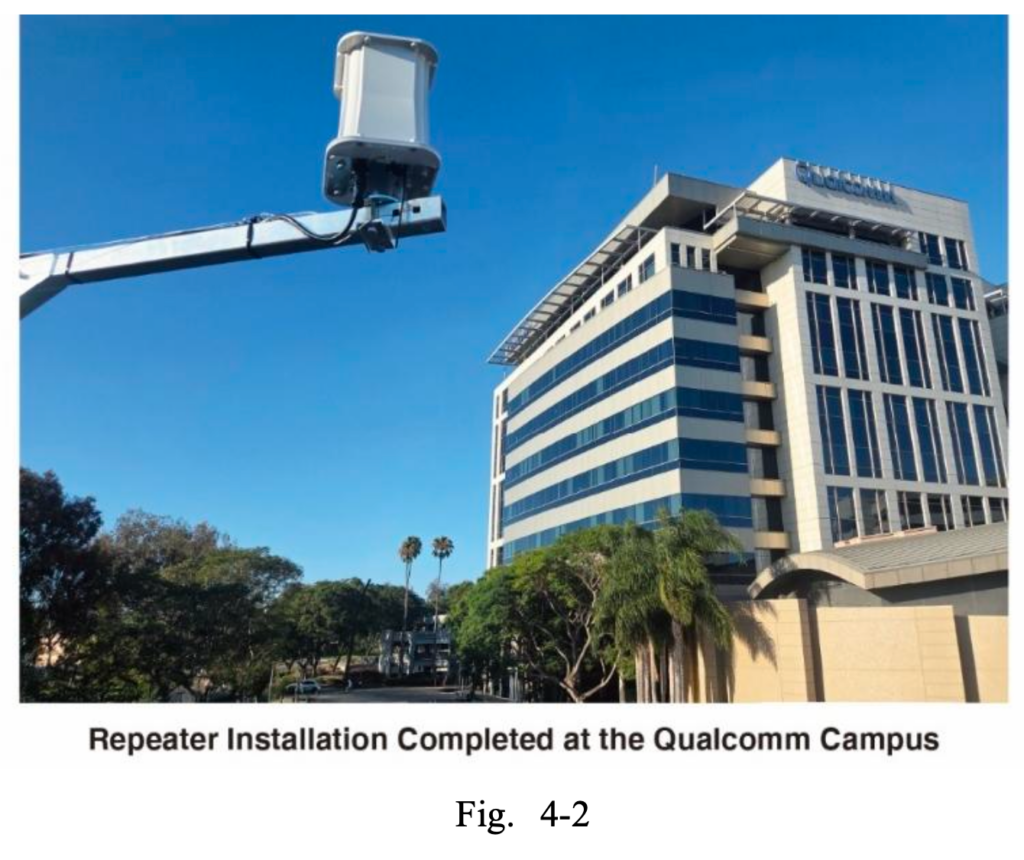
The Qualcomm Technologies campus provides an ideal validation environment because it combines wide-area coverage requirements with physical obstructions such as buildings and vegetation that create frequent NLOS conditions. These characteristics resemble the deployment environments encountered by MNOs in urban districts, enterprise campuses, and other high-capacity service areas.
The validation integrated the multi-hop repeater system with an existing private 5G SA mmWave network, where multiple repeater nodes were configured as a multi-hop architecture. The evaluation focused on the ability to extend coverage into areas where direct propagation from the base station was limited, while also assessing communication performance, operational characteristics, and overall network behavior under real-world conditions.
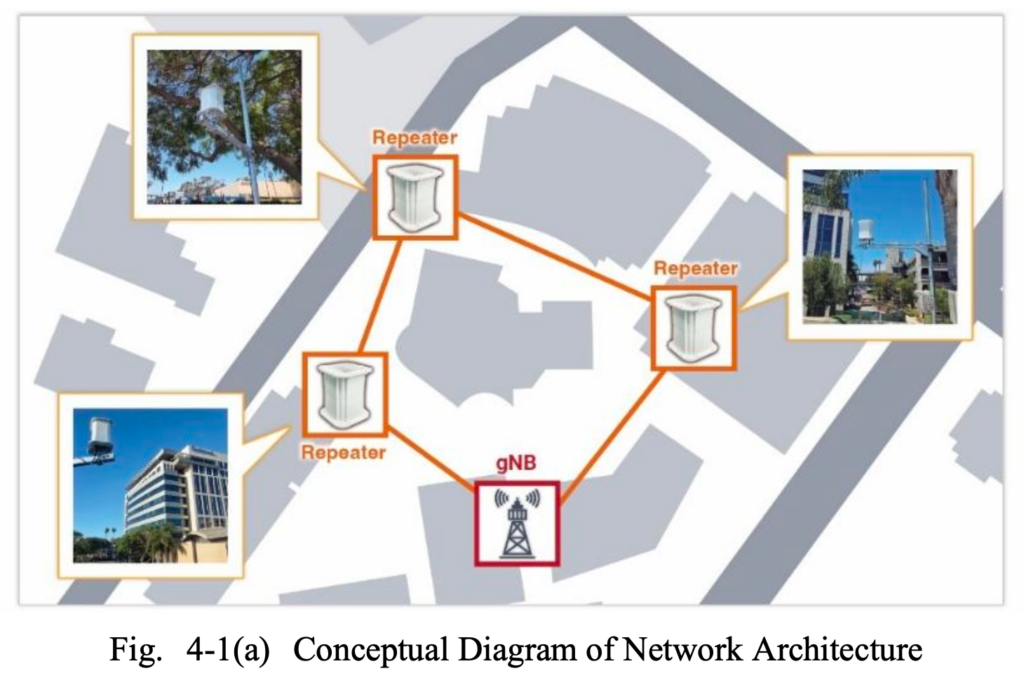
The validation confirmed that each repeater autonomously scanned 360 degrees to detect the optimal donor signal and automatically initiated relay operation. In addition, three repeaters successfully established a three-hop relay configuration through autonomous coordination. The three-hop relay architecture extended mmWave coverage to NLOS areas around buildings and parking areas within the campus. It also improved received signal strength in areas with weak radio coverage, showing the repeater architecture can contribute to both coverage expansion and more stable connectivity.
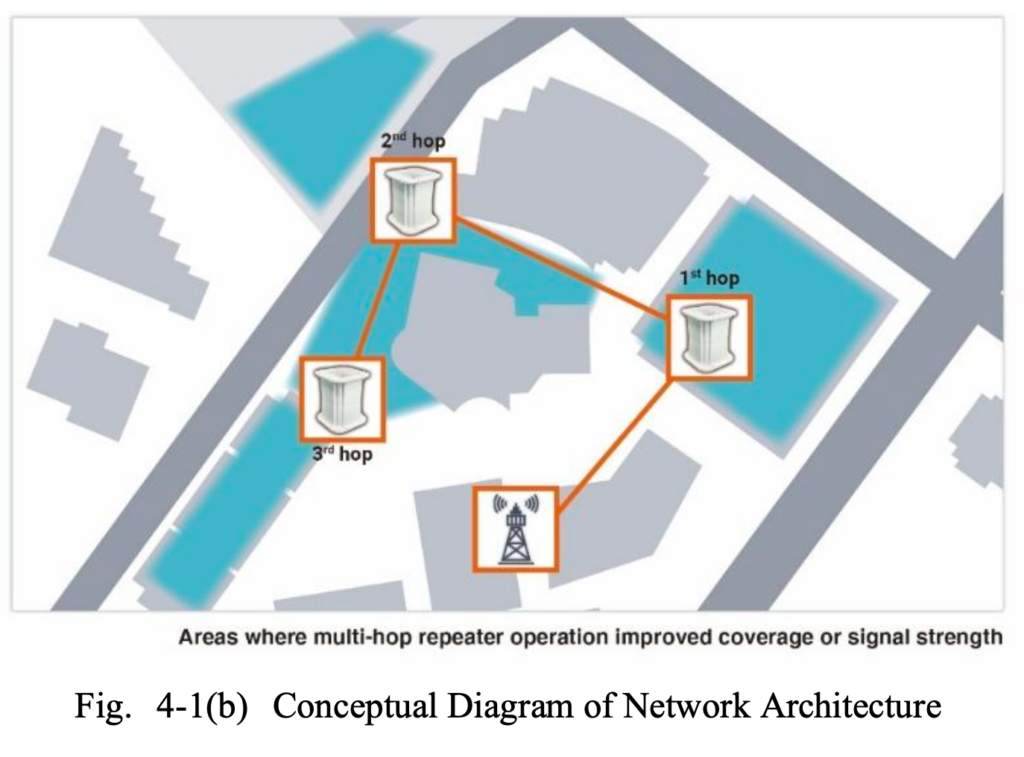
The field validation generated valuable technical insights into radio propagation and operational behavior that are difficult to reproduce in laboratory environments. It demonstrated not only the performance of individual network components, but also the practical feasibility of a multi-hop network architecture for extending high-frequency networks.
5 | Technical implications of the validation
Traditionally, maintaining LOS propagation between the base station and user devices has been regarded as a prerequisite for achieving consistent performance in mmWave networks. However, the validation demonstrated that coordinating multiple repeater nodes in a multi-hop architecture enables coverage to be extended flexibly even in NLOS environments where direct propagation is blocked by buildings, trees, or other physical obstacles. This suggests that multi-hop architectures can significantly broaden the practical deployment scenarios for mmWave networks while reducing one of their most fundamental deployment constraints.
Combining compact, integrated repeater nodes—which consolidate both donor and service functions into a single enclosure—with autonomous control capabilities is expected to simplify installation and reduce operational complexity. In addition, the ability to extend coverage by leveraging existing infrastructure rather than deploying new base stations is expected to accelerate network deployment while optimizing both capital and operational costs, ultimately contributing to a lower TCO.
The multi-hop architecture also demonstrated strong scalability. Because repeater nodes can be added incrementally as service areas expand or traffic demands evolve, MNOs can build and extend networks in a flexible and demand-driven manner. This provides a practical approach to supporting future network expansion and capacity growth in high-frequency spectrum deployments.
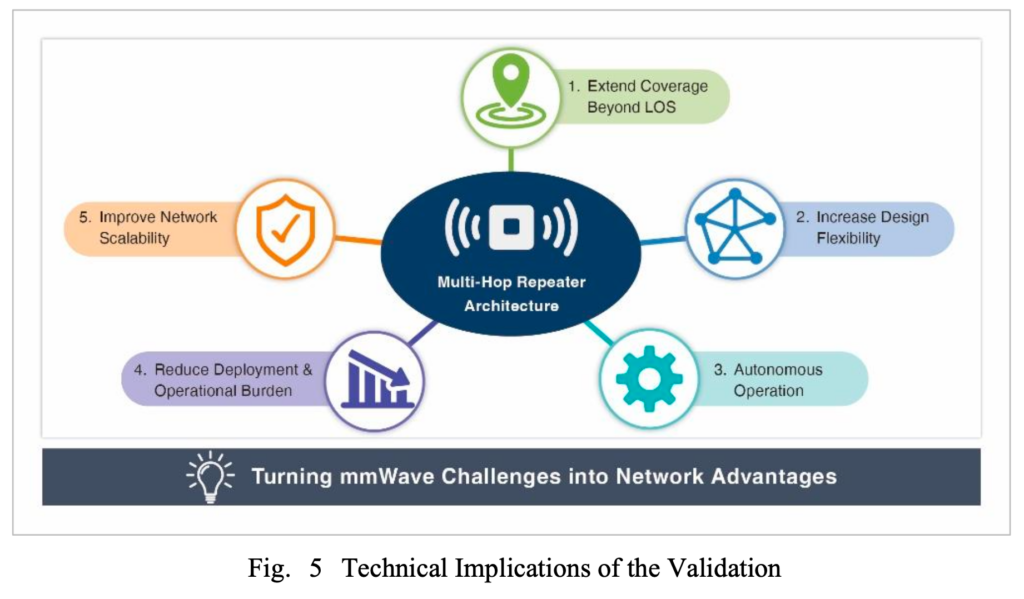
The significance of the validation extends well beyond the performance of the repeater technology itself. Rather, it presents a new architectural option for designing high-frequency networks, and suggests that repeater technology should be viewed not merely as a means of extending radio coverage, but as a foundational building block that enhances the flexibility, scalability, and economic efficiency of deployments.
6 | What it means for MNOs — coverage expansion to maximizing network value
Although mmWave technology delivers exceptional throughput and capacity, its limited propagation range and susceptibility to physical obstructions make wide-area coverage based solely on base station deployment both expensive and complex. The key challenge is no longer simply how to deliver ultra-high-speed connectivity, but how to deliver that performance where it is needed most in an efficient, scalable, and economically sustainable manner.
The value of a multi-hop repeater architecture is now being demonstrated not only through theoretical analysis and simulation, but also through real-world network deployments. For example, a field trial conducted by KDDI Corporation (KDDI) and Kyocera in the Nishi-Shinjuku district of Tokyo reported that road-level coverage in the 28 GHz mmWave network increased from 33% to 99%. Evaluation results indicated an approximately eighteen-fold increase in downlink data traffic, while demonstrating the potential to reduce the nine-year TCO by more than 50%—versus the same coverage through additional base stations alone.
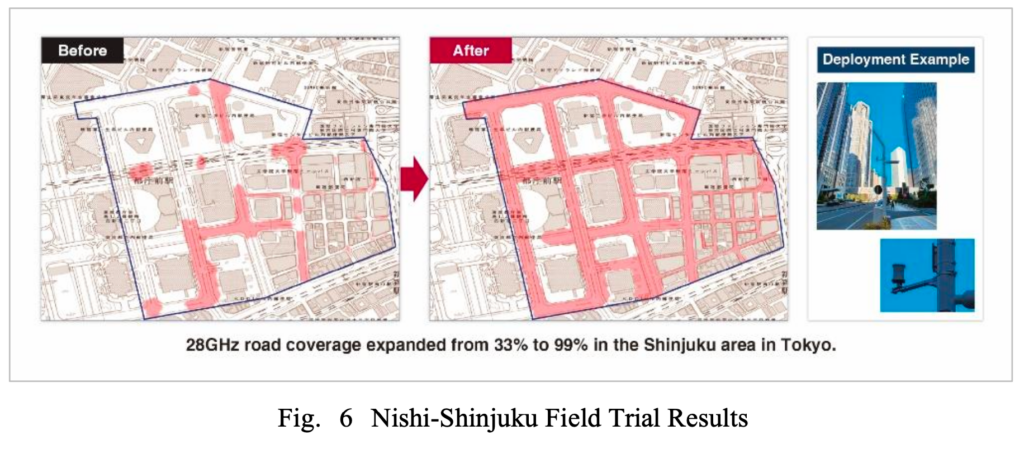
These results should not be interpreted as universally applicable, as each operator has its own spectrum assets, existing infrastructure, traffic characteristics, and investment priorities. Nevertheless, they demonstrate that repeater technology can serve as more than a coverage enhancement solution. Instead, it can become an architectural component capable of simultaneously improving service quality, network capacity, and investment efficiency.
The field validation conducted at the Qualcomm Technologies campus in San Diego reinforces this perspective. It demonstrated that a multi-hop repeater architecture can flexibly extend coverage even in NLOS environments created by buildings, vegetation, and other obstructions. The quantitative results obtained from the two projects provide complementary evidence supporting the practical value of multi-hop architectures. They suggest broad applicability across a wide range of deployment scenarios, including dense urban areas, stadiums, airports, enterprise campuses, industrial facilities, Multi-Dwelling Units (MDUs), and FWA networks.
For MNOs, the key challenge is no longer simply delivering ultra-high-speed connectivity, but ensuring that such performance can be delivered efficiently where it is needed most and sustained through a scalable and economically viable network architecture. Multi-hop repeater architecture represents a compelling approach to addressing this challenge, and has the potential to redefine how high-frequency networks are designed with the evolution of 5G-Advanced and, ultimately, 6G networks.
7 | Future outlook
As 5G continues to evolve, MNO priorities are shifting beyond simply increasing throughput and capacity toward enabling more flexible, intelligent, and operationally efficient networks. Adoption of AI-driven network optimization and autonomous network operation is expected to accelerate with 5G-Advanced, making it increasingly important to balance high service quality with operational efficiency. 6G is expected to utilize even higher frequency spectrum, further increasing the importance of network architectures that effectively address the propagation characteristics and deployment challenges inherent to high-frequency wireless communications.
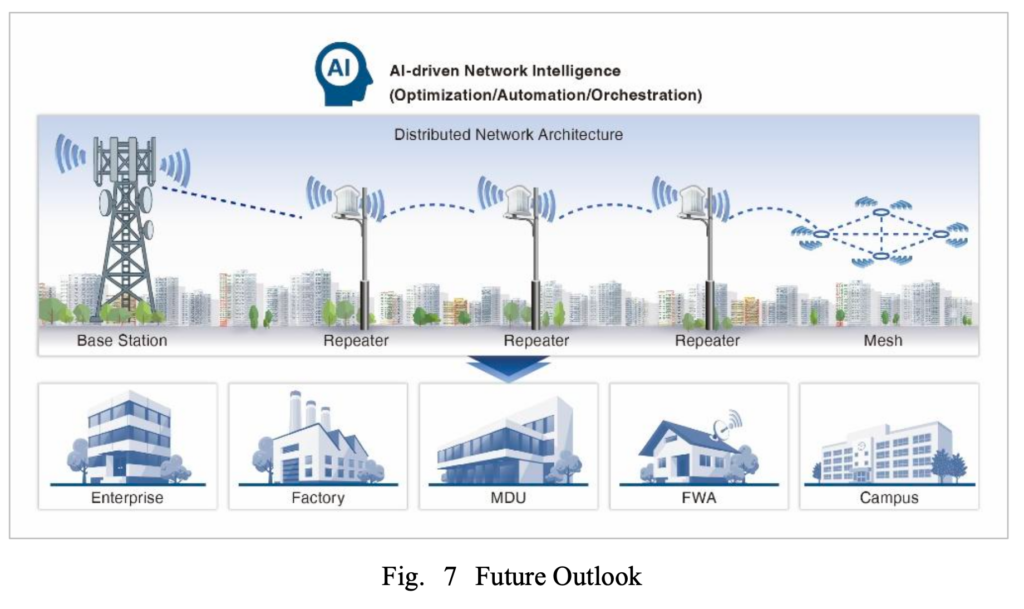
Future networks will depend not only on improvements in base station performance but also on distributed network architectures in which multiple wireless nodes cooperate to dynamically establish and optimize coverage. Technologies such as multi-hop relay and autonomous control are expected to become key architectural building blocks to support this evolution.
This trend is already beginning to emerge in North America. In Canada, for example, localized 28 GHz services for non-MNOs have been introduced since 2025, while large-scale commercial mmWave deployment by major MNOs is still in its early stages. Spectrum auctions for the 26 GHz and 38 GHz bands are scheduled for 2027, with broader commercial deployment expected from 2028. MNOs that begin technology validation and network architecture planning before spectrum acquisition will be better positioned to accelerate commercial rollout and establish a competitive advantage with their commercial deployments.
Looking ahead, advances in AI are expected to enable dynamic optimization of communication paths and real-time adaptation of network topology based on traffic demand. This will make it possible to optimize the entire network—including repeater nodes—as an integrated system rather than managing network elements independently. Such capabilities will support the efficient delivery of high-quality connectivity across a wide range of deployment scenarios, from dense urban environments and enterprise campuses to industrial facilities and FWA networks.
The future of high-frequency wireless networks will depend not only on improving radio performance, but also on how efficiently that performance can be delivered where it is needed most. The real-world validation presented in this article demonstrates one practical approach to addressing this challenge while highlighting the direction of future architecture for 5G-Advanced and beyond. Multi-hop repeater architecture has the potential to become a key enabler of next-generation network design by balancing service quality, coverage expansion, and investment efficiency.
8 | Industry perspective
Sunil Patil, Vice President of Product Management, Qualcomm Technologies:
“While mmWave plays a critical role in enabling ultra-high-speed, high-capacity, and low-latency wireless communications, expanding coverage remains one of the key challenges for commercial deployment. We believe Kyocera’s mmWave repeater technology has the potential to address these challenges by enabling more flexible and efficient high-frequency network architectures.
“The enterprise campus selected for this deployment provides an ideal environment for field validation, combining office buildings, outdoor spaces, and diverse mobility scenarios that closely reflect real-world operating conditions. This enables the evaluation of mmWave performance, coverage, and usability in practical deployment environments. Through this validation, we expect to gain valuable insights into the applicability of mmWave networks across a wide range of use cases, including enterprise, educational, and research campuses, commercial facilities, and smart city environments.
“Qualcomm Technologies remains committed to working with industry partners, including Kyocera, to accelerate the adoption of mmWave technologies. Through continued collaboration and innovation, we aim to help advance next-generation wireless infrastructure and support the evolution toward 5G-Advanced and the 6G era.”
Kazuyuki Yoshimura, Senior Managing Executive Officer, CTO and General Manager, Core Technology Sector, KDDI Corporation:
“KDDI has been working together with Kyocera to develop and validate mmWave repeater technology as a practical approach to achieving high-quality and efficient mmWave network deployment. Through our joint efforts, we have found that a multi-hop repeater architecture has the potential to provide a flexible, scalable, and economically efficient approach to building high-frequency wireless networks.
“For example, in a field trial conducted in the Nishi-Shinjuku district of Tokyo, we deployed a network combining mmWave base stations and mmWave repeaters, demonstrating significant expansion of service coverage while also improving throughput and investment efficiency.
“To accelerate the adoption of mmWave technology, it is essential that the industry develop a broad range of solutions capable of extending coverage across diverse deployment environments—not only in dense urban areas, but wherever high-quality connectivity is needed. The field validation at the Qualcomm Technologies campus described in this article represents a valuable effort to evaluate the applicability of a multi-hop repeater architecture in a representative real-world environment outside Japan. From a mobile network operator’s perspective, we hope that initiatives such as this will help expand the mmWave ecosystem and support the sustainable global deployment of high-quality wireless networks.”
About the author: Eiji Hanawa is a business leader at Kyocera focused on next-generation wireless infrastructure and market development. His work includes strategy and business development related to 5G mmWave repeater technology, operator engagement and global expansion opportunities in advanced wireless networks.

