


The gigabit promise stops at the socket. Europe’s Gigabit Infrastructure Act takes fibre into new buildings, but its Wi-Fi spectrum policy leaves the final metres unresolved. In dense apartment blocks, limited 6 GHz capacity threatens to undermine the gigabit promise.
Europe has written gigabit connectivity into building law, but it has not secured the spectrum that carries gigabit to the devices inside. Since 12 February 2026, every new or majorly renovated building in the EU must be fibre-ready, and every new multi-dwelling building must have an access point open to operators.
The fibre now reaches the flat. The last ten meters, where nearly every laptop, TV, phone and smart thermostat connects over Wi-Fi, run on a 6 GHz allocation that Europe has so far capped at 480 MHz. The upper part of the band is being held largely for future mobile networks.
This post explores the gap between the Gigabit Infrastructure Act (GIA) and Europe’s Wi-Fi spectrum policy. It bites hardest in multi-dwelling units (MDUs), where dozens of households share the same air. It is also a question we will put to regulators, operators and vendors at RISER, the European Summit for Residential MDU Connectivity and PropTech, in Amsterdam on April 6-8, 2027.
What the Gigabit Infrastructure Act requires
The Gigabit Infrastructure Act (Regulation (EU) 2024/1309) entered into force on 11 May 2024 and replaced the 2014 Broadband Cost Reduction Directive. Its in-building rules are concrete and, for MDUs, significant:
• Article 10(1): new buildings and major renovations with permit applications filed after 12 February 2026 must have fibre-ready in-building physical infrastructure and in-building fibre wiring, up to the point where the end user connects to the public network.
• Article 10(2): new or majorly renovated multi-dwelling buildings must also be equipped with an access point for operators.
• Article 10(4): Member States had until 12 November 2025 to adopt technical specifications for access points, cables, sockets and ducts.
• Article 11: any network provider may roll out to the access point and request access to in-building infrastructure on fair, reasonable and non-discriminatory terms.
Recital 48 sets the yardstick. By 2030, every end user at a fixed location should be covered by a gigabit network “up to the network termination point”. That is exactly where the Act’s ambition ends.
Search the full text, and the term Wi-Fi does not appear once. Wireless is mentioned, almost always as 5G, which is named seven times. The Act does define in-building infrastructure as able to host wired or wireless access networks, but only between the building access point and the termination point. Everything beyond the termination point, which is where residents actually experience their connection, sits outside its scope.
480 MHz and five wide channels
Europe opened the lower 6 GHz band (5945-6425 MHz) to license-exempt Wi-Fi in 2021 under the Commission Implementing Decision (EU) 2021/1067. The upper band (6425-7125 MHz) is where the fight is. In November 2025, the Radio Spectrum Policy Group (RSPG), the body of national spectrum authorities that advises the European Commission, recommended prioritizing 6585-7125 MHz (540 MHz) for mobile networks and holding 6425-6585 MHz (160 MHz) until the World Radiocommunication Conference in late 2027 (WRC-27), the global treaty conference that sets international spectrum allocations. The Wi-Fi Alliance responded that the 160 MHz was only nominally on hold, with no clear route to Wi-Fi access.
The channel math explains why this matters for buildings. Plum Consulting’s 2024 assessment for the Wi-Fi Alliance, summarized in the Alliance’s September 2026 strategic assessment with Aria Consulting, counts five 160 MHz channels available in Europe today: two at 5 GHz and three at 6 GHz.
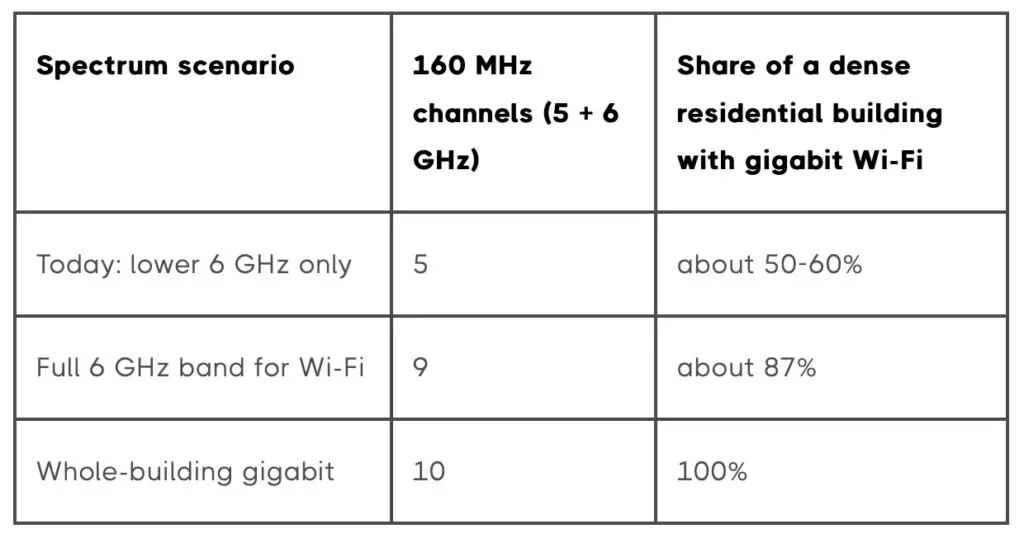
In other words, the EU’s own Digital Decade objective of 1 Gbps for all households cannot be met room by room in a dense building on today’s allocation. Opening the upper band closes most of the gap; nothing else does.
The effect already shows in usage data. Ookla’s Q1 2026 figures, cited in the same assessment, put 6 GHz at 1.6% of European Wi-Fi samples against 13.8% in North America. The access points and phones sold in Europe are largely the same hardware sold in the US; the upper 6 GHz capability is simply switched off.
The UK has already chosen a different path. Ofcom, the UK communications regulator, has set out a hybrid split that gives Wi-Fi priority in 6425-6585 MHz and mobile priority above it, while allowing license-exempt Wi-Fi across the mobile-priority portion under automated frequency coordination.
Inconsistencies with spectrum policy
Building infrastructure and spectrum are handled by different parts of the EU machine, and the seams show. None of these is a technical disagreement; each is a policy gap.

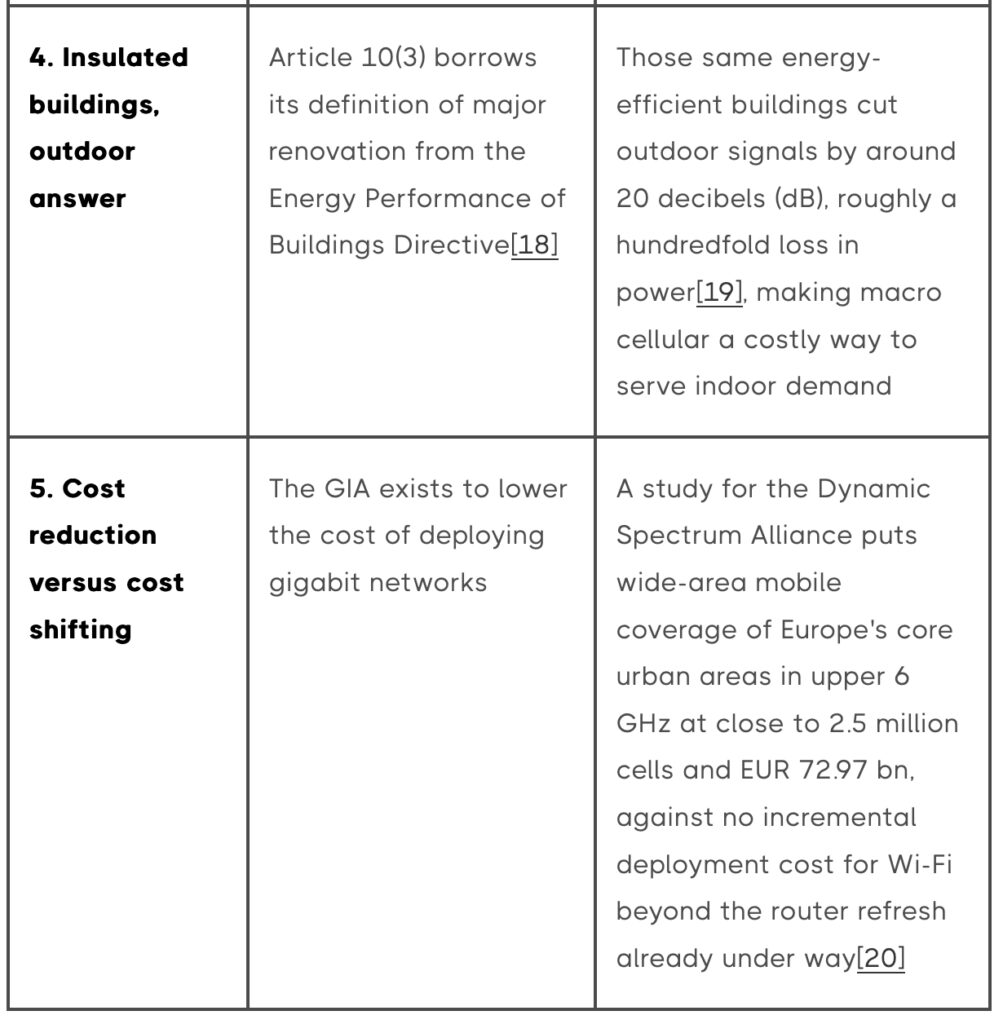
The fourth point deserves emphasis. Brussels is pushing two building policies at once: tighter thermal envelopes and fibre-ready wiring. Both make the inside of the building the place where connectivity has to be solved, and both make Wi-Fi more important, not less.
Why MDUs feel it first
A detached house with one router can live comfortably on today’s channels. An apartment block cannot. Picture forty flats, each with a router from a different provider, plus smart meters, TVs, thermostats and the cars parked below, all active during the evening busy hour. Every one of those access points competes for the same handful of wide channels, and performance drops exactly when residents need it most.
Europe’s MDU model makes this worse. In most European buildings, each household buys its own broadband, self-installs a consumer-grade router, and gets no building-level channel planning, monitoring, or service level. In the US, building-wide managed Wi-Fi, where one provider designs and runs a single network across every unit and common area, is now mainstream in new multifamily. In our recent interviews with European regulators, that model was largely unfamiliar. Bringing that operational experience into the European conversation is one of the reasons Maravedis and HanseCom created RISER.
The GIA unintentionally reinforces the unmanaged pattern. Article 11 opens the building access point to every operator, which helps retail competition in the riser. It says nothing about coordinating the air inside the building, so each new entrant simply adds another uncoordinated router to the stack.
Managed Wi-Fi uses scarce spectrum far more efficiently, because access points can be placed and tuned as one system. But planning cannot create channels that regulation has withheld. As Wi-Fi Alliance CEO Kevin Robinson told us on Industry Shakers in 2025, cellular is unlikely to serve indoor users “in a way that is economically feasible”. Wi-Fi still has to do the indoor job; the only question is how much spectrum it gets to do it.
The window that‘s still open
Nothing is final yet. The RSPG opinion is advisory. Under the Commission’s mandate to CEPT (the European Conference of Postal and Telecommunications Administrations, which prepares harmonized spectrum rules for 46 European countries), the sharing-scenario conclusions are due around 30 October 2026, harmonized technical conditions follow in July 2027, and WRC-27 meets at the end of 2027. The CEPT sharing conclusions will therefore be public by the time RISER convenes in April 2027, three months before the harmonized technical conditions are due, which makes the summit a timely place to test them against real buildings.
A second door is the Digital Networks Act, proposed on 21 January 2026 to replace the European Electronic Communications Code. The European Parliament decides on it on an equal footing with the Council. That matters: Members of the European Parliament (MEPs) answer to residents rather than to spectrum budgets, and several are starting to ask why Wi-Fi is missing from Europe’s connectivity strategy. In June 2026, the Wi-Fi Alliance, the Dynamic Spectrum Alliance and others called on lawmakers to recognize Wi-Fi as a key enabler of the Digital Decade targets.
The question policymakers keep putting to the Wi-Fi camp is simple: why can’t you do this with the spectrum you already have? The MDU is the clearest answer, and it can be quantified. We would put four practical asks on the table:
- Measure gigabit where people use it. Digital Decade reporting should track delivered speed at the device inside dense buildings, not only coverage at the termination point.
- Authorize low-power indoor Wi-Fi in the upper band now. Indoor-only use protects outdoor incumbents and keeps the option open to identify the band at WRC-27 for International Mobile Telecommunications (IMT), the international term for 5G and 6G mobile systems.
- Make technology neutrality explicit in the Digital Networks Act. Name Wi-Fi alongside fibre, 5G and satellite as part of the gigabit chain.
- Extend fibre-ready to wireless-ready. The Article 10(4) specifications and the voluntary fibre-ready label could add simple provisions for in-unit and common-area access point locations, so new MDUs are built for managed Wi-Fi from day one.
Behind those asks sits an evidence gap. Nobody has yet put a euro value on what a connected building delivers in Europe: resident savings from bulk connectivity, digital inclusion in social and student housing, energy and water savings from smart-building systems, and jobs in a European PropTech (property technology) and managed services ecosystem. Those are numbers politicians respond to. Closing that gap will be a running thread at RISER, from the workshop day on April 6 to the two main conference days that follow.
The Maravedis take
Europe is building a fibre motorway into every apartment block and then narrowing it to a single lane at the front door. The GIA was right to treat buildings as infrastructure. The inconsistency is treating the building’s radio layer as someone else’s problem.
The fix does not require choosing Wi-Fi over mobile. It requires recognizing that indoor demand needs an indoor answer, and that the GIA’s gigabit promise is kept only if the last ten meters have the spectrum to carry it. MDUs are where the gap is widest, easiest to measure, and where the economic case is strongest.
Maravedis is currently mapping MDU connectivity across Europe’s largest markets, and we will put this debate on stage at RISER in Amsterdam on April 6-8, 2027, the summit we co-produce with HanseCom. Regulators, operators, building owners, fiber and Wi-Fi vendors: if you have a view on how Europe closes the last-ten-meters gap, we want you in the room. Register your interest at risereurope.com.

