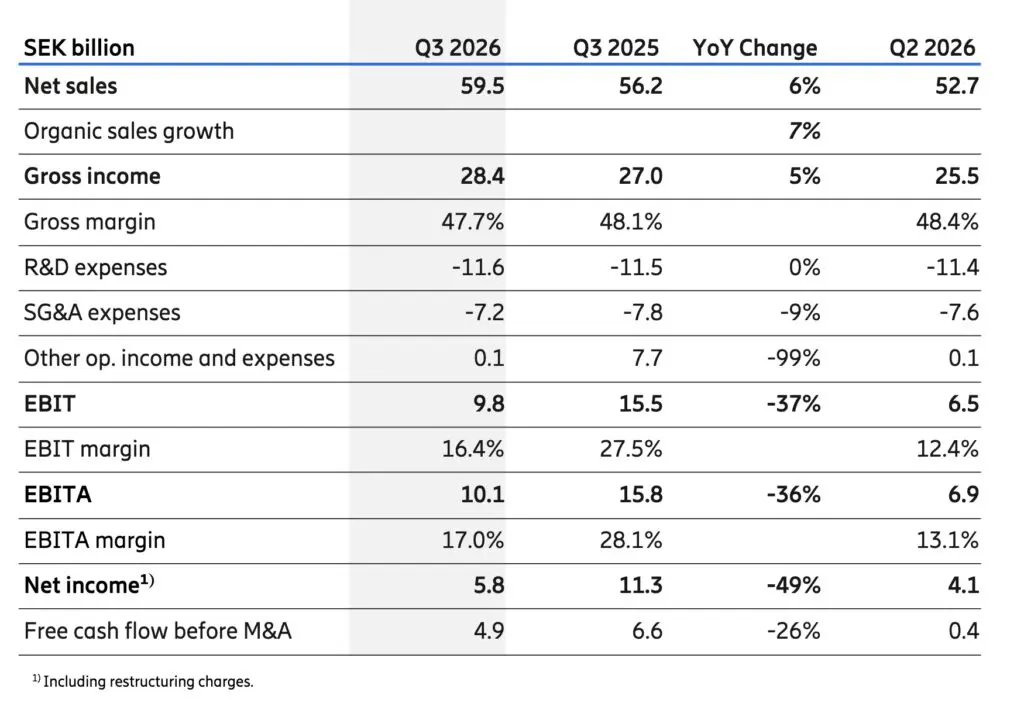
Ericsson beat Q3 earnings forecasts on seven percent organic sales growth, but warned AI-driven component costs will pressure margins through 2027, and said growth remains hard to come by – to the point, almost, it has rejigged enterprise wireless as a Starlink-adjacent indoor R&D exercise.
In sum – what to know:
Earnings beat – Ericsson’s adjusted EBITA beat forecasts by 28%, but rising component costs, price increases, and multi-year contracts complicate its margin outlook.
Enterprise reshuffle – The firm is folding enterprise wireless into its networks unit to improve R&D synergies and growth, while also creating a new APAC sales region.
Elusive growth – Flat RAN market remains the big challenge, says CEO Per Narvinger, while enterprise and AI-related opportunities are yet to deliver broad 5G monetization.
Ericsson grew organic sales by seven percent in the third quarter, driven primarily by its ‘networks’ business. It beat expectations – hands-down, it seems; by as much as 27 percent on its EBITA scores – and claimed positive growth across every business unit. But it also warned that some customers have bought equipment in the quarter ahead of price increases, and that higher component costs will put pressure on gross margins through 2027 as the radio access network (RAN) market remains flat. Ericsson said it will pass on higher costs.
Besides, in something of a parallel to Nokia’s announcement yesterday about the sale of its campus 5G business, the Swedish vendor has also moved to reorganize its under-performing ‘enterprise wireless’ division, which has been (mostly) shunted back into its ‘networks’ business to “create R&D synergies… and scale” – and also to drive customer growth. Interestingly, it said part of its future R&D focus will be to dovetail with satellite networks from the likes of Starlink in indoor enterprise environments.
Ericsson will create a new Asia Pacific (APAC) sales business from January, combining its activities in North East Asia, South East Asia, Oceania, and India – to operate more effectively “across the region… [and] at country and customer level”. Its APAC business will be headed by Patrick Johansson, in charge of its EMEA unit; it is recruiting for his replacement in EMEA. Åsa Tamsons, head of ‘enterprise wireless solutions’, its equivalent to Nokia’s ECE unit, will support the integration of its enterprise portfolio through the end of the year – and “transition” after that.
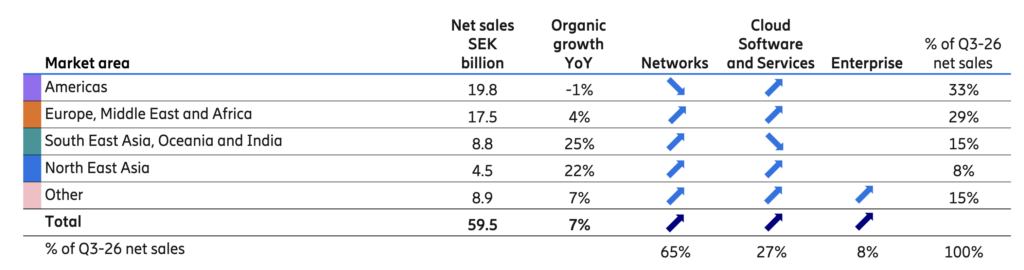
Reported sales rose to SEK 59.5 billion from SEK 56.2 billion a year earlier; adjusted EBITA fell 36 percent to SEK 10.1 billion from SEK 15.8 billion – although the year-ago figure included a SEK 7.6 billion capital gain. The figure would have increased without the gain, it reasoned. Adjusted gross margin slipped to 47.7 percent from 48.1 percent, while free cash flow before mergers and acquisitions fell to SEK 4.9 billion from SEK 6.6 billion. Net income declined to SEK 5.8 billion from SEK 11.3 billion, with the prior-year also benefiting from a divestment gain.
Per Narvinger, in his first earnings call since taking over from Bjore Ekholm as chief executive in June, said customer demand remained solid in strategic markets, supported by commercial actions and deployments across network modernization, differentiated connectivity, and mission-critical networks (!). But the RAN market is flat, he repeated, and component costs will be a headwind to gross margin next year. Its portfolio optimization, pricing measures, and efficiency improvements will offset those pressures, he said.
There were some good quotes from Narvinger about AI RAN and baseband GPUs, which will be covered elsewhere – along with further coverage of changes to its private 5G and neutral host business. But Narvinger was candid (and best) in a Q&A session on the earnings call, where he conceded the cost problem is structural, and not just a short-term squeeze, and directly linked to the “AI boom”. He said: “With the development of AI, many new applications are going to be dependent on mobile connectivity. Networks will need to be more reliable and resilient.
“With AI models optimized for use cases, leveraging Ericsson’s purpose-built silicon, we [will help] customers get more out of their spectrum assets without increasing power consumption. We will continue to invest and make sure we stay at the forefront of this development. At the same time, we remain realistic about the market. The RAN market is broadly flat and component costs are increasing in the wake of the AI boom. We’ve been able to mitigate this with tactical actions such as product substitution and upselling. [But] these efforts will not be enough long-term.”
He added: “We are also taking structural action, including portfolio optimization, raising prices, supply chain measures, and efficiency improvements. Many customer contracts are multi-year, so structural mitigations will take time to flow through. We will not be immune to higher component costs, but protecting the value of our technology and profitability of our mobile networks business remains our top priority.”
The whole industry’s biggest challenge, he suggested, is to find growth in a “very flattish” market. Cost discipline might protect profitability, but it won’t create a growth market – is the point. He explained: “You can put growth in different buckets. You can put [it in a bucket about] working with what you have. We [will make] market share gains whenever it makes sense. You can put it in another bucket where you help your customers to deploy new use cases and increase revenue, [and expect] more money to flow [back in your] direction.”
He went on: “And there’s [a bucket called] business development, about what you do in adjacent fields – such as with mission critical networks, and how to leverage sensing technologies for different industries, including defense. And I’d put enterprise [wireless] in that bucket [too] – because we haven’t really gotten the growth or the benefit [yet] from what you could do – more in the enterprise segment than with network APIs. Finding long-term growth is of course something we are working on, but there are different types of buckets.”
Again, we will cover the enterprise wireless discussion separately.
And not new, but worth quoting: Parvinger said 5G monetization is advancing, but slowly. Some operators are using 5G SA functionality, including slicing and quality-on-demand services, but volumes are not very significant. “We start talking about what is possible so long in advance that when it actually starts happening, it becomes old news. But some customers are making use of the 5G SA functionality – which is something we’ve [talked] about for a long time. [But it is not] happening in volume yet.” It was a good reality check, late in the call.
Narvinger talked about ‘mission critical networks’, too – overlapping in terms of customer demands with private campus 5G, if not in terms of scale. Like Nokia, Ericsson is keeping its ‘wireless WAN’ solutions, for larger-scale private wireless effectively, as a standalone business, reporting to Yossi Cohen, head of its ‘Americas’ business. He said: “Mission critical, which is quite different in nature… If you sell a new blue light network, it’s an entire network, and it is black or white: you have one or you don’t. It is a very good [piece of] business today. But we are [still] waiting for the kinds of use cases [that make] use of the quality-on-demand functionality that we have in 5G SA.”
He said: “Again, think of AI applications. I’m convinced people [will be] so dependent on AI agents they will want guaranteed… access to that agent always. Which means you cannot have… [this] best effort paradigm, [as you have today]… An AI agent speaks [to the idea of] having this kind of network slicing where you have different quality on different services. So this will happen. It is a matter of time. And we see good examples of this being implemented worldwide even if the volume is not there.”