

RCR Wireless
  • News
  • Channels
    • 5G
    • 6G
    • BSS OSS
    • Carriers
    • IoT
    • Network Infrastructure
    • Open RAN
    • Private 5G
    • Telco AI
    • Telco Cloud
    • Test & Measurement
  • Resources
    • Reports
    • Webinars
    • White papers
    • AI Fundamentals
    • Analyst Angle
    • Editorial Calendar
    • Fundamentals
      • 5G NR Release 17
      • AI
        • Telco AI in 2025
    • Podcasts
      • Let’s Get Digital with Carrie Charles
      • Wireless Connectivity to Enable Industry 4.0 for the Middleprise
      • Well Technically…
      • Will 5G Change the World
      • Accelerating Industry 4.0 Digitalization
  • AI Infrastructure
  • Programs
  • Events
  • RCRtv
  • Advertise
  • Subscribe
Thursday, September 10, 2026
RCR Wireless
  • News
  • Channels
    • 5G
    • 6G
    • BSS OSS
    • Carriers
    • IoT
    • Network Infrastructure
    • Open RAN
    • Private 5G
    • Telco AI
    • Telco Cloud
    • Test & Measurement
  • Resources
    • Reports
    • Webinars
    • White papers
    • AI Fundamentals
    • Analyst Angle
    • Editorial Calendar
    • Fundamentals
      • 5G NR Release 17
      • AI
        • Telco AI in 2025
    • Podcasts
      • Let’s Get Digital with Carrie Charles
      • Wireless Connectivity to Enable Industry 4.0 for the Middleprise
      • Well Technically…
      • Will 5G Change the World
      • Accelerating Industry 4.0 Digitalization
  • AI Infrastructure
  • Programs
  • Events
  • RCRtv
  • Advertise
  • Subscribe
Add RCR Wireless as a preferred source on Google
  • Qualcomm 6G Insights
  • Huawei Content Hub
  • Qualcomm – 6G Vision
  • OSS/BSS Channel
  • RCRTech Roundtable: AI Infrastructure
RCR Wireless
RCR Wireless
  • Advanced Mimo
  • Mobile mmWave
  • 5G Positioning
  • Green Networks
  • Metaverse
  • Automotive
  • Industrial and Wide-area IoT
Copyright 2021 - All Right Reserved
Home - Demystifying cellular patents and licensing Part 3: All patents are not created equal (Analyst Angle)
5GAnalyst Angle

Demystifying cellular patents and licensing Part 3: All patents are not created equal (Analyst Angle)

by Prakash Sangam June 3, 2019
written by Prakash Sangam June 3, 2019 Share
LinkedinEmail
Share 0LinkedinEmail
283

The statement “All patents are not created equal” seems like a cliché, but is absolutely true! The differences between patents are multi-dimensional and much more nuanced than what meets the eye. I slightly touched upon this in my previous article. There is denying that going forward, patents will play an increasingly bigger role in cellular, not only pitting companies against each other but also countries against one another for superiority and leadership in technology. Hence it is imperative that we understand how patents are differentiated, and how their value changes based on their importance.

image2

Let me start with a simple illustration. Consider today’s cars, which have lots of different technologies and hence patents. When you compare the patents for the car engine, to say, the patents for the doors, the difference between relative importance is pretty clear. If you look at the standards for building a car, probably the patents for both the engine and the door are listed as listed essential, i.e., SEPs (Standard Essential Patents). However, the patent related to the engine is at the core of the vehicle’s basic functionality. The patent for the door, although essential, is clearly less significant. Another way to look at this is, without the idea of building the engine; there is not even a need for the idea for doors. That means the presence of one is the reason for other’s existence. The same concepts also apply to cellular technology and devices. Some patents are invariably more important than others. For example, if you consider the 5G standard, the patents that cover the Scalable-OFDMA are fundamental to 5G. These are the core of 5G’s famed flexibility to support multiple Gigabits of speeds, very low latency, and extremely high reliability. You can’t compare the value of that patent to another one that might increase the speed by a few kilobits in a rare use case. Both patents, although being SEPs, are far apart in terms of value and importance.  

On a side note, if you would like to know more about SEPs, check out my earlier article here.

That brings us to another classic challenge of patent evaluation—patent counting. Counting is the most simplistic and easy to understand measure—whoever has the most patents is the leader! Well, just like most simple approaches, counting also has a big issue—it is highly unreliable. Let me again explain it with an illustration. Consider one person having 52 pennies and a second person having eight quarters. If we apply simple counting as a metric, the first person seems to be the winner, which can’t be farther from the truth. Now applying the same concept to cellular patents, it would look stupid to call somebody a technology leader purely based on the number of patents they own, unless you know what they are.
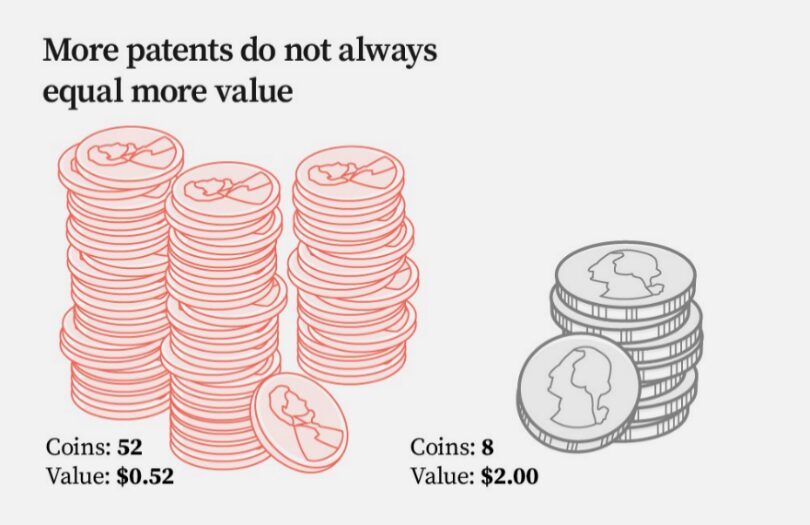
image1

When you look at the 5G standard, it has thousands of SEPs. If you count patents for Scalable-OFDMA and other similar fundamental and core SEPs with the same weight as minor SEPs that define peripheral and insignificant protocols and other things, you would be highly undervaluing the building blocks of the technology. So, simply counting without understanding the importance of the patents for technology leadership is very flawed. Also, the process of designating a certain patent as a SEP or not is nuanced as well, which makes the system vulnerable to rigging and manipulation, resulting in artificially increased SEP counts. I will cover this in the later articles. This potential for inflating the numbers further exacerbates the problem of patent counting.

In conclusion, it is amply clear that all patents are not created equal, and simpleton patent counting is not the best measure to understand the positioning of somebody’s technology prowess. One has to go deeper and understand their importance to realize the value. In my next articles, I will discuss the key patents that define 5G and explore alternate methods for patent evaluations that are possibly more robust and logical. In the meantime, beware and don’t be fooled by entities claiming to be leaders because of the sheer volume of their patent portfolio.


 

You Might Also Like
  • New Matter API puts the operator gateway back in the smart home (Analyst Angle)
  • The good, the bad, the okay – growth and opportunities in prepaid wireless (Analyst Angle)
  • VodafoneThree intros tiered 5G SA slicing portfolio for consumers, enterprises, critical services
  • ZTE’s computing business drives H1 growth as carrier spending weakens
  • Omdia sees RAN growth outside China despite weak global market
  • Preparing base station antenna sites for the 5G-Advanced and AI era (Analyst Angle) 
Share 0 LinkedinEmail
Prakash Sangam

Prakash Sangam is the founder and principal at Tantra Analyst, a leading research and consultancy firm covering IP strategy, 5G, IoT, AI, as well as client and cloud computing. He has more than 20 years of wireless industry experience working for Qualcomm, Ericsson, and AT&T. A prolific writer, blogger, and speaker, Prakash enjoys analyzing technical and business challenges and transforming them into impactful strategies and persuasive messaging. He is a regular contributor to Forbes, EETimes, RCR Wireless, Medium, and other leading publications and has been on the speaking circuit for leading industry events, including Mobile World Congress, and CTIA. Prakash holds a Bachelor’s of Engineering in electronics and communications from Karnatak University in India, and a Masters of Business Administration from San Diego State University. He can be reached on twitter @MyTechMusings

previous post
Kagan: 5G wireless patent quality counts more than quantity
next post
Recent 5G trial activity in China focuses on industrial enablement

White Papers

  • Norton eBook: The 2026 Telco Playbook

  • Enea White Paper: Why Intelligent AAA is the Swiss Army Knife of Telecom

  • CSG White Paper: Telco AI Enabler: Mediation’s Defining Role

  • Enea White Paper: Scalable Database Design for 5G and Beyond

  • Supermicro and NVIDIA Whitepaper: Powering sovereign AI at scale

Editorial Reports

  • Report: Building 6G — Aligning technology, policy and purpose

  • Report: Rethinking the RAN

  • Report: Building AI-Era Network Fabrics

Webinars

  • Appledore Webinar: Closing the Agent-Ready Data Gap for Autonomous Networks

  • Mimosa Webinar – Build the Right Network

  • Webinar: Building 6G — aligning technology, policy and purpose

  • SIMCom Webinar: Scaling your next deployment – from plastic to provisioning

  • Webinar: Rethinking the RAN as AI, cloud and openness converge

Since 1982, RCR Wireless News has been providing wireless and mobile industry news, insights, and analysis to mobile and wireless industry professionals, decision makers, policy makers, analysts and investors.

Facebook Twitter Youtube Linkedin Envelope Rss

Useful Links

  • Subscribe
  • About RCR Wireless News
  • Contact Us
  • Advertise
  • Editorial Calendar
  • Archive
  • RSS
  • Wireless News Archive
  • Subscribe
  • About RCR Wireless News
  • Contact Us
  • Advertise
  • Editorial Calendar
  • Archive
  • RSS
  • Wireless News Archive

Edtior's Picks

High bandwidth, high fidelity: Vertex 6.0 delivers emulation for ISAC, 6G and more
New Matter API puts the operator gateway back in the smart home (Analyst...
AT&T strikes deal with Amazon Leo – as EU operators seek D2D stake,...

Latest Articles

High bandwidth, high fidelity: Vertex 6.0 delivers emulation for ISAC, 6G and more
New Matter API puts the operator gateway back in the smart home (Analyst Angle)
AT&T strikes deal with Amazon Leo – as EU operators seek D2D stake, US opens D2D tap
Nokia says AI pushes optical networks into the scale-across era

© 2026 RCR Wireless News All Right Reserved. Developed by Eight Hats.

Cookie Policy | Privacy Policy

RCR Wireless
  • News
  • Channels
    • 5G
    • 6G
    • BSS OSS
    • Carriers
    • IoT
    • Network Infrastructure
    • Open RAN
    • Private 5G
    • Telco AI
    • Telco Cloud
    • Test & Measurement
  • Resources
    • Reports
    • Webinars
    • White papers
    • AI Fundamentals
    • Analyst Angle
    • Editorial Calendar
    • Fundamentals
      • 5G NR Release 17
      • AI
        • Telco AI in 2025
    • Podcasts
      • Let’s Get Digital with Carrie Charles
      • Wireless Connectivity to Enable Industry 4.0 for the Middleprise
      • Well Technically…
      • Will 5G Change the World
      • Accelerating Industry 4.0 Digitalization
  • AI Infrastructure
  • Programs
  • Events
  • RCRtv
  • Advertise
  • Subscribe
RCR Wireless
  • News
  • Channels
    • 5G
    • 6G
    • BSS OSS
    • Carriers
    • IoT
    • Network Infrastructure
    • Open RAN
    • Private 5G
    • Telco AI
    • Telco Cloud
    • Test & Measurement
  • Resources
    • Reports
    • Webinars
    • White papers
    • AI Fundamentals
    • Analyst Angle
    • Editorial Calendar
    • Fundamentals
      • 5G NR Release 17
      • AI
        • Telco AI in 2025
    • Podcasts
      • Let’s Get Digital with Carrie Charles
      • Wireless Connectivity to Enable Industry 4.0 for the Middleprise
      • Well Technically…
      • Will 5G Change the World
      • Accelerating Industry 4.0 Digitalization
  • AI Infrastructure
  • Programs
  • Events
  • RCRtv
  • Advertise
  • Subscribe
@2020 - All Right Reserved. Designed and Developed by PenciDesign