

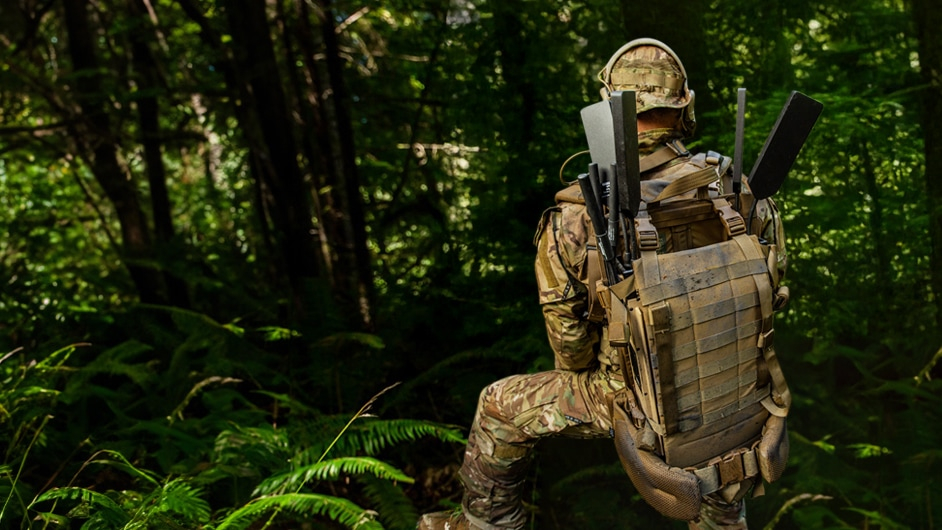
News that Nokia is partnering with Latvian operator LMT to build a 5G tactical communications system for military use in the Baltics underscores how 5G is moving from industrial and enterprise applications into defense. But what exactly is a 5G tactical comms system, and why all the noise suddenly?
In sum – what to know:
Tactical defense – private or portable 5G networks built for military use, delivering high-bandwidth, low-latency, and secure communications at the “tactical edge”.
Key capabilities – includes edge computing for on-site AI/analytics, hybrid architectures to bridge with legacy radios and satellite comms, plus ruggedized hardware.
Field applications – enables situational awareness (ISR), autonomous robot coordination, mobile command and control hubs, edge AI surveillance, and smart logistics.
News from Nokia last week (November 7) about a strategic deal with Latvian mobile operator Latvijas Mobilais Tālis (LMT) to build a 5G tactical comms system for military use in the Baltic region is an example of how 5G is shifting from civilian and enterprise deployments to defense applications – where wireless security, bandwidth, and latency are a strategic asset. It marks a progression, too, of the industrial 5G story, about how private 5G, mostly, is moving beyond factories and warehouses into security infrastructure to connect military-grade sensors, vehicles, and command systems. All told, it reinforces this tale about ‘mission-critical’ 5G, which seeks to redefine connectivity as a force multiplier in the new AI-phase of digital transformation.
So what has Nokia announced – just to cover the news angle? The Finnish vendor has said it has signed a deal with LMT to jointly develop a “unique” 5G-powered tactical communications system to support military vehicles, drones, sensors, personnel, and also enable interoperability among national and coalition forces. It emphasises rapid deployment in rugged environments (a hallmark of tactical systems) and readiness for battlefield conditions. LMT operates Europe’s first 5G military testbed at the Ādaži base, a key NATO site in Latvia. Nokia references its “Banshee” portable 5G/LTE tactical private wireless solution, already used at the Ādaži base, as well as by the US Marine Corps and others.
As further context: market research firm Fortune Business Insights has just released a report that quantifies the trend for military 5G. It says the market was worth $1.14 million in 2024, and will grow at a compound rate (CAGR) of about 21.3 percent per annum to be worth $5.24 million by 2032. It identifies major drivers: integration of high-end autonomous and robotic systems on the land, in the air, and at sea; and militaries transitioning from early pilots to large deployments of private 5G networks. Heightened geopolitical tension is a factor, always. The report also proposes some constraints: cybersecurity and data‑interception risks, and the complexity to deploy reliable networks in contested or degraded environments.
Plus, the defense market, like the industrial market, tends to lag commercial 5G adoption by three-to-five years due to higher assurance, resilience, and regulatory requirements. But there are big opportunities, it says: private/tactical 5G with dedicated spectrum and bespoke design is a major growth frontier, and the interplay of edge 5G with computing processing and AI analytics is becoming central for integrated (land/sea/air) defense operations. North America (mainly the US) dominates the market share, it says; Asia‑Pacific and Europe are identified as high‑growth regions. And vendors span traditional defence primes (like Lockheed Martin and BAE Systems) and wireless vendor firms (Nokia, Ericsson, Samsung), which have form at the intersection of commercial and defence communications.
So there’s some background for you. But let’s strip it back: what even are ‘5G tactical defense systems’?
Basically, 5G tactical defense systems bring amped-up commercial 5G performance to the battlefield – but with defense-grade security, plus edge compute and hybrid networking as standard. They are purpose-built, often portable or private, 5G networks and the associated hardware/software that deliver high-bandwidth, low-latency, resilient and secure communications at the “tactical edge” – in deployed military or defense operations such as bases, ships, and vehicles, and for exercises, engagements, and disaster response.
As discussed, these systems are made, typically in tandem, by major telecom vendors and major defense primes, and put together by specialised integrators (Sabre Systems, Microamp Solutions, Aicox – are references we could find). Certain mobile operators and hardware vendors are also variously involved. (Verizon, Intel, Microsoft, Juniper, and Radisys are referenced alongside Nokia on Lockheed Martin’s website, for example.) National militaries in the US, Sweden, Germany, Baltics, and NATO partners are actively testing and deploying them across surveillance (ISR), autonomous systems, command and control (mobile C2), and logistics cases.
Here are some shorthand bullets to get us through:
Crucial features
- Private / local 5G – isolated network slices or completely private core / RAN deployments for control and security.
- Edge computing – colocated with the radio to run AI/processing close to data sources, and reduce latency and optimise bandwidth.
- Hybrid architecture – to bridge 5G with ad-hoc mesh, SATCOM, vehicular networks, and legacy radios for multi-domain connectivity.
- Ruggedized kit – hardened radios and user devices for operation in tough environments; plus enhanced encryption anchors for security.
Notable examples
- Lockheed Martin (general) – 5G.MIL is a commercial-plus-defense portfolio for unified tactical networking (edge compute, gateways, hybrid mesh) demonstrated in multi-domain exercises. See here.
- Nokia + LMT (Baltics) – as above; a strategic deal for a 5G defense solution to support regional cross-border Baltic defense needs. See here
- Nokia + Blackned / Rheinmetall (Germany) – Nokia has a deal with defence tech firm Blackned (owned by Rheinmetall) to develop next-gen tactical networks for the German army. See here.
- Ericsson + Telia (Sweden) – Ericsson’s is supporting the Swedish Armed Forces to test 5G tactical defense systems; good example of operator/vendor/government collaboration. See here.
Concrete applications
- Battlefield situational awareness – streaming multi-source video (mobile drones, fixed cameras) and data (sensor fusion) at low latency for faster decisions.
- Autonomous system orchestration – coordinating UAVs/UGVs in real-time for navigation, target hand-off, formation control.
- Mobile command / control – rapidly deployable 5G nodes to turn a vehicle, ship, or tent into a high-capacity command hub.
- Edge AI surveillance – on-site inference (object detection, target recognition) to reduce backhaul and speed responses.
- Smart logistics / warehousing – automated inventory, tracking, and resupply on bases and logistics hubs.
Back to the start: the Nokia story says 5G is becoming a strategic asset in defense scenarios. It validates the significance of the connectivity piece, really around edge-computing networks, within broader digital transformation – whether that for private enterprises in industrial domains or militaries and governments in security and defense. Connectivity is no longer just an enabler – as it used to be rather dismissively celebrated – but a piece of mission-critical infrastructure.

