
RCR Wireless
  • News
  • Channels
    • 5G
    • 6G
    • BSS OSS
    • Carriers
    • IoT
    • Network Infrastructure
    • Open RAN
    • Private 5G
    • Telco AI
    • Telco Cloud
    • Test & Measurement
  • Resources
    • Reports
    • Webinars
    • White papers
    • AI Fundamentals
    • Analyst Angle
    • Editorial Calendar
    • Fundamentals
      • 5G NR Release 17
      • AI
        • Telco AI in 2025
    • Podcasts
      • Let’s Get Digital with Carrie Charles
      • Wireless Connectivity to Enable Industry 4.0 for the Middleprise
      • Well Technically…
      • Will 5G Change the World
      • Accelerating Industry 4.0 Digitalization
  • AI Infrastructure
  • Programs
  • Events
  • RCRtv
  • Advertise
  • Subscribe
Wednesday, August 19, 2026
RCR Wireless
  • News
  • Channels
    • 5G
    • 6G
    • BSS OSS
    • Carriers
    • IoT
    • Network Infrastructure
    • Open RAN
    • Private 5G
    • Telco AI
    • Telco Cloud
    • Test & Measurement
  • Resources
    • Reports
    • Webinars
    • White papers
    • AI Fundamentals
    • Analyst Angle
    • Editorial Calendar
    • Fundamentals
      • 5G NR Release 17
      • AI
        • Telco AI in 2025
    • Podcasts
      • Let’s Get Digital with Carrie Charles
      • Wireless Connectivity to Enable Industry 4.0 for the Middleprise
      • Well Technically…
      • Will 5G Change the World
      • Accelerating Industry 4.0 Digitalization
  • AI Infrastructure
  • Programs
  • Events
  • RCRtv
  • Advertise
  • Subscribe
Add RCR Wireless as a preferred source on Google
  • Qualcomm 6G Insights
  • Huawei Content Hub
  • Qualcomm – 6G Vision
  • OSS/BSS Channel
  • RCRTech Roundtable: AI Infrastructure
RCR Wireless
RCR Wireless
  • Advanced Mimo
  • Mobile mmWave
  • 5G Positioning
  • Green Networks
  • Metaverse
  • Automotive
  • Industrial and Wide-area IoT
Copyright 2021 - All Right Reserved
Home - The EC updates AI Act, banning systems that pose ‘unacceptable risk’
AI-Machine-LearningPolicy

The EC updates AI Act, banning systems that pose ‘unacceptable risk’

by Catherine Sbeglia Nin February 5, 2025
written by Catherine Sbeglia Nin February 5, 2025 Share
LinkedinEmail
Share 0LinkedinEmail
EU AI Act
Courtesy of the European Commission
394

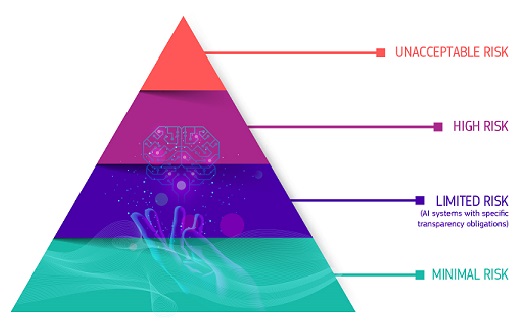
The AI Act defines four levels of risk for AI systems: Unacceptable risk, high risk, limited risk and minimal risk

The European Union’s (EU) Artificial Intelligence Act (AI Act), first unveiled in 2023, set a common regulatory and legal framework for the development and application of AI. It was proposed by the European Commission (EC) in April 2021 and passed in the European Parliament in May 2024. This week, the EC established new guidelines that prohibits the use of AI practices whose risk assessment is deemed “unacceptable,” while “high.”

The EC’s website explains that the AI Act has defined four levels of risk for AI systems: Unacceptable risk, high risk, limited risk and minimal risk.

Unacceptable risk AI systems, or those considered a “clear threat to the safety, livelihoods and rights of people,” are now banned in the EU. These include things like social scoring, internet or CCTV material scraping for facial recognition databases and harmful AI-based manipulation, deception and exploitation of vulnerabilities.

While not prohibited, the EC will also monitor AI systems categized as “high risk.” These include applications that appear to have been created in good faith but could lead to devasting consequences if something were to go wrong. Examples include: AI safety components in critical infrastructures whose failure could put the life and health of citizens at risk, such as transportation; AI solutions used in education institutions that may determine the access to education and course of someone’s professional life, such as exam scoring; AI-based safety components of products, such as robot-assisted surgery; and AI use-cases in law enforcement that may interfere with people’s fundamental rights, such as evidence evaluation.

Before a high risk AI system can be place on the market, it must undergo a “conformity” assessment and comply with all AI Act requirements. Then the system must be registrared standalone in a database and must bear the Conformité Européene (CE) Mark, which has been used to regulate goods sold within the European Economic Area (EEA) since 1985.

Enforcement of the act will be overseen b national regulators, and those companies found to be non-compliant will be slapped with hefty financial penalties of €35 million or more, depending on global annual revenue. Additionally, those engaging in prohibited AI practices may also be banned from operating in the EU at all.

For most AI developers in the region, though, none of this will be necessary. That’s because, according to the EC, the majority of AI systems currently used in the EU present minimal or no risk.

“The AI Act ensures that Europeans can trust what AI has to offer,” the EC stated. “While most AI systems pose limited to no risk and can contribute to solving many societal challenges, certain AI systems create risks that we must address to avoid undesirable outcomes.”

For an AI Act deep dive, check out “Five things to know about the European AI Act.”

You Might Also Like
  • Huawei sees Mobile AI driving new wave of uplink network investment
  • Monday (telco diary) | Sovereign AI for Industry 4.0
  • Subsea shift – ITU and FCC redraw rules for global cable resilience
  • How the FCC can protect IoT innovation and GPS resilience in the 900 MHz band (Reader Forum)
  • Elisa says AI automation has cut network incidents by over 80%
  • India tightens scrutiny of foreign satellite operators as Jio expands space ambitions
Share 0 LinkedinEmail
Catherine Sbeglia Nin

Catherine Sbeglia Nin is the Managing Editor for RCR Wireless News, where she covers topics such as Wi-Fi, network infrastructure, AI and edge computing. She also produced and hosted Arden Media's podcast Well, technically... After studying English and Film & Media Studies at The University of Rochester, she moved to Madison, WI. Having already lived on both coasts, she thought she’d give the middle a try. So far, she likes it very much.

previous post
Test and Measurement: ATIS expands Open RAN MVP
next post
SK Telecom joins MIT Generative AI Impact Consortium

White Papers

  • Norton eBook: The 2026 Telco Playbook

  • Enea White Paper: Why Intelligent AAA is the Swiss Army Knife of Telecom

  • CSG White Paper: Telco AI Enabler: Mediation’s Defining Role

  • Enea White Paper: Scalable Database Design for 5G and Beyond

  • Supermicro and NVIDIA Whitepaper: Powering sovereign AI at scale

Editorial Reports

  • Report: NTN in motion — evolving standards, expanding services

  • Market Pulse Report: Telco AI in 2026 – Trends, Challenges and Opportunities

  • Nvidia Report: The State of AI in Telecommunications: 2026 Trends

Webinars

  • Webinar: Building 6G — aligning technology, policy and purpose

  • SIMCom Webinar: Scaling your next deployment – from plastic to provisioning

  • Webinar: Rethinking the RAN as AI, cloud and openness converge

  • Webinar: Scale-Up, Scale-Out, Scale-Across – Building AI-Era Network Fabrics

  • Webinar: NTN in motion – evolving standards, expanding services

Since 1982, RCR Wireless News has been providing wireless and mobile industry news, insights, and analysis to mobile and wireless industry professionals, decision makers, policy makers, analysts and investors.

Facebook Twitter Youtube Linkedin Envelope Rss

Useful Links

  • Subscribe
  • About RCR Wireless News
  • Contact Us
  • Advertise
  • Editorial Calendar
  • Archive
  • RSS
  • Wireless News Archive
  • Subscribe
  • About RCR Wireless News
  • Contact Us
  • Advertise
  • Editorial Calendar
  • Archive
  • RSS
  • Wireless News Archive

Edtior's Picks

Industry perspective: From automation to autonomy
Omdia sees RAN growth outside China despite weak global market
Unlock greater intelligence and innovation in OSS/BSS with a unified cloud, data and...

Latest Articles

Industry perspective: From automation to autonomy
Omdia sees RAN growth outside China despite weak global market
Unlock greater intelligence and innovation in OSS/BSS with a unified cloud, data and AI platform
Omdia: Mission critical networks demand more: Rethink your OSS and BSS

© 2026 RCR Wireless News All Right Reserved. Developed by Eight Hats.

Cookie Policy | Privacy Policy

RCR Wireless
  • News
  • Channels
    • 5G
    • 6G
    • BSS OSS
    • Carriers
    • IoT
    • Network Infrastructure
    • Open RAN
    • Private 5G
    • Telco AI
    • Telco Cloud
    • Test & Measurement
  • Resources
    • Reports
    • Webinars
    • White papers
    • AI Fundamentals
    • Analyst Angle
    • Editorial Calendar
    • Fundamentals
      • 5G NR Release 17
      • AI
        • Telco AI in 2025
    • Podcasts
      • Let’s Get Digital with Carrie Charles
      • Wireless Connectivity to Enable Industry 4.0 for the Middleprise
      • Well Technically…
      • Will 5G Change the World
      • Accelerating Industry 4.0 Digitalization
  • AI Infrastructure
  • Programs
  • Events
  • RCRtv
  • Advertise
  • Subscribe
RCR Wireless
  • News
  • Channels
    • 5G
    • 6G
    • BSS OSS
    • Carriers
    • IoT
    • Network Infrastructure
    • Open RAN
    • Private 5G
    • Telco AI
    • Telco Cloud
    • Test & Measurement
  • Resources
    • Reports
    • Webinars
    • White papers
    • AI Fundamentals
    • Analyst Angle
    • Editorial Calendar
    • Fundamentals
      • 5G NR Release 17
      • AI
        • Telco AI in 2025
    • Podcasts
      • Let’s Get Digital with Carrie Charles
      • Wireless Connectivity to Enable Industry 4.0 for the Middleprise
      • Well Technically…
      • Will 5G Change the World
      • Accelerating Industry 4.0 Digitalization
  • AI Infrastructure
  • Programs
  • Events
  • RCRtv
  • Advertise
  • Subscribe
@2020 - All Right Reserved. Designed and Developed by PenciDesign

