


The CBRS-GAA 80 MHz spectrum is poised to become one of the most valuable mid-bands globally
Despite the tiered spectrum-sharing system and regulated transmission power levels, the Citizen Broadband Radio Service (CBRS) remains one of the most attractive spectrums for 5G services. According to a report from Global Market Insights (Report ID: GMI5485), the market size for 5G fixed wireless access (FWA) is set to exceed USD 25 billion by 2022–2023 and is projected to exhibit a robust 30% compound annual growth rate (CAGR) through 2023–2032. This surge is largely attributed to the flexible deployment models of 5G-FWA, as illustrated in Figure 1, where service providers can integrate multiple cell types terminating in a common 5G baseband (DU-CU or distributed unit-centralized unit).
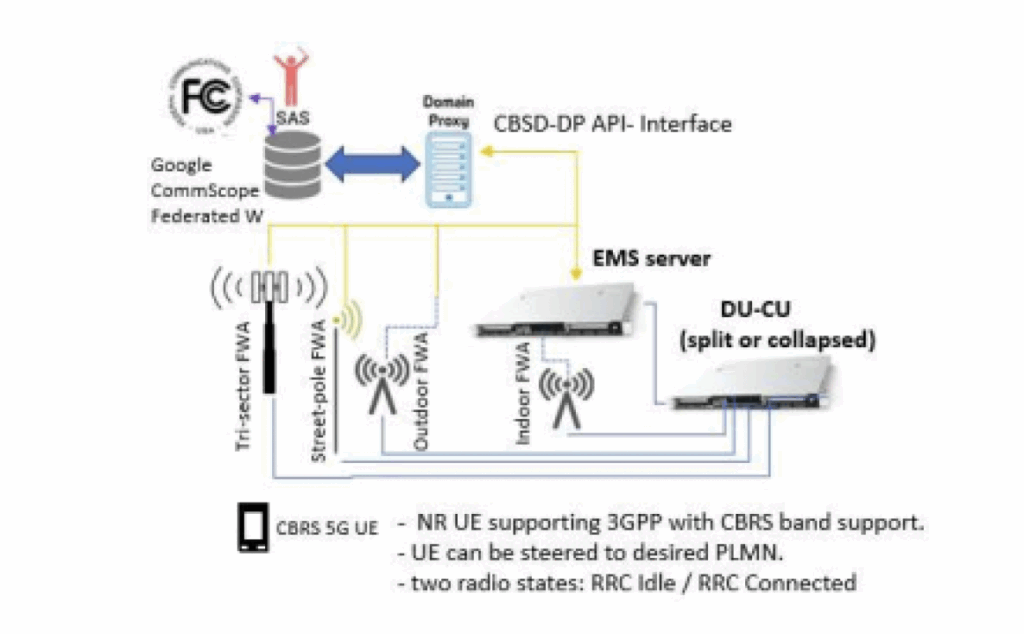
5G FWA is already creating significant growth opportunities, as depicted by recent findings from the NTIA report: NTIA Report on CBRS SAS Dat a Analysis (2023).
Several cutting-edge methodologies outlined in 3GPP releases for 5G-Advanced (5G-A) and preliminary 6G developments are poised to maximize the data-carrying potential of this spectrum. For example, 3GPP Release 19 introduces the concept of simultaneous sensing and RF transmission, enhancing interference mitigation between cellular networks and incumbent equipment. This article outlines a range of 3GPP-standardized features that optimize spectrum utilization, specifically for fixed wireless access (hereafter referred to as FWA).
A traditional FWA system comprises a tall, fixed infrastructure of the radio access network (RAN) to provide wireless connectivity indoors and outdoors. However, the scarcity of low- and
mid-band spectrum that offers both wide bandwidth and strong propagation distance remains a significant limitation. Additionally, emerging wireless service providers prefer minimal dependence on national carriers due to the associated high total cost of ownership (TCO). This paper discusses how to optimize the FWA service model’s spectrum efficiency through the integration of the latest RAN features from 5G-A and forthcoming 6G standards.
General Authorized Access (GAA), the unlicensed and shared portion of CBRS, is poised for substantial demand growth in both 5G and 6G ecosystems. Without efficient spectrum sharing techniques and enhanced uplink (UL) coverage within GAA-CBRS, the FWA market could face contraction. The primary reason stems from the Spectrum Access System (SAS), which handles spectrum allocation, grants, and renewals in increments of n × 10 MHz bandwidth. Challenges such as poor uplink performance, limited coverage distances, and weak indoor penetration necessitate denser, costlier network deployments for new service providers.
Currently, SAS-controlled spectrum sharing techniques allocate GAA (free licenses) spectrum among all CBRS-GAA transmitters while ensuring that Priority Access License (PAL) holders and incumbent users are protected. The SAS server safeguards PAL and incumbent transmission zones by maintaining low interference and noise levels within designated clusters.
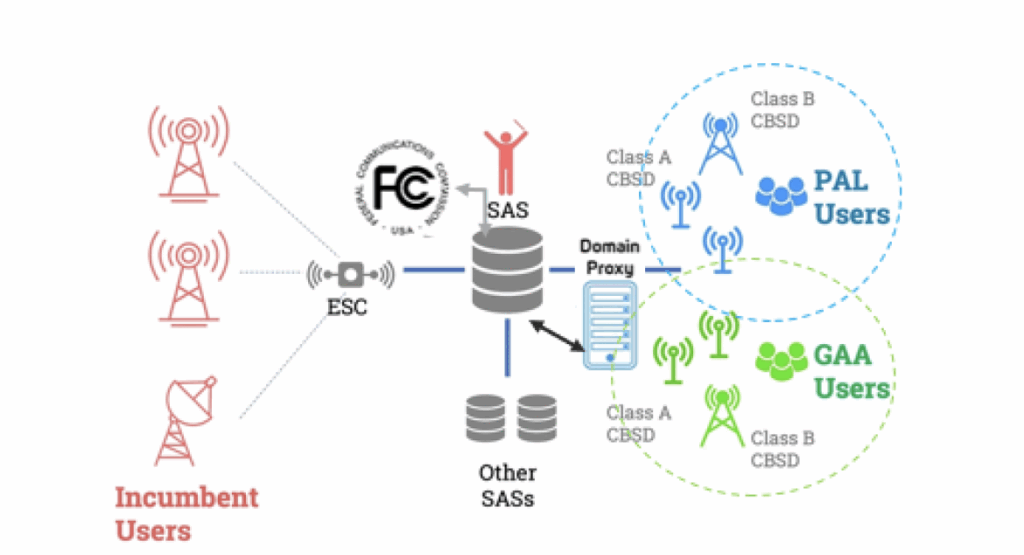
When an incumbent user becomes active, SAS/Environmental Sensing Capability (ESC) systems are responsible for deactivating all GAA/PAL transmissions within exclusion zones. Techniques such as Licensed Shared Access (LSA) and Dynamic Spectrum Access (DSA) were introduced in 3GPP Release 14 to enable coexistence; however, these mechanisms have proven to be time-consuming. New advancements in 3GPP Releases 18 and 19 for 5G-A, and initial 6G developments, propose more dynamic coexistence mechanisms where 5G-A/6G cells can continue operating even when federal incumbent users are active.
3GPP Release 19 proposes a new spectrum-sharing model under study item TR 22.837 V19.0.0 (2023-06) — Feasibility Study on Integrated Sensing and Communication (Fs_Sensing) — which enables real-time dynamic spectrum variation.
The proposed mechanisms leverage advanced capabilities of 5G-A/6G RAN, introducing:
– Predictability of available CBRS-GAA resources at any moment
– Interference detection and intelligent mitigation
– Holistic spectrum management across homogeneous (3GPP-3GPP) and heterogeneous (3GPP-non-3GPP) technologies
An advanced RAN will feature continuous sensing signaling, enabling new User Equipment (UE) capabilities to report 5G-A/6G RAN sensing data, positioning information, and UE IDs. This enables the RAN to detect CBRS-GAA transmissions from incumbents (e.g., radar, satellite) without relying on SAS/ESC intervention. The 5G-A/6G RAN will process sensing data in real-time through a sensing processing entity and adjust cell parameters and frequency allocations to avoid conflicts with incumbents and PAL users. Furthermore, the network operator will be empowered to configure and optimize sensing operations (e.g., authorization levels, sensing areas, and operational windows). In parallel, the ORAN standards group is developing reinforcement learning (RL) algorithms within the RAN Intelligent Controller (RIC) to allocate spectrum resources efficiently based on real-time network conditions.
Efficient spectrum sharing also mandates rapid interference management techniques. In LTE-CBRS systems, the integration of the Distributed Unit (DU) and Centralized Unit (CU) on a per-cell basis makes fast interference coordination challenging. In contrast, 5G ORAN architectures, with their split DU/CU designs and shared DUs, offer more effective intra- and inter-cell interference management.
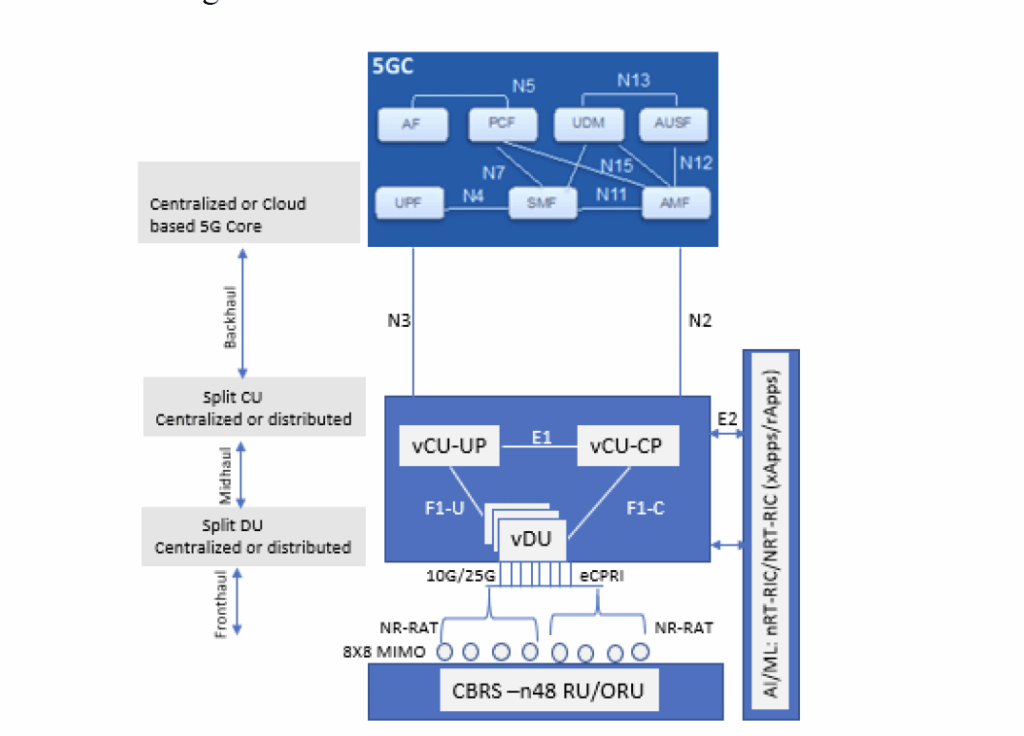
State-of-the-art AI/ML-based algorithms are being deployed to detect interference patterns and dynamically optimize spectrum usage among cells, users, and even incumbent systems like radars. The disaggregated ORAN architecture, characterized by its openness and flexibility, is
especially conducive to real-time spectrum sharing and interference management through third-party applications via near-real-time and non-real-time RAN Intelligent Controllers (nRT-RIC/NRT-RIC).
Another significant challenge for CBRS is its poor uplink coverage. Charter Communications’ CBRS FWA field study (NCTA Technical Paper, 2019) identified limited uplink performance even with outdoor Customer Premises Equipment (CPE). A typical cell footprint using a 12-foot CPE with 4×4 MIMO antennas was found to extend approximately 2.6 miles. Despite the expansion of fixed and mobile broadband networks, a vast underserved household market persists, offering immense opportunities for FWA solutions.
Several uplink enhancement methods exist. For instance, IMT-2020 introduced the concept of Low-Mobility Large-Cell (LMLC) configurations designed for rural coverage, focusing on low-mobility users (pedestrians moving below 3 km/h and vehicles at 30 km/h) with inter-site distances ranging from 6 km to 21 km.
3GPP Release 15 introduced “Supplemental Uplink” capabilities, enabling enhanced uplink coverage by allowing UEs experiencing low uplink SINR to switch to a co-located second frequency band. Supplemental uplink can extend NR-CBRS coverage by approximately 4–7 dB through semi-static power-sharing, as illustrated in Figure 4.
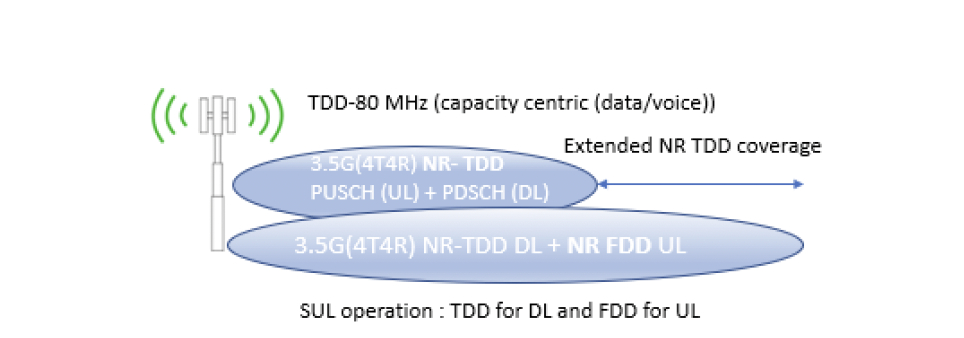
Subsequent 3GPP Releases 17 and 18 have introduced enhancements to the physical uplink shared channel (PUSCH), physical uplink control channel (PUCCH), and physical random-access channel (PRACH), optimizing coverage and access latency. Future 5G-A/6G networks aim to dynamically adjust uplink waveforms and modulation schemes (e.g., prioritizing coverage-enhancing waveforms and Quadrature Phase Shift Keying (QPSK) modulation) to optimize data rates while maintaining energy efficiency.
Upcoming FWA systems, featuring advanced indoor/outdoor CPEs with UL-MIMO enhancements (e.g., 8×8 MIMO configurations), promise to substantially boost CBRS-GAA coverage in both indoor environments and at cell edges.
Conclusion
The evolution of 5G-A and 6G network architectures is steering toward cloud-native, self-intelligent, and flexible designs. The traditional Release 15-based RAN-Core split is likely to give way to more coherent, jointly-designed protocols capable of supporting diverse and demanding services in 6G. The CBRS-GAA 80 MHz spectrum is poised to become one of the most valuable mid-bands globally, owing to its extensive testing, deployment, and common availability across North America, Europe, and Japan. The FCC’s plans to extend the CBRS band by an additional 100 MHz further enhance its strategic importance.


