
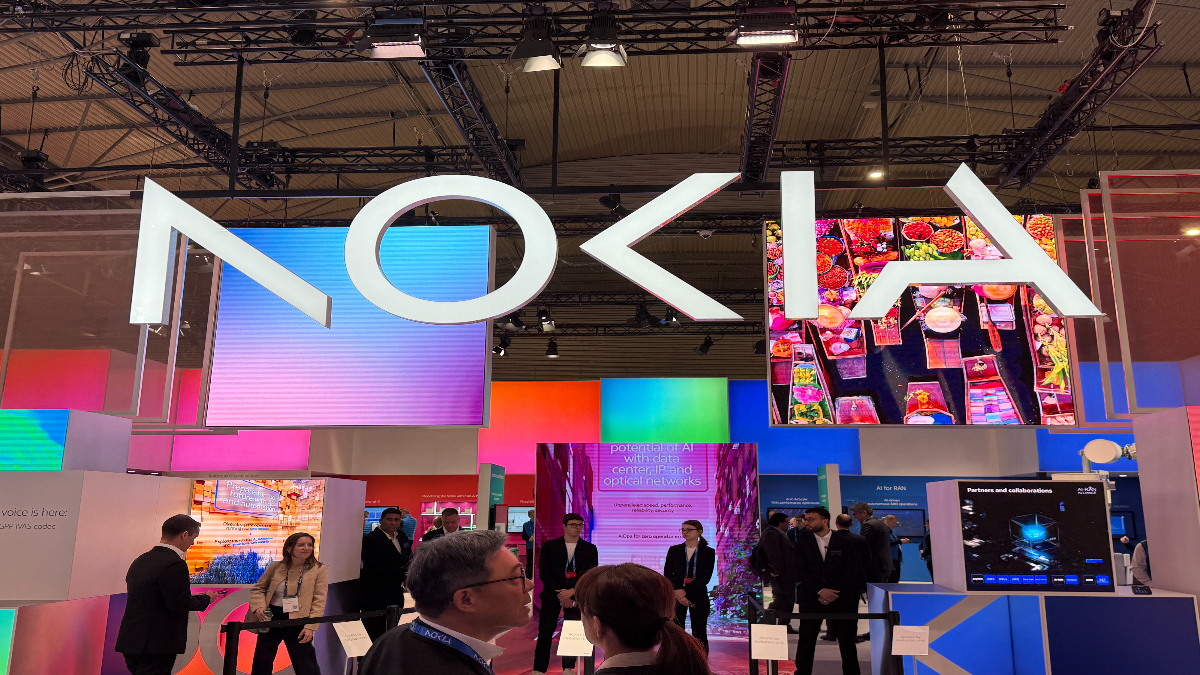
Speaking at the Morgan Stanley European Technology, Media and Telecom Conference, Nokia’s chief financial officer Marco Wirén said the company had already conducted commercial live proof-of-concept tests with two customers during 2026
In sum – what to know
Live tests underway – Nokia has conducted live-network proof-of-concept tests with two customers in 2026 as part of its AI-RAN work with Nvidia.
Efficiency gains targeted – Nokia says spectral-efficiency gains are currently a little above 20%, with targets of 50% in 2027 and 100% in 2028 compared with a traditional solution.
Commercial launch planned – Nokia aims to launch the product commercially toward the end of 2027, with a solution available for commercial sale from 2028 onwards.
Nokia is targeting a 100% gain in spectral efficiency from its AI radio access network (AI-RAN) work by 2028, as the company advances live-network testing with customers and its collaboration with Nvidia.
Speaking at the Morgan Stanley European Technology, Media and Telecom Conference, Nokia’s chief financial officer Marco Wirén said the company had already conducted commercial live proof-of-concept tests with two customers during 2026. The work is part of Nokia’s collaboration with Nvidia, which involves around 20 telecommunications operators. Nokia plans to bring the product to market by the end of 2027, with commercial sales expected to begin in 2028.
Nokia’s current spectral-efficiency gain is a little above 20% compared with a traditional solution, according to the executive. The company plans to increase that figure to 50% next year and 100% in 2028.
More capacity from existing spectrum
Wirén said the expected efficiency gains could help mobile operators make greater use of the spectrum they already hold, reducing the amount of additional spectrum they would otherwise need to buy. He also pointed to the possibility of using network capacity that is currently underutilized for other revenue streams.
Nokia is also emphasizing the cost implications of the technology. Asked whether AI-RAN could help the company regain lost customers or market share, Wirén said the development was driven by the benefits Nokia believes it can provide to operators.
“They get the spectral efficiency gains, they get opportunities to actually utilize 100% of the network at the same cost base as they use today,” he said. “TCO is very important so that they will not increase the TCO. This should be very beneficial for them,” the executive said.
Nvidia collaboration and market positioning
Wirén said Nokia’s work with Nvidia was progressing somewhat faster than the company had expected. He described the collaboration as close and said both sides were working toward clearly defined targets.
“We have very good collaboration with Nvidia, and we’ve been very happy to see also that the AI-RAN is proceeding actually a little bit faster than we expected,” he said. “The teams are working very tightly together continuously.”
Asked whether Nokia considered itself ahead of competitors in AI-RAN, the executive said: “Yeah, we are the one that is actually creating that. So far, we haven’t seen others starting doing that.”
During the vendor’s latest earnings call, Nokia’s chief executive officer Justin Hotard placed particular emphasis on Nokia’s AI-RAN strategy, describing the technology as a way to transform the radio network into a platform for physical AI.
He said the RAN is entering a transition toward general-purpose computing, similar to changes previously seen in other parts of the technology industry. “We are positioning Nokia to lead this shift in partnership with Nvidia,” Hotard said. “Nokia’s AI-native anyRAN software, running on Nvidia’s Aerial-RAN computer, provides a software-defined foundation for integrating AI-powered radio functions that improve network capacity and performance,” he added. According to Hotard, the platform also provides customers with “a software upgrade path to 6G.”
During the call, Hotard said T-Mobile had completed its first live voice call over AI-RAN in its production network, while Finnish carrier Elisa had run voice, mobile data, and AI workloads simultaneously on the same AI-RAN platform in its commercial network.
The broader Nokia-Nvidia AI-RAN ecosystem is also expanding. At Nvidia’s GTC 2026 event in Berlin, the companies said nearly 20 telecom operators had publicly announced AI-RAN collaborations using Nokia’s anyRAN software and Nvidia ARC. T-Mobile recently marked what the companies described as the world’s first AI-RAN call on its commercial network in Bellevue, Washington, using commercial ARC servers, Nokia’s Nvidia CUDA-accelerated RAN software, massive MIMO radios, an existing 5G Standalone core and a commercial smartphone. BT is planning live AI-RAN trials in Birmingham in 2027, while Deutsche Telekom has validated the commercial platform in labs in Bonn and Oulu and plans field trials in 2027, while Orange is testing Nokia 5G software on NvidiaARC for spectral-efficiency improvements and edge services in live networks.
Table of Contents