

RCR Wireless
  • News
  • Channels
    • 5G
    • 6G
    • BSS OSS
    • Carriers
    • IoT
    • Network Infrastructure
    • Open RAN
    • Private 5G
    • Telco AI
    • Telco Cloud
    • Test & Measurement
  • Resources
    • Reports
    • Webinars
    • White papers
    • AI Fundamentals
    • Analyst Angle
    • Editorial Calendar
    • Fundamentals
      • 5G NR Release 17
      • AI
        • Telco AI in 2025
    • Podcasts
      • Let’s Get Digital with Carrie Charles
      • Wireless Connectivity to Enable Industry 4.0 for the Middleprise
      • Well Technically…
      • Will 5G Change the World
      • Accelerating Industry 4.0 Digitalization
  • AI Infrastructure
  • Programs
  • Events
  • RCRtv
  • Advertise
  • Subscribe
Wednesday, September 30, 2026
RCR Wireless
  • News
  • Channels
    • 5G
    • 6G
    • BSS OSS
    • Carriers
    • IoT
    • Network Infrastructure
    • Open RAN
    • Private 5G
    • Telco AI
    • Telco Cloud
    • Test & Measurement
  • Resources
    • Reports
    • Webinars
    • White papers
    • AI Fundamentals
    • Analyst Angle
    • Editorial Calendar
    • Fundamentals
      • 5G NR Release 17
      • AI
        • Telco AI in 2025
    • Podcasts
      • Let’s Get Digital with Carrie Charles
      • Wireless Connectivity to Enable Industry 4.0 for the Middleprise
      • Well Technically…
      • Will 5G Change the World
      • Accelerating Industry 4.0 Digitalization
  • AI Infrastructure
  • Programs
  • Events
  • RCRtv
  • Advertise
  • Subscribe
Add RCR Wireless as a preferred source on Google
  • Qualcomm 6G Insights
  • Huawei Content Hub
  • Qualcomm – 6G Vision
  • OSS/BSS Channel
  • RCRTech Roundtable: AI Infrastructure
RCR Wireless
RCR Wireless
  • Advanced Mimo
  • Mobile mmWave
  • 5G Positioning
  • Green Networks
  • Metaverse
  • Automotive
  • Industrial and Wide-area IoT
Copyright 2021 - All Right Reserved
Home - Analyst Angle - Are you ready for Wi-Fi 7—the next generation of Wi-Fi (Analyst Angle)
Analyst AngleWi-Fi

Are you ready for Wi-Fi 7—the next generation of Wi-Fi (Analyst Angle)

by Prakash Sangam February 22, 2022
written by Prakash Sangam February 22, 2022 Share
LinkedinEmail
Share 0LinkedinEmail
wi-fi 7
Image courtesy of Qualcomm.
305

If you think the successive generations of Wi-Fi are coming far more quickly than before, you are not wrong. While Wi-Fi 6E is relatively new, and Wi-Fi 6 devices are ramping up now, the industry is already readying the next step, Wi-Fi 7. There are indeed good reasons for this accelerated development. Consumers and enterprises were consuming Wi-Fi at a feverish pace, to begin with, and the pandemic added more fuel to the fire. At the same time, new concepts such as metaverse require even higher performance and quality of experience. So, Wi-Fi 7 is coming at the right time. Let’s look at what it is and why you have to be ready for it.

Why do you need the next generation?

Three dimensions necessitate the next generation of Wi-Fi. First, continuously increasing data consumption and demand. Thanks to the pandemic, everybody knows that simply getting connected to the network is not enough. You need enough speeds and lower latency for a smooth user experience, adequate capacity to handle many users being online simultaneously, and good coverage everywhere. These needs will only increase with content getting richer, working from home becoming a norm,  gaming getting social, more interactive, cloud-based, and more.

The second dimension is new experiences and architectures with demanding performance needs. The much-hyped metaverse promises unparalleled immersive experiences with augmented reality, virtual reality, and extended reality. As the cloud evolves from its centralized approach to a distributed architecture, the value moves toward the edge, creating edge cloud. Edge cloud seems to have almost unlimited possibilities, many of which are even yet to be imagined.  

These new trends and experiences need extreme speeds and capacity, with extremely low latency that the current generation can not support. 

The third dimension is the spectrum. Thanks to the relentless effort of the industry, Wi-Fi now has large swaths of the spectrum: The good old 2.4 GHz band with about 80 megahertz of bandwidth and good range; the 5 GHz band divided into two parts totaling close to 500 megahertz; the latest 6 GHz band, with a whopping up to 1200 megahertz of bandwidth. The challenge is to utilize all these bands for the best possible performance.

When you put all these dimensions together, it is clear that developing a new generation of Wi-Fi is not an option but a necessity. 

How will Wi-Fi 7 solve today’s and future challenges?

Wi-Fi 7 is based on IEEE 802.11be specifications. As with any generation, the specifications have lots of features. But usually, only a subset of them will be commercialized, depending on the vendor interest and market demand. Based on the folks I have spoken to across the industry, there seems to be unanimous support for some key features that effectively address the challenges I have outlined in the previous section. Let’s look at some of those features and their benefits.

Up to 320 megahertz of channel bandwidth providing higher speeds and capacity

Using wider bandwidth is the simplest way to increase performance for any wireless technology. Wi-Fi 7 supports channel bandwidth of up to 320 megahertz, offering more than 10 Gbps theoretical peak speeds. The 6 GHz band with 1200 megahertz of the available spectrum allows up to 5 contiguous 320 megahertz bands. If the contiguous spectrum is unavailable, one can aggregate two 160 megahertz channels to achieve the full bandwidth. That’s where the next feature comes in handy.

Multi-Link Operation (MLO) for lower latency, higher speeds, and reliability

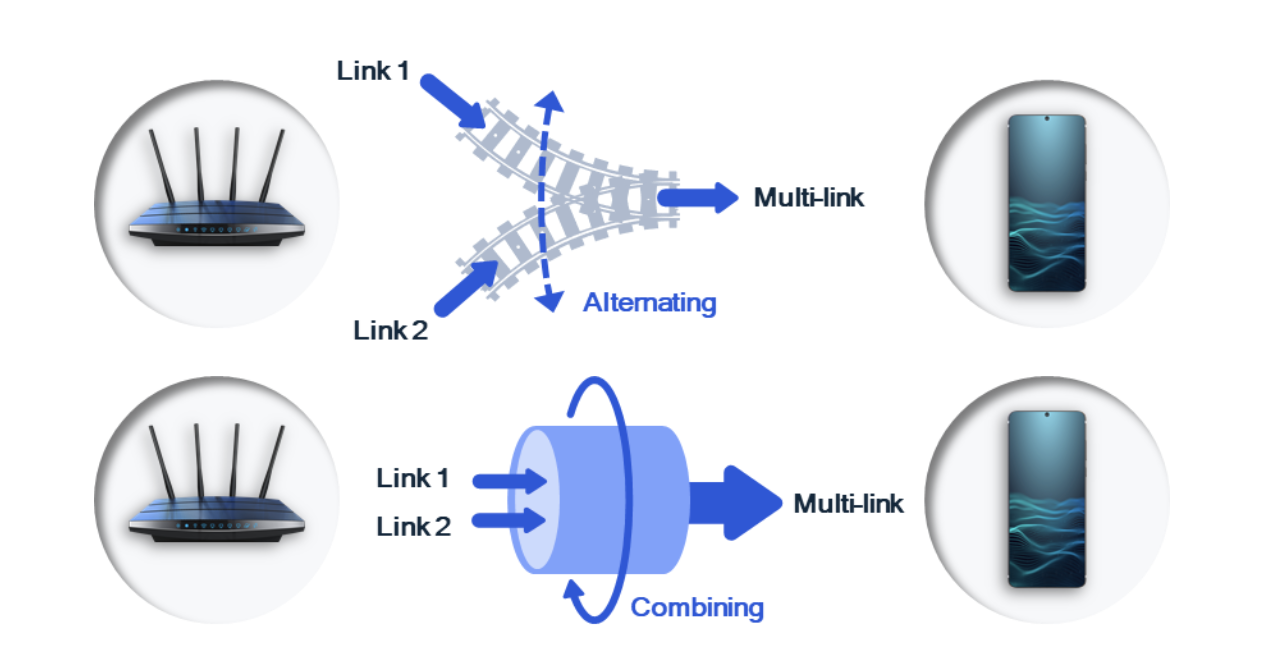
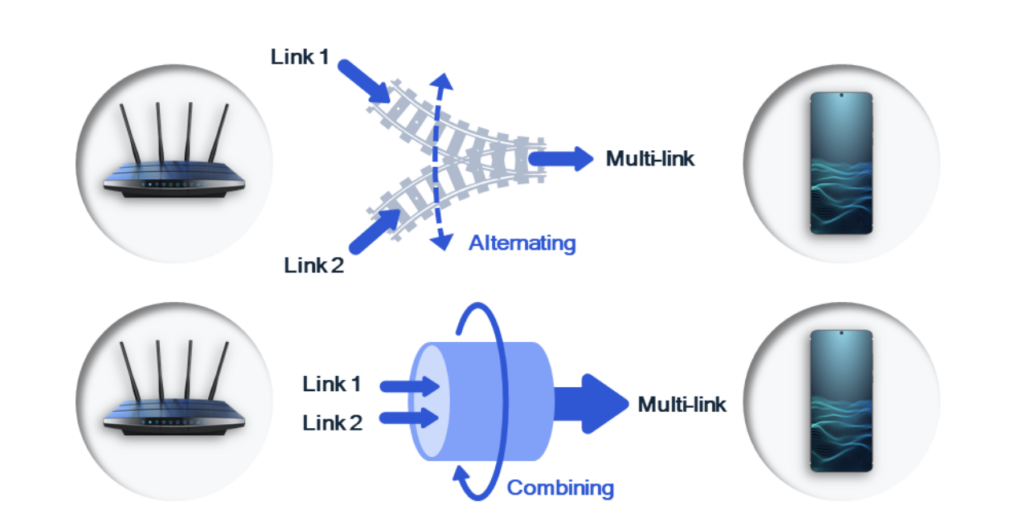
MLO aggregates two links from any spectrum bands, similar to carrier aggregation in 4G or 5G. Depending on the cost and performance considerations, there are two options. The first is simply alternating between the two links, depending on what is available. The second is combining both the links to create a fatter data pipe. 
Screen Shot 2022 02 22 at 2.52.00 PM
Image courtesy of Qualcomm.

The alternating option opportunistically selects the best possible link at any given time. This option only needs one receive chain in the device, and hence very cost-effective. However, it improves performances performance only in some scenarios, and the latency is highly dependent on the traffic conditions. 

In the combining option, both links are always connected, providing higher speeds and consistently lower latency in perceivably all cases, compared to alternating. Also, because of redundancy, it offers significantly better reliability. With all these, combing MLO is a must for new-age experiences such as Metaverse and Edge Cloud.

Some vendors, such as Qualcomm, claim that the best performance is achieved when combining two high-bands (5 or 6 GHz), not 2.4 GHz. That makes sense as 2.4 GHz is highly congested, and with only 20 megahertz channel bandwidth, it can’t materially improve performance. 

MLO is also helpful in regions without the 6 GHz band. It can maximize the performance of the 5 GHz band by offering up to 240 megahertz (160 + 80 megahertz)  of channel bandwidth.

Preamble puncturing for wider bandwidth even with interference

The wider bandwidths are often not possible because of the presence of incumbent narrowband users (interference). Preamble Puncturing effectively solves this challenge by puncturing the wideband channel around the interference, as shown in the schematic.  

unnamed
Image courtesy of Qualcomm.

4096 (4k) QAM

Another simple yet hard to implement option is higher-order modulation. Wi-Fi 7 standardizes the support for 4096 QAM. Some vendors, such as Qualcomm, have already implemented it in commercial products in a proprietary way. The challenge with 4K QAM is its limited range. In my view, its utility is more for marketing reasons, as it enables vendors to claim extreme peak speeds.

Long list of other enhancements

There are also some more meaningful enhancements that Wi-Fi 7 brings. These include Restricted Target Wakeup Time (TWT) that reserves timing for specific devices. This allows latency-sensitive devices to be served on a priority basis and improves device battery life by extending their sleep cycles. New QoS signaling is also being introduced to support deterministic low latency connections and a slew of security enhancements. 

Final thoughts

Wi-Fi 7 is coming at the right time when the industry to ready for its next phase with new experiences and new architectures that demand extreme performance. There have already been some demos and other announcements, and there will be more this year. I even expect commercial products from vendors vying for market leadership toward the end of the year. 

If you would like to read articles like this and get an up-to-date analysis of the latest mobile and tech industry news, sign-up for our monthly newsletter at TantraAnalyst.com/Newsletter, or listen to our Tantra’s Mantra podcast.

You Might Also Like
  • How RFID-integrated mobile devices boost efficiency and reduce cost (Analyst Angle)
  • The Cambium collapse – what it means for WISPs (Analyst Angle)
  • When the vendor disappears – what the Cambium collapse means for MDUs (Analyst Angle)
  • New Matter API puts the operator gateway back in the smart home (Analyst Angle)
  • The good, the bad, the okay – growth and opportunities in prepaid wireless (Analyst Angle)
  • Huawei, HP sign global Wi-Fi patent deal

Table of Contents

  • Why do you need the next generation?
  • How will Wi-Fi 7 solve today’s and future challenges?
  • Up to 320 megahertz of channel bandwidth providing higher speeds and capacity
  • Multi-Link Operation (MLO) for lower latency, higher speeds, and reliability
  • Preamble puncturing for wider bandwidth even with interference
  • 4096 (4k) QAM
  • Long list of other enhancements
  • Final thoughts
Share 0 LinkedinEmail
Prakash Sangam

Prakash Sangam is the founder and principal at Tantra Analyst, a leading research and consultancy firm covering IP strategy, 5G, IoT, AI, as well as client and cloud computing. He has more than 20 years of wireless industry experience working for Qualcomm, Ericsson, and AT&T. A prolific writer, blogger, and speaker, Prakash enjoys analyzing technical and business challenges and transforming them into impactful strategies and persuasive messaging. He is a regular contributor to Forbes, EETimes, RCR Wireless, Medium, and other leading publications and has been on the speaking circuit for leading industry events, including Mobile World Congress, and CTIA. Prakash holds a Bachelor’s of Engineering in electronics and communications from Karnatak University in India, and a Masters of Business Administration from San Diego State University. He can be reached on twitter @MyTechMusings

previous post
IoT in the healthcare industry (Reader Forum)
next post
Dell Telecom Systems Business ‘really looking to get into the game’

White Papers

  • Norton eBook: The 2026 Telco Playbook

  • Enea White Paper: Why Intelligent AAA is the Swiss Army Knife of Telecom

  • CSG White Paper: Telco AI Enabler: Mediation’s Defining Role

  • Enea White Paper: Scalable Database Design for 5G and Beyond

  • Supermicro and NVIDIA Whitepaper: Powering sovereign AI at scale

Editorial Reports

  • Report: Building 6G — Aligning technology, policy and purpose

  • Report: Rethinking the RAN

  • Report: Building AI-Era Network Fabrics

Webinars

  • Appledore Webinar: Closing the Agent-Ready Data Gap for Autonomous Networks

  • Mimosa Webinar – Build the Right Network

  • Webinar: Building 6G — aligning technology, policy and purpose

  • SIMCom Webinar: Scaling your next deployment – from plastic to provisioning

  • Webinar: Rethinking the RAN as AI, cloud and openness converge

Since 1982, RCR Wireless News has been providing wireless and mobile industry news, insights, and analysis to mobile and wireless industry professionals, decision makers, policy makers, analysts and investors.

Facebook Twitter Youtube Linkedin Envelope Rss

Useful Links

  • Subscribe
  • About RCR Wireless News
  • Contact Us
  • Advertise
  • Editorial Calendar
  • Archive
  • RSS
  • Wireless News Archive
  • Subscribe
  • About RCR Wireless News
  • Contact Us
  • Advertise
  • Editorial Calendar
  • Archive
  • RSS
  • Wireless News Archive

Edtior's Picks

Ciena launches $200m venture fund as AI networking accelerates
Onomondo preps €100m ‘war chest’ to rip-up IoT rule book, tee-up physical AI
Who Will Build the AI Boom? Solving America’s Skilled Labor Crisis with Mike...

Latest Articles

Ciena launches $200m venture fund as AI networking accelerates
Onomondo preps €100m ‘war chest’ to rip-up IoT rule book, tee-up physical AI
Who Will Build the AI Boom? Solving America’s Skilled Labor Crisis with Mike Greenawalt of the Greenawalt Foundation
How RFID-integrated mobile devices boost efficiency and reduce cost (Analyst Angle)

© 2026 RCR Wireless News All Right Reserved. Developed by Eight Hats.

Cookie Policy | Privacy Policy

RCR Wireless
  • News
  • Channels
    • 5G
    • 6G
    • BSS OSS
    • Carriers
    • IoT
    • Network Infrastructure
    • Open RAN
    • Private 5G
    • Telco AI
    • Telco Cloud
    • Test & Measurement
  • Resources
    • Reports
    • Webinars
    • White papers
    • AI Fundamentals
    • Analyst Angle
    • Editorial Calendar
    • Fundamentals
      • 5G NR Release 17
      • AI
        • Telco AI in 2025
    • Podcasts
      • Let’s Get Digital with Carrie Charles
      • Wireless Connectivity to Enable Industry 4.0 for the Middleprise
      • Well Technically…
      • Will 5G Change the World
      • Accelerating Industry 4.0 Digitalization
  • AI Infrastructure
  • Programs
  • Events
  • RCRtv
  • Advertise
  • Subscribe
RCR Wireless
  • News
  • Channels
    • 5G
    • 6G
    • BSS OSS
    • Carriers
    • IoT
    • Network Infrastructure
    • Open RAN
    • Private 5G
    • Telco AI
    • Telco Cloud
    • Test & Measurement
  • Resources
    • Reports
    • Webinars
    • White papers
    • AI Fundamentals
    • Analyst Angle
    • Editorial Calendar
    • Fundamentals
      • 5G NR Release 17
      • AI
        • Telco AI in 2025
    • Podcasts
      • Let’s Get Digital with Carrie Charles
      • Wireless Connectivity to Enable Industry 4.0 for the Middleprise
      • Well Technically…
      • Will 5G Change the World
      • Accelerating Industry 4.0 Digitalization
  • AI Infrastructure
  • Programs
  • Events
  • RCRtv
  • Advertise
  • Subscribe
@2020 - All Right Reserved. Designed and Developed by PenciDesign
